
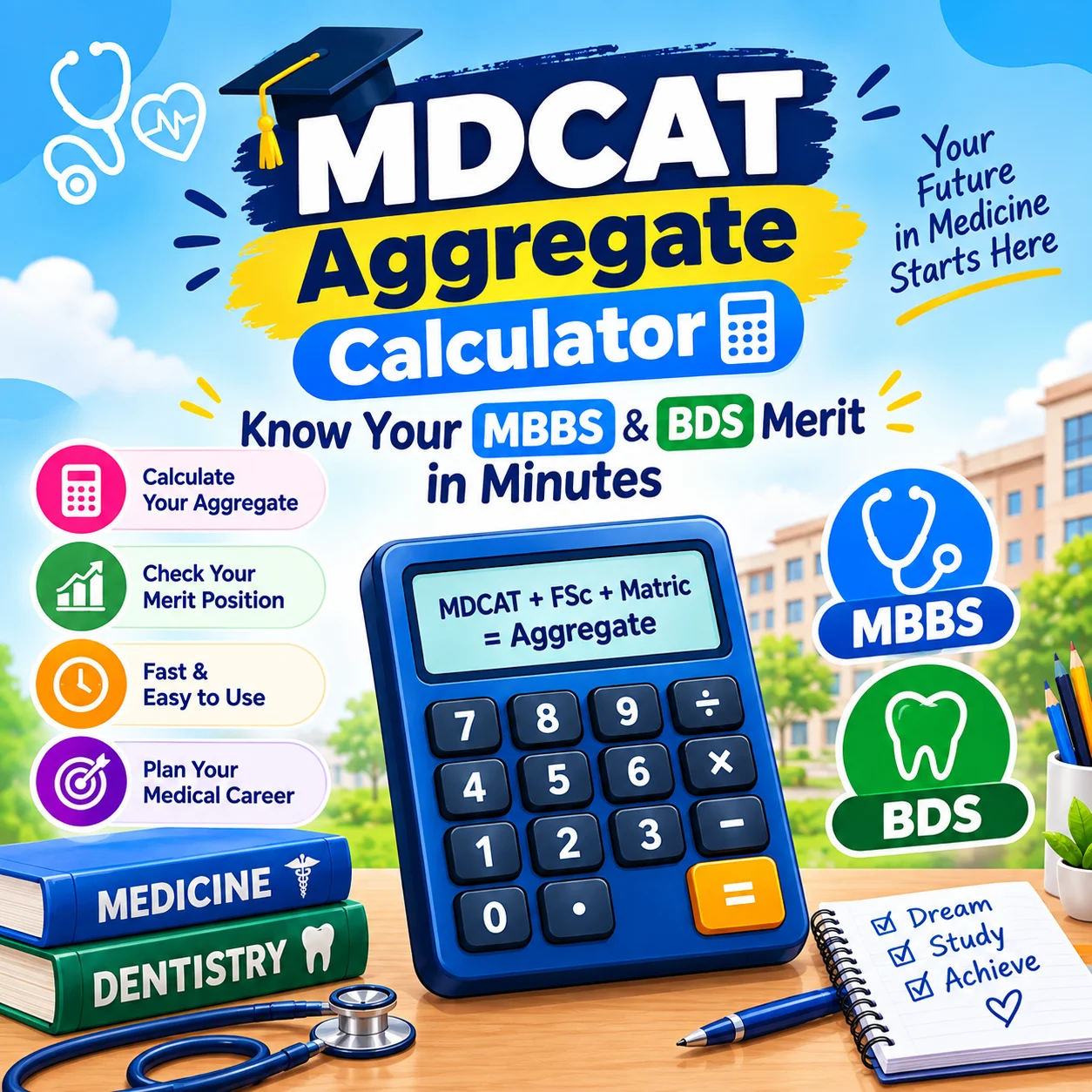
What Is the MDCAT Aggregate and Why Everyone Is Searching For It
The MDCAT aggregate is the single percentage score that decides whether a student gets into a medical or dental college in Pakistan. It is not just your MDCAT result — it blends your Matric, FSc, and MDCAT marks into one number.
Every year, thousands of pre-medical students sit through months of biology, chemistry, and physics revision, only to hit a wall of confusion once the MDCAT result is announced. They know their test score, but they don't know what it actually means for their admission chances.
That confusion is completely normal. Pakistan's medical admission system does not rank students on the MDCAT score alone. It uses a weighted formula that pulls from three different academic stages of a student's life, and getting even one part of that calculation wrong can lead to a wildly inaccurate expectation.
This is exactly the gap the MDCAT Aggregate Calculator on this page is built to close.
Why This Calculator Matters More Than a Manual Guess
Doing this math by hand is easy to get wrong, especially when your board uses a different total marks scheme than your friend's board. A calculator removes the guesswork and gives you an instant, formula-accurate percentage so you can compare it against previous years' closing merits.
What Is the MDCAT Aggregate Calculator?
The MDCAT Aggregate Calculator is a free online tool that converts your Matric, FSc (or equivalent), and MDCAT marks into one merit percentage using the official Pakistan Medical and Dental Council (PMDC) weightage formula.
It is built for students applying to MBBS and BDS programs across Punjab, Sindh, Khyber Pakhtunkhwa, Balochistan, Azad Jammu and Kashmir, and Gilgit-Baltistan.
Background of the Aggregate System
Pakistan's medical admission merit system was designed to avoid ranking students on a single exam alone. By blending three academic markers together, admitting authorities try to reward consistent academic performance, not just one good test day.
Who Actually Uses This Calculator
This tool is useful for:
- Students who have completed FSc Pre-Medical (or an equivalent qualification) and appeared in the MDCAT
- A-Level students who have their IBCC equivalence marks ready
- Parents trying to estimate realistic college options for their child
- Repeaters comparing this year's aggregate against last year's attempt
Why It Matters for Admission Planning
Your aggregate is what gets compared against previous years' closing merit for each college. Knowing your number early lets you apply to a realistic range of institutions instead of hoping for the best or underselling your chances.
Eligibility and Requirements to Calculate Your Aggregate
Before using the calculator, it helps to know exactly what inputs the formula expects, and where students commonly go wrong with their documents.
You Must Have
- Your official Matric (SSC) result, with obtained marks and total marks
- Your FSc Pre-Medical (HSSC) result, or an IBCC equivalence certificate if you studied A-Levels or another board
- Your MDCAT result slip showing obtained marks out of the total marks set for that year's test
You May Not Get an Accurate Result If
- You use percentage figures instead of raw obtained and total marks
- Your board's total marks differ from the commonly assumed 1100, since some boards use 1050 or other totals
- You enter A-Level grades directly without converting them through IBCC equivalence first
- You use last year's MDCAT total marks instead of the current year's total
How Does the MDCAT Aggregate Formula Work?
The MDCAT aggregate formula combines three weighted components into one percentage. Each component is calculated as a percentage of its own total, then multiplied by its assigned weightage.
The formula generally used is:
MDCAT Aggregate = (Matric obtained ÷ Matric total × 10) + (FSc obtained ÷ FSc total × 40) + (MDCAT obtained ÷ MDCAT total × 50)
Breaking Down Each Component
Matric (SSC) — 10% weightage. Your 9th and 10th grade result contributes the smallest share, but it still matters when merit lists come down to fractions of a percentage.
FSc or Equivalent (HSSC) — 40% weightage. This is the second-largest contributor. A-Level and other board students need their IBCC equivalence certificate to convert their result into an FSc-equivalent score before this step.
MDCAT — 50% weightage. The test itself carries the single largest share. This is also the component students have the most recent opportunity to influence, since Matric and FSc results are already locked in by the time MDCAT is taken.
Worked Example
Here's how the calculation plays out with sample numbers:
| Component | Obtained Marks | Total Marks | Weightage | Contribution |
|---|---|---|---|---|
| Matric | 1000 | 1100 | 10% | 9.09% |
| FSc Pre-Medical | 1000 | 1100 | 40% | 36.36% |
| MDCAT | 160 | 200 | 50% | 40.00% |
| Total Aggregate | 85.45% |
How to Use This Calculator
Using the MDCAT Aggregate Calculator on this page takes less than a minute. Here's the exact process:
- Enter your Matric marks. Type in your obtained marks and the total marks shown on your official Matric result card.
- Enter your FSc or equivalent marks. If you studied A-Levels or another international qualification, convert your grades using your IBCC equivalence certificate first, then enter the equivalent obtained and total marks.
- Enter your MDCAT score. Input your obtained marks exactly as shown on your MDCAT result slip, along with the total marks for that year's test.
- Click calculate. The tool instantly applies the 10-40-50 weightage formula and displays your aggregate percentage.
- Compare your result. Use your aggregate to compare against previous years' closing merit for the colleges you are interested in. Remember that closing merits shift every year based on the applicant pool, so treat past figures as a reference point, not a guarantee.
A Note on Accuracy
The calculator is highly accurate as long as the marks entered are correct. Double-check that you have not swapped obtained and total marks, and that your FSc total reflects your actual board's marking scheme rather than an assumed number.
Application and Usage Process
| Step | Action | Details |
|---|---|---|
| 1 | Gather your result documents | Matric result card, FSc/equivalent result card or IBCC certificate, MDCAT result slip |
| 2 | Confirm total marks for each component | Check your board's official total marks, not an assumed figure |
| 3 | Enter data into the calculator | Input obtained and total marks accurately for each section |
| 4 | Review your aggregate | Note the percentage and cross-check with a manual calculation if unsure |
| 5 | Research college-wise merit lists | Compare your aggregate against official closing merit announcements from your target colleges |
Common Mistakes to Avoid
Mixing Up Percentage and Raw Marks
Some students enter their percentage instead of obtained and total marks. This throws off the calculation because the tool needs raw figures to apply the correct weightage.
Ignoring A-Level Equivalence
A-Level students sometimes try to enter their grades directly instead of using their IBCC equivalence certificate. This produces an inaccurate aggregate, since medical colleges only accept the IBCC-converted score.
Assuming the Same Total Marks Every Year
MDCAT total marks and format have changed in past cycles. Always use the total marks printed on your specific year's result slip rather than assuming last year's figures apply.
Forgetting Provincial or Institutional Variations
Tips for Better Results
Focus on MDCAT Preparation Early
Since MDCAT carries the largest single weightage at 50%, consistent preparation across biology, chemistry, physics, and English typically offers the highest return on your remaining study time compared to trying to retroactively change locked-in academic results.
Keep Your Documents Organized
Have digital and physical copies of your Matric, FSc, and MDCAT result cards ready before application season begins. Delays often happen when documents are misplaced during a busy admission window.
Track Multiple Years of Closing Merit
Looking at how closing merit moved over the last two or three admission cycles for a college gives a more realistic picture than relying on a single year's figure, since intake numbers and applicant pools shift annually.
Apply to a Realistic Spread of Colleges
Rather than applying only to the highest-ranked institutions, include a mix of colleges across different closing merit ranges to improve your overall admission chances.
Read more: What Is the COMSATS Merit Predictor and Why Do Students Search for It?
Frequently Asked Questions
What is the MDCAT aggregate formula?
The standard formula used by most public sector medical colleges in Pakistan is 10% Matric, 40% FSc or equivalent, and 50% MDCAT. Each component is converted to a percentage of its total marks before the weightage is applied. Provincial or institutional variations may apply, so always confirm with the official prospectus of your target college.
Can this calculator be used for BDS admissions?
Yes. BDS admissions generally follow the same PMDC weightage formula as MBBS. The main difference is that dental program closing merits are often somewhat lower than MBBS closing merits at the same institution, though this varies by college and year.
Do A-Level students use the same formula?
A-Level students use the same formula, but their FSc component must first be converted into an FSc-equivalent score through an official IBCC equivalence certificate before it is entered into the calculator.
Does a higher aggregate guarantee admission?
No. A higher aggregate improves your position on the merit list, but eligible applicants may receive an offer only if their aggregate meets or exceeds the closing merit set by the specific college and category they applied under. Seat availability, quotas, and each year's applicant pool all affect the final outcome.
Why do different websites show slightly different aggregates for the same marks?
Small differences usually come from rounding methods or from using outdated total marks for MDCAT or a particular board. Always cross-check your total marks against your official result documents and consult your target university's official admission portal for the authoritative version of the formula.
Final Thoughts and Next Step
Understanding your MDCAT aggregate takes away a lot of the uncertainty that builds up during admission season. Once you know your number, you can plan your college applications with realistic expectations instead of guesswork.
Check the official requirements and formula published by your target college's admission office, and use the calculator above to estimate your aggregate before you finalize your application list.
Reviewed by: [Name/Role Placeholder] Reviewed for accuracy by an education professional specializing in scholarships and academic guidance.
Last Updated: September 2026
Requirements, weightages, and total marks may change from one admission cycle to the next. Always confirm the latest formula and closing merit figures from the official PMDC, UHS, or relevant provincial admission portal before making application decisions.
Disclaimer: Information provided in this article is for educational purposes only and should be verified with the official admitting authority before making application decisions.
Disclosure: This website may earn revenue through advertising or affiliate partnerships. This does not influence our recommendations.





0 Comments