
What Is the Punjab University Merit Calculator?
The Punjab University Merit Calculator is a useful tool for students who want to estimate their admission merit before applying to the University of the Punjab. It helps organize academic marks and other applicable components so students can understand how their estimated merit is calculated.
For the 2026–27 undergraduate admission cycle, Punjab University merit calculator states that admission merit can involve academic qualifications and an entry test, with the entry-test weightage varying by program. The current undergraduate admission notice specifies 33% entry-test weightage for engineering programs and 25% for non-engineering programs.
The calculator should be treated as an estimate, not an admission guarantee. The final merit used by Punjab University depends on the applicable admission rules, program, category, documents, and official verification.
Why Do Students Use a Merit Calculator?
Students often want to know their approximate merit before spending time completing an application. A calculator can make the process easier by putting different academic figures into one calculation.
It can also help students identify mistakes in their marks, understand the effect of an entry test score, and compare their estimated result with the requirements published for their selected program.
What Does “Merit” Mean at Punjab University?
Merit generally refers to the score or position used to determine admission according to the university's applicable criteria.
Punjab University's official admission regulations explain that different programs can have different basic and additional criteria. The university also publishes merit lists showing merit marks and final merit marks for applicants.
How Does the Punjab University Merit Calculator Work?
The Punjab University Merit Calculator works by applying the relevant merit components to the information entered by a student. The exact calculation can differ according to the degree program and current admission rules.
For undergraduate BS programs, Punjab University's published admission criteria describe an academic formula based on matriculation and FA/FSc or an equivalent qualification, with applicable additional marks. The university's current regulations state that the academic component may be multiplied according to the applicable academic weightage.
Academic Marks
Academic marks are an important part of the undergraduate merit calculation.
Punjab University's admission criteria for BS four-year programs describe the basic academic formula as:
Academic merit = (¼ of Matriculation marks + FA/FSc or equivalent marks + applicable additional marks) ÷ (¼ of total Matriculation marks + total FA/FSc or equivalent marks)
The applicable weighting is then used according to the admission criteria for the relevant program.
Students should not assume that this formula applies identically to every Punjab University program. Always check the latest notice for the specific department.
Entry Test Marks
Entry-test marks can also contribute to undergraduate admission merit.
For the 2026–27 undergraduate admission notice, Punjab University lists 33% entry-test weightage for engineering programs and 25% for non-engineering programs.
This difference is important because entering the same marks into a generic formula can produce an incorrect estimate if the student's program uses a different weighting system.
Additional Marks
Punjab University's published criteria list several possible additional-mark categories, including Hafiz-e-Quran, elective subjects, optional subjects, diplomas, additional electives, additional optional subjects, subject marks, and certain other categories. The applicability of these marks depends on the university's rules and the applicant's circumstances.
Students should enter additional marks only when they genuinely qualify and can provide the required documentation.
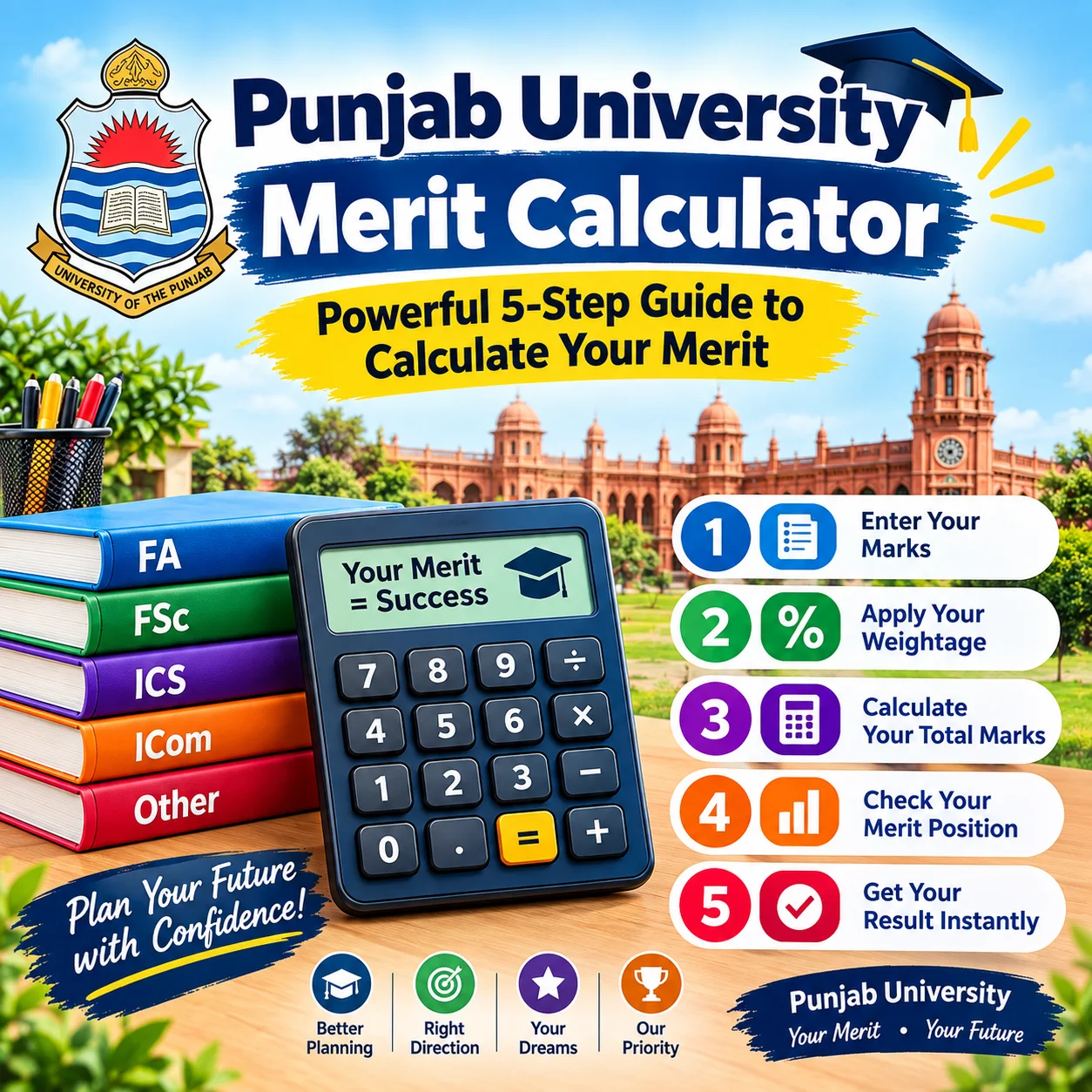
How to Use This Punjab University Merit Calculator?
Using the Punjab University Merit Calculator is straightforward when you have your academic information available.
Step 1: Select Your Relevant Program
Start by identifying the Punjab University program for which you want to estimate merit.
This matters because engineering and non-engineering undergraduate programs can use different entry-test weightages. The university's 2026–27 notice confirms different entry-test weightages for these categories.
Step 2: Enter Your Matriculation Marks
Enter your obtained Matriculation marks and the correct total marks requested by the calculator.
Check your certificate before entering the figures. A small typing error can change the estimated percentage and produce a misleading result.
Step 3: Enter Your Intermediate Marks
Enter your FA, FSc, or equivalent marks as requested.
If you are applying on a provisional basis, check the current Punjab University rules carefully because the treatment of Part-I results can be specified in the applicable admission criteria. The university's published regulations contain provisions for provisional applicants.
Step 4: Enter Your Entry-Test Score
Add your Punjab University entry-test score if your selected program requires or uses it.
Do not automatically apply the same entry-test percentage to every program. For the 2026–27 undergraduate cycle, Punjab University lists 33% for engineering programs and 25% for non-engineering programs.
Step 5: Check Your Estimated Merit
After entering the required information, review the calculated result carefully.
Use the result as an estimate for planning. Your official application, eligibility, documents, program-specific criteria, and university verification remain more important than a calculator result.
Use the Calculator Here
Enter your academic information into the calculator below to estimate your merit:
Before relying on the result, compare the calculator's inputs and formula with the latest official Punjab University admission notice for your program.
What Information Do You Need Before Using the Calculator?
You can get a more reliable estimate when your academic information is accurate and complete.
Keep These Details Ready
Prepare:
- Matriculation obtained marks
- Matriculation total marks
- FA/FSc or equivalent obtained marks
- FA/FSc or equivalent total marks
- Entry-test marks, if applicable
- Relevant additional marks, if applicable
- Program name
- Admission category, if applicable
- Any required equivalence information
Check Your Certificates First
Do not rely only on memory when entering marks.
Look at your official certificates or result documents and enter the numbers exactly. This is especially important for students who have studied through different examination systems.
Punjab University merit calculator also provides rules for conversion of certain qualifications and marks. For example, its published conversion guidance addresses foreign qualifications and different examination systems.
What Are the Main Factors That Can Affect Your Merit?
Your estimated merit can depend on several factors, and the exact combination varies by program.
Matriculation Performance
Matriculation marks form part of the published academic criteria for BS four-year programs.
Strong earlier academic performance can therefore contribute to the academic portion of an applicant's merit.
Intermediate Performance
FA, FSc, or an equivalent qualification is another major academic component.
Students should enter their marks accurately because the academic formula uses these results in determining the academic portion of merit.
Entry-Test Performance
For programs that use an entry test, test performance can substantially affect the final calculation.
For the current 2026–27 undergraduate cycle, Punjab University's official notice specifies different entry-test weightages for engineering and non-engineering programs.
Applicable Additional Marks
Some candidates may qualify for additional marks under the university's admission criteria.
The published rules include several categories, but students should claim only those that apply to them and for which they can provide acceptable evidence.
What Are Common Mistakes Students Make?
A calculator is only as useful as the information entered into it.
Entering the Wrong Total Marks
One common mistake is entering the obtained marks correctly but using an incorrect total.
Always verify both numbers from the official result document.
Applying the Wrong Program Formula
A student may find a merit formula online and assume that it applies to every Punjab University program.
That approach can be risky because admission criteria and weightages may differ by program. Punjab University's current admission notice should be treated as the controlling source for the relevant admission cycle.
Adding Marks Without Eligibility
Do not add additional marks simply because they appear in a general merit formula.
Additional marks can have specific conditions and documentation requirements. Punjab University's regulations explain several such categories.
Treating Estimated Merit as Guaranteed Admission
A calculated percentage does not automatically mean admission.
Selection can depend on the official merit list, available seats, program requirements, admission category, and other applicable conditions.
Ignoring Updated Admission Notices
Admission policies can change from one academic year to another.
For example, Punjab University's 2026–27 undergraduate admission notice specifies the current entry-test weightages and application information. Students should not automatically reuse an older formula.
How Can You Improve Your Merit Estimate?
The goal of a calculator is not simply to produce a number. It should help you understand where your result comes from.
Verify Every Input
Before accepting the result, check your Matriculation and Intermediate figures against your certificates.
If you have an equivalence certificate, use the marks or percentage applicable under the relevant official rules.
Check Your Program's Current Criteria
Search for the exact Punjab University department and program you intend to apply for.
The official admission notice is more reliable than an old social media post, an unofficial calculator, or a previous year's merit formula.
Keep Entry-Test Preparation Separate
Your academic marks may already be fixed, but your entry-test performance can be an important component for programs that use the test.
Knowing the applicable weightage helps you understand how the test contributes to your overall merit.
Compare With Official Merit Lists Carefully
Previous merit lists can provide context, but they should not be treated as a promise about future admission.
Program demand, available seats, applicant performance, and admission policies can change.
What Documents Should Students Keep Ready?
Having documents prepared can make the application process smoother.
Academic Documents
Students may need relevant academic certificates, result cards, photographs, identification documents, and other materials specified in the current admission instructions.
The exact document list should be checked against the official application portal and admission notice.
Equivalence Documents
Students with qualifications from systems outside the applicable local examination structure may need an equivalence certificate.
Punjab University's conversion guidance states that equivalence requirements apply to certain qualifications, including O/A Levels and other foreign or different examination systems.
Evidence for Additional Marks
If you claim an additional-mark category, keep the supporting documentation available.
For example, Punjab University's regulations specify documentary and verification requirements for certain categories such as Hafiz-e-Quran.
Read more: NUST Aggregate Calculator — Check Your Real Admission Merit Instantly
Where Should You Verify Punjab University Admission Information?
The safest approach is to verify admission information directly through official Punjab University resources.
Punjab University Admission Notices
Punjab University's admission notices provide current information about undergraduate admissions, schedules, programs, and other requirements.
The university's 2026–27 undergraduate notice states that applications were accepted online and provides the applicable admission information for that cycle.
Punjab University Admission Criteria
The university's admission criteria page explains the academic formulas and additional-mark provisions used in applicable admission calculations.
Punjab University FAQ
Punjab University's admission FAQ specifically directs applicants to a merit calculator for calculating merit, showing that the university itself recognizes merit calculation as part of the admission process.
Is the Punjab University Merit Calculator Official?
The calculator on this page should not be assumed to be an official Punjab University admission system simply because it uses the university's name.
It is designed to help students estimate merit using relevant inputs. For an official decision, students should rely on Punjab University's admission portal, admission notices, regulations, and published merit lists.
Why Does This Difference Matter?
An unofficial calculator may use a simplified formula or may not immediately reflect a policy update.
The university's official calculation and final merit list take precedence over an online estimate.
Frequently Asked Questions About Punjab University Merit Calculator
What is the Punjab University Merit Calculator used for?
The Punjab University Merit Calculator is used to estimate a student's admission merit from relevant academic and, where applicable, entry-test information. It can help students understand their approximate position before completing the admission process. The result is an estimate and does not guarantee admission because the university's official criteria and merit lists control the final decision.
How is Punjab University undergraduate merit calculated?
Punjab University undergraduate merit can include academic qualifications and an entry test, depending on the program. For the 2026–27 undergraduate cycle, the university states that entry-test weightage is 33% for engineering programs and 25% for non-engineering programs. The applicable academic formula and additional criteria should be checked in the current official admission rules.
Can I use my Matric and Intermediate marks in the calculator?
Yes. The undergraduate academic criteria published by Punjab University use Matriculation and FA/FSc or equivalent qualifications as components of the academic calculation. Enter the exact obtained and total marks from your official documents. If your qualification requires equivalence or conversion, follow the university's applicable rules before relying on an estimated result.
Does the calculator guarantee admission to Punjab University?
No. A calculator cannot guarantee admission. It provides an estimate based on the information entered and the formula implemented by the calculator. Final admission depends on the university's applicable eligibility requirements, merit calculation, available seats, admission category, document verification, and official merit lists.
Where can I verify the latest Punjab University merit rules?
You should verify the latest information through Punjab University's official admission notices, admission criteria, regulations, and admission portal. Rules can change between academic years or programs, so older formulas and previous merit lists should be used only as background information.
What Should You Do After Calculating Your Merit?
Use your estimated result as a planning tool rather than a final admission decision.
First, check your selected program's current eligibility requirements. Next, verify the applicable merit formula and entry-test weightage through the official Punjab University source.
Finally, keep your academic documents ready and complete the application according to the current instructions.
The most important lesson is simple: calculate carefully, verify officially, and never treat an estimated merit score as a guaranteed admission result.
Author and Accuracy Review
Written by: Ashes Jhon
Reviewed by: [Education Professional / Reviewer Name]
Reviewed for accuracy by an education professional specializing in scholarships and academic guidance.
Last Updated: September 2026
Admission requirements, merit formulas, deadlines, entry-test weightages, and eligibility rules may change. Always confirm the latest information from the official University of the Punjab source before making an application decision.
Disclaimer: Information provided in this article is for educational purposes only and should be verified with the official organization before making application decisions.






0 Comments