
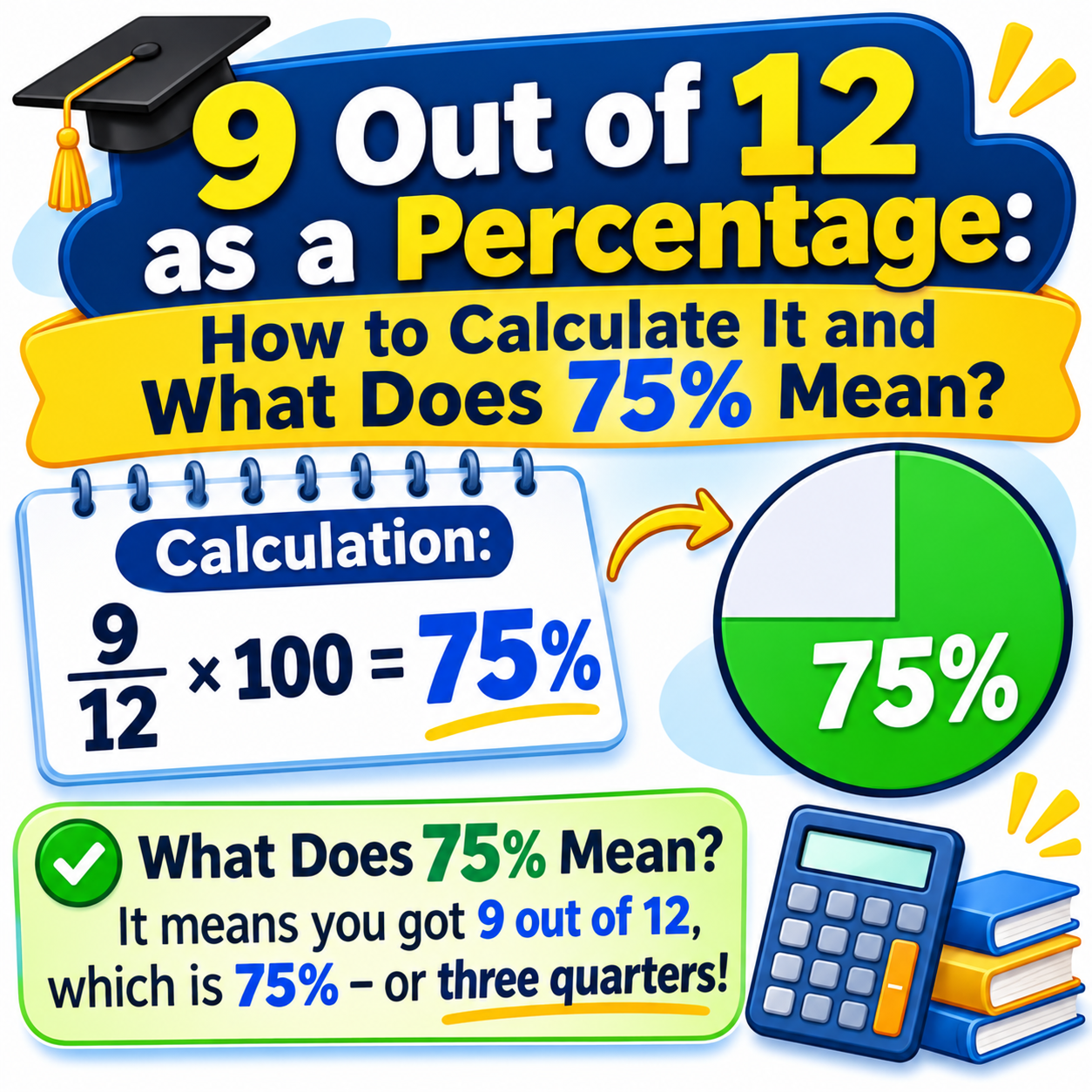
9 out of 12 is equal to 75%. If you scored 9 marks out of a total of 12 marks in an exam, your percentage is 75%.
To calculate this result, divide 9 by 12 and multiply the answer by 100. This simple formula works for school examinations, university assessments, quizzes, assignments, and other grading systems.
Students frequently search for percentage conversions because marks are not always reported in the same format. A teacher might award marks out of 12, while a university requires students to understand their performance as a percentage.
Understanding this calculation helps you interpret your academic results, compare different assessments, and identify how many marks you need to achieve a particular percentage.
Quick Answer: 9/12 Percentage
| Calculation | Result |
|---|---|
| Obtained marks | 9 |
| Total marks | 12 |
| Decimal value | 0.75 |
| Percentage | 75% |
| Marks lost | 3 |
| Performance | 75 out of 100 |
The final answer is 75 percent.
What Does 9 Out of 12 Mean?
9 out of 12 means that a student received nine marks from a total of twelve possible marks.
It represents the proportion of questions answered correctly, points earned, or marks achieved in an assessment.
For example, imagine a teacher gives a short classroom test containing 12 questions. Each question carries one mark, and a student answers nine questions correctly.
The student's score is 9/12, which converts to 75%.
Understanding the Numerator and Denominator
A fraction has two main parts:
- Numerator: The top number, representing the marks obtained.
- Denominator: The bottom number, representing the total available marks.
In the fraction 9/12:
- 9 is the numerator.
- 12 is the denominator.
The numerator tells you how much you achieved, while the denominator tells you the total possible amount.
Understanding these two numbers makes percentage calculations easier, even when the numbers change.
Why Do Students Convert Marks Into Percentages?
Percentages provide a standardized way to understand academic performance.
A score of 9/12 might look different from 18/24 or 45/60, but all three represent the same percentage.
Converting marks into percentages makes it easier to:
- Understand examination performance.
- Compare results from different tests.
- Calculate overall academic scores.
- Track improvement over time.
- Understand percentage-based grading requirements.
How to Calculate 9 Out of 12 as a Percentage?
You can calculate 9 out of 12 using a simple mathematical formula.
The standard percentage formula is:
Percentage = (Obtained Marks ÷ Total Marks) × 100
Now substitute the values:
Percentage = (9 ÷ 12) × 100
Percentage = 0.75 × 100
Percentage = 75%
Therefore, 9 out of 12 equals 75%.
Step 1: Identify Your Obtained Marks
Start by identifying the marks you received.
In this example, the obtained marks are 9.
Step 2: Identify the Total Marks
Next, identify the maximum marks available in the assessment.
Here, the total marks are 12.
Step 3: Divide Obtained Marks by Total Marks
Divide 9 by 12.
9 ÷ 12 = 0.75
This gives you the decimal representation of your score.
Step 4: Multiply by 100
Multiply the decimal by 100 to convert it into a percentage.
0.75 × 100 = 75
Your final percentage is 75%.
How Does the Fraction 9/12 Become 75%?
The fraction 9/12 can also be simplified before converting it into a percentage.
Both the numerator and denominator can be divided by 3.
9 ÷ 3 = 3
12 ÷ 3 = 4
Therefore:
9/12 = 3/4
Now convert 3/4 into a decimal:
3 ÷ 4 = 0.75
Multiply by 100:
0.75 × 100 = 75%
This method demonstrates that 9/12 and 3/4 represent exactly the same value.
Alternative Method: Equivalent Fraction
You can also convert the fraction into a denominator of 100.
9/12 = 75/100
Since 75 out of 100 represents 75%, the answer is 75%.
This method is especially useful for students learning fractions, ratios, and percentages.
Percentage Calculator: Convert 9 Out of 12 Instantly
A percentage calculator can simplify the process when you need to calculate several examination scores.
Instead of manually dividing and multiplying every time, enter your obtained marks and total marks into a calculator.
Example calculation:
- Obtained marks: 9
- Total marks: 12
- Calculated percentage: 75%
The calculator uses the same mathematical formula:
(Obtained Marks / Total Marks) × 100
How to Use a Marks-to-Percentage Calculator
Follow these steps:
- Enter 9 in the obtained marks field.
- Enter 12 in the total marks field.
- Select Calculate if your calculator includes a calculation button.
- Review the percentage displayed in the result section.
You should see 75% as the final result.
When Should You Use a Percentage Calculator?
A percentage calculator is useful when:
- You receive marks from multiple subjects.
- Your examination uses different total marks.
- You need to calculate assignment results.
- You want to compare academic performance.
- You need to determine the marks required for a target percentage.
Always check that the total marks are greater than zero and that your obtained marks do not exceed the maximum possible marks.
Is 75% a Good Score in an Examination?
A score of 75% generally indicates that a student has achieved three-quarters of the available marks.
However, its academic classification depends on the institution, examination board, course, and grading policy.
Some institutions may classify 75% as a B grade, while others may assign a different letter grade or academic category.
Understanding a 75% Result
A 75% score means:
- You obtained 75% of the available marks.
- You lost 25% of the available marks.
- You achieved three-quarters of the assessment.
- Your score is equivalent to 75 marks out of 100.
For a short test worth 12 marks, losing three marks still produces a 75% result.
Does 75% Mean an A Grade?
Not necessarily.
There is no universal grading scale that applies to every school, college, and university.
For example, one institution may classify 75% as a B, while another may place it within a different grade category.
Students should consult their official grading policy before converting a percentage into a letter grade or GPA.
Is 75% a Passing Score?
A 75% result exceeds many commonly used passing thresholds, but students should not assume that every institution uses the same requirements.
Some courses require minimum marks in individual subjects, practical examinations, or final assessments.
Always check the official examination regulations.
How Many Marks Did You Lose Out of 12?
If you received 9 out of 12, you lost 3 marks.
The calculation is:
Marks Lost = Total Marks − Obtained Marks
12 − 9 = 3
Your result can be summarized as follows:
| Category | Marks |
|---|---|
| Total marks | 12 |
| Obtained marks | 9 |
| Lost marks | 3 |
| Percentage achieved | 75% |
| Percentage lost | 25% |
Understanding lost marks can help students identify areas that need improvement.
For example, if three marks were lost because of calculation mistakes, reviewing the relevant mathematical concepts may help improve future performance.
How Many Marks Do You Need to Achieve Different Percentages Out of 12?
The number of marks required depends on your target percentage.
Use the following table to understand how different scores convert into percentages.
| Obtained marks | Total marks | Percentage |
|---|---|---|
| 1 | 12 | 8.33% |
| 2 | 12 | 16.67% |
| 3 | 12 | 25% |
| 4 | 12 | 33.33% |
| 5 | 12 | 41.67% |
| 6 | 12 | 50% |
| 7 | 12 | 58.33% |
| 8 | 12 | 66.67% |
| 9 | 12 | 75% |
| 10 | 12 | 83.33% |
| 11 | 12 | 91.67% |
| 12 | 12 | 100% |
How Many Marks Are Needed for 80%?
To calculate the marks needed for 80%, multiply the total marks by 80 and divide by 100.
(12 × 80) ÷ 100 = 9.6
If the assessment only awards whole marks, you would need at least 10 marks to reach or exceed 80%.
How Many Marks Are Needed for 90%?
(12 × 90) ÷ 100 = 10.8
If only whole marks are available, you need 11 marks.
11 out of 12 equals approximately 91.67%.
How Many Marks Are Needed for 100%?
You need all 12 marks.
12 ÷ 12 × 100 = 100%.
Examples of Similar Percentage Calculations
The same formula works for different marks and examination totals.
Here are some examples:
| Marks obtained | Total marks | Percentage |
|---|---|---|
| 9 | 12 | 75% |
| 10 | 12 | 83.33% |
| 8 | 12 | 66.67% |
| 15 | 20 | 75% |
| 18 | 24 | 75% |
| 30 | 40 | 75% |
| 45 | 60 | 75% |
| 60 | 80 | 75% |
| 75 | 100 | 75% |
Example 1: A Classroom Quiz
A student receives 9 correct answers in a 12-question quiz.
The calculation is:
(9 ÷ 12) × 100 = 75%
The student achieves 75% in the quiz.
Example 2: A University Assignment
Suppose a university assignment carries 24 marks, and a student receives 18.
(18 ÷ 24) × 100 = 75%
Although the student received 18 rather than 9 marks, the percentage remains identical.
Example 3: A School Examination
A student receives 45 marks out of 60 in a mathematics examination.
(45 ÷ 60) × 100 = 75%
This demonstrates why percentages are useful for comparing assessments with different maximum marks.
Common Mistakes to Avoid When Calculating Percentages
Percentage calculations are straightforward, but small errors can produce incorrect results.
Dividing Total Marks by Obtained Marks
A common mistake is calculating 12 ÷ 9 instead of 9 ÷ 12.
Always divide obtained marks by total marks.
Forgetting to Multiply by 100
Dividing 9 by 12 produces 0.75, not 75%.
To express the result as a percentage, multiply the decimal by 100.
Using the Wrong Total Marks
Make sure you enter the maximum marks for the correct assessment.
For example, 9 out of 12 and 9 out of 15 produce different percentages.
Confusing Percentage With Marks
A score of 75% does not mean the student received 75 marks.
It means the student achieved 75% of the available marks.
Rounding Too Early
Keep the full decimal value during calculations and round only the final result when necessary.
For 9/12, the result is exactly 75%, so rounding is not required.
Tips for Improving Your Academic Percentage
A 75% result can provide a useful starting point for improving future examination performance.
Students can use their results to identify strengths and weaknesses.
Review Incorrect Answers
Look at the three marks you lost and identify the reason.
Were the mistakes caused by misunderstanding, calculation errors, incomplete answers, or poor time management?
Knowing the reason is more useful than simply repeating the test.
Practice Similar Questions
Regular practice can improve accuracy and confidence.
Try solving similar questions without checking the answer immediately.
Understand the Marking Scheme
Different assessments may award partial marks for working, explanations, or correct methods.
Understanding the marking criteria can help students present complete answers.
Track Your Progress
Keep a record of your results across quizzes, assignments, and examinations.
Comparing percentages over time can help you understand whether your study methods are working.
Read more: CalKIDS Scholarship 2026–2027: Eligibility, Award Amount, Requirements, and How to Claim Your Money
Frequently Asked Questions About 9 Out of 12 Percentage
1. What is 9 out of 12 as a percentage?
9 out of 12 is equal to 75%. To calculate it, divide 9 by 12 and multiply the result by 100. The calculation is (9 ÷ 12) × 100 = 75%. This means you achieved 75% of the total available marks.
2. Is 9 out of 12 a good score?
Yes, 9 out of 12 represents 75% of the available marks. It generally indicates that you answered most questions correctly or achieved three-quarters of the assessment points. However, the official grade classification depends on your school's or university's grading system.
3. How do I calculate 9/12 without a calculator?
You can simplify the fraction 9/12 by dividing both numbers by 3. This gives 3/4. Divide 3 by 4 to get 0.75, then multiply by 100. The final answer is 75%.
4. How many marks did I lose if I scored 9 out of 12?
You lost 3 marks because the total available marks were 12 and your obtained marks were 9. Subtracting 9 from 12 gives 3. Those lost marks represent 25% of the total assessment.
5. Is 75% equal to 9 out of 12?
Yes. Both represent exactly the same mathematical value. Multiplying 75% by 12 gives 9 marks. Therefore, 75% of 12 is 9.
Final Thoughts: 9 Out of 12 Is 75%
Calculating 9 out of 12 as a percentage is simple once you understand the standard percentage formula.
Divide the obtained marks by the total marks and multiply the result by 100.
For this example:
(9 ÷ 12) × 100 = 75%
A score of 9 out of 12 means you achieved 75% of the available marks and lost 3 marks.
You can use the same method for school tests, university assignments, examination results, and other academic assessments.
Next step: Use a marks-to-percentage calculator to convert your other examination scores and understand your overall academic performance.
Author Information
Author: Ashes Jhon
Ashes Jhon writes educational resources covering academic calculations, examination results, student guidance, and education-related topics.
Reviewed by: [Reviewer Name and Professional Credentials – Verify Before Publishing]
Last Updated: November 2026
The mathematical formula and result in this article are not dependent on an academic year's grading policy. However, grade classifications and passing requirements vary by educational institution.
Disclaimer: This article is intended for educational purposes. Students should consult their institution's official grading policy when interpreting examination results.
Disclosure: This website may earn revenue through advertising or affiliate partnerships. This does not influence our recommendations.







0 Comments