
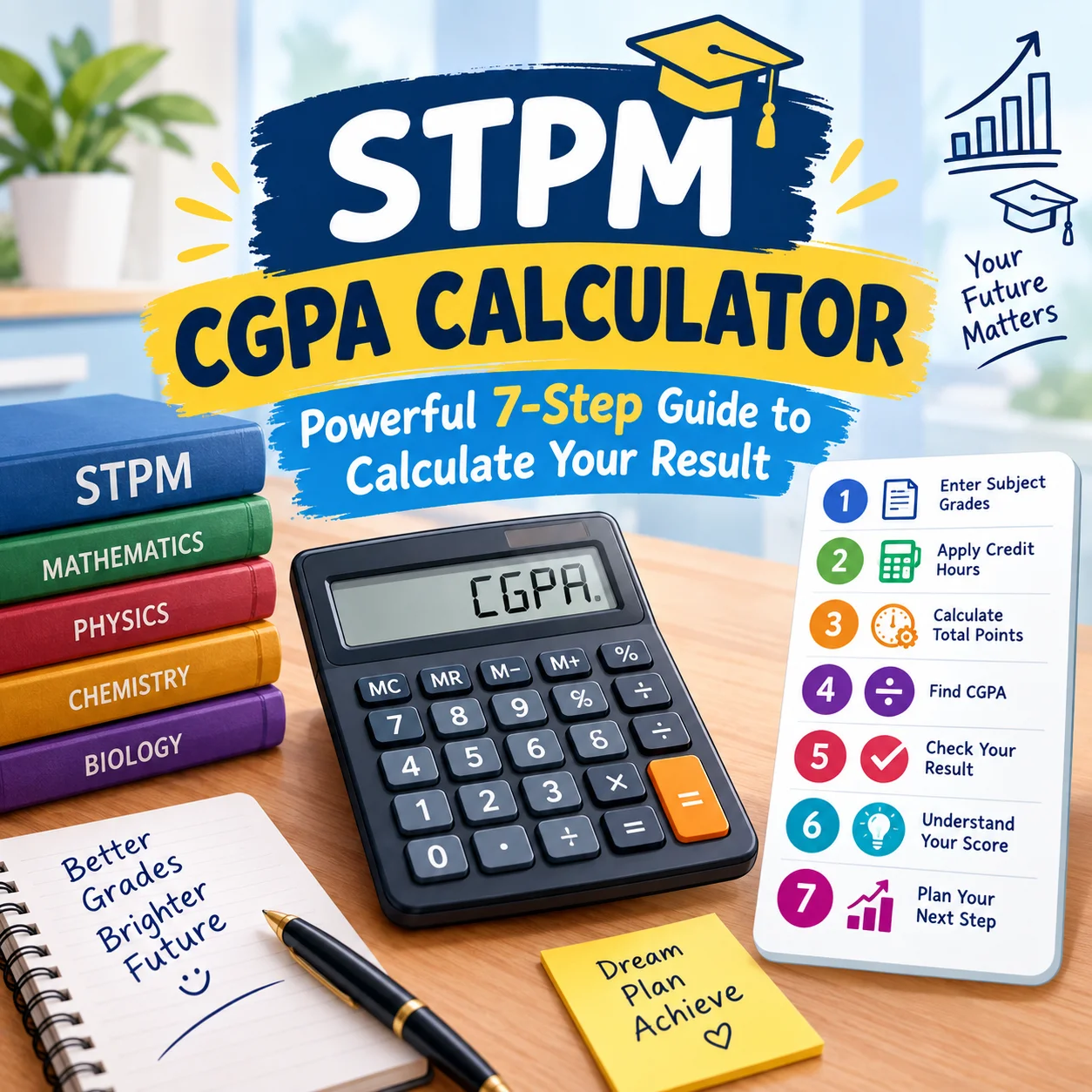
What Is the STPM CGPA Calculator and Why Does It Matter?
The STPM CGPA Calculator helps students estimate their Sijil Tinggi Persekolahan Malaysia (STPM) Cumulative Grade Point Average, commonly called PNGK in Malaysia. It converts your subject grades into grade points and calculates an estimated overall result based on the STPM grading method.
For students planning university applications, this calculation can make academic planning much easier. Instead of manually checking several grade values, you can enter your results and quickly see an estimated CGPA.
STPM is administered by the Malaysian Examinations Council (Majlis Peperiksaan Malaysia, or MPM). The official STPM system uses subject grade points, and the overall PNGK is calculated from the best four subjects, including Pengajian Am, subject to the applicable admission rules.
Why Do Students Search for an STPM CGPA Calculator?
Students commonly use a calculator when they want to understand how individual grades affect their overall academic result.
For example, a student might know that they received an A in one subject and a B+ in another but may not immediately understand how those grades translate into a final CGPA.
A calculator provides a practical way to estimate the result before making important academic plans.
What Does CGPA Mean in STPM?
CGPA means Cumulative Grade Point Average. In Malaysian STPM terminology, the corresponding term is Purata Nilai Gred Keseluruhan (PNGK).
The official MPM grading information assigns numerical grade points to STPM subject grades. For example, an A carries 4.00 points, A- carries 3.67, B+ carries 3.33, and B carries 3.00.
Is STPM CGPA the Same as Percentage?
No. STPM CGPA is a grade-point measure rather than a simple percentage.
Your individual subject performance is converted into grade points according to the applicable STPM grading system. The relevant subject grade points are then used to determine the overall PNGK.
How Does the STPM CGPA Calculator Work?
The calculator works by converting your STPM subject grades into numerical grade points and then calculating the applicable average.
For a simple four-subject calculation, the basic mathematical idea is:
CGPA = Total Grade Points ÷ Number of Subjects
However, students should remember that official STPM results involve the examination structure, subject grades, Pengajian Am, coursework where applicable, repeat examination rules, and the applicable four-best-subject calculation. The calculator is therefore an estimation tool and should not be treated as an official replacement for an MPM result statement.
What Grade Points Are Used in STPM?
The official STPM grading system includes the following subject-grade values:
| STPM Grade | Grade Point |
|---|---|
| A | 4.00 |
| A- | 3.67 |
| B+ | 3.33 |
| B | 3.00 |
| B- | 2.67 |
| C+ | 2.33 |
| C | 2.00 |
| C- | 1.67 |
| D+ | 1.33 |
| D | 1.00 |
| F | 0.00 |
These values are documented by the Malaysian Examinations Council. Grades from C through A are classified as full passes, while C- through D are partial passes and F is a fail.
Does Pengajian Am Count Toward the CGPA?
Yes. Pengajian Am is important when calculating the overall STPM PNGK.
MPM states that the overall PNGK is calculated using the grade points of the four best subjects, including Pengajian Am, subject to the method applied by the relevant university admission authority.
How Many Subjects Can an STPM Student Take?
The STPM system allows candidates to take up to five subjects, including Pengajian Am, subject to the applicable subject restrictions.
For admission purposes, the four best subjects including Pengajian Am are used in the relevant calculation.
How to Use the STPM CGPA Calculator?
The easiest way to use the calculator is to enter your subject grades carefully and check the calculated result before using it for academic planning.
Use the calculator below:
Step 1: Identify Your STPM Subjects
Start by listing the STPM subjects you want to evaluate.
Your subjects may include Pengajian Am and other subjects from your chosen academic stream. If you are checking an official admission requirement, use the subjects and qualifications specified by the relevant institution.
Step 2: Enter Your Grade for Each Subject
Enter the final subject grade rather than an individual paper grade if the calculator asks for subject grades.
For example, if your final subject grade is B+, select B+. Do not enter the grade from one semester paper unless the calculator specifically asks for semester-level information.
Step 3: Check the Grade-Point Conversion
The calculator should associate each grade with its corresponding numerical value.
For example:
- A = 4.00
- A- = 3.67
- B+ = 3.33
- B = 3.00
- B- = 2.67
Checking the conversion helps you catch an accidental entry before relying on the result.
Step 4: Include Pengajian Am Correctly
Make sure Pengajian Am is included when the calculator is designed to estimate the official four-subject STPM PNGK.
This matters because the official calculation specifically includes Pengajian Am among the four best subjects.
Step 5: Review the Calculated CGPA
After entering the grades, review the estimated CGPA shown by the calculator.
Do not immediately interpret the number as an admission decision. Universities may have programme-specific academic and subject requirements.
Step 6: Compare the Result With Your Target
You can use the estimated result as a planning reference.
For example, if your preferred degree programme requires a particular academic qualification, compare your result with the latest official requirements published by the relevant university or admission authority.
Step 7: Verify Before Making an Application Decision
The final step is verification.
Use your official STPM result and check the latest requirements from the relevant university, UPUOnline, or other authorised institution. Calculator results are useful for planning, but they do not replace official academic records.
What Is an Example of an STPM CGPA Calculation?
A simple example can show how the calculation works.
Suppose a student has the following four subject grades:
| Subject | Grade | Grade Point |
|---|---|---|
| Pengajian Am | A- | 3.67 |
| Mathematics | B+ | 3.33 |
| Economics | A | 4.00 |
| History | B | 3.00 |
The total grade points are:
3.67 + 3.33 + 4.00 + 3.00 = 14.00
The estimated average is:
14.00 ÷ 4 = 3.50
So, in this simplified example, the estimated CGPA is 3.50.
Why Is This Only an Example?
Actual STPM results depend on the official examination and assessment rules.
KPM explains that STPM assessment includes centrally administered final examinations and coursework, with weightings varying by subject. Students receive results for individual semesters, and the overall result is based on the applicable combination of semester results and coursework.
For this reason, a calculator should be viewed as a planning aid rather than an official result-generation system.
What Are the Main Components of STPM Results?
Understanding the components behind STPM results helps students use a CGPA calculator more responsibly.
Semester Examinations
STPM uses a semester-based assessment structure.
KPM states that students sit centrally administered final examinations for Semesters 1, 2, and 3. Students may also improve certain Semester 1 and Semester 2 examination results through repeat examinations under the applicable rules.
Coursework
Some STPM subjects include coursework as part of assessment.
The weighting is not necessarily identical for every subject. KPM states that final centralised examinations generally account for 60%–80%, while coursework accounts for 20%–40%, depending on the subject.
Subject Grade
Your performance is ultimately reflected through a subject grade.
The subject grade is associated with a numerical grade-point value used in the overall PNGK calculation.
Overall PNGK
The overall PNGK provides a cumulative summary of academic performance.
MPM specifies that the PNGK is calculated from the grade points of the four best subjects, including Pengajian Am, subject to the relevant admission methodology.
What Requirements Should You Check Before Using the Calculator?
There are no special eligibility requirements simply to use a CGPA calculator. However, you need accurate STPM grades if you want a meaningful estimate.
You Must Have
For a useful calculation, you should have:
- Your latest STPM subject grades.
- Your Pengajian Am grade.
- The grades for your other relevant subjects.
- Correct grade-point conversions.
- The latest programme requirements if you are checking university eligibility.
You May Need Additional Information
Some academic decisions require more than your CGPA.
You may also need:
- MUET results.
- Specific subject grades.
- SPM qualifications.
- Programme-specific prerequisites.
- University-specific requirements.
- Citizenship or residency information where applicable.
- Other documents requested by the institution.
For example, KPM's general information for admission to public universities includes academic requirements for STPM applicants and may also include MUET and SPM conditions. Programme-specific requirements can differ.
Why Should You Check the Official Requirement?
A CGPA alone does not guarantee admission.
Universities can set additional requirements for particular programmes. Always check the latest official information before submitting an application.
How Can STPM CGPA Help With University Planning?
An estimated CGPA can help students organise their academic goals.
Understanding Your Academic Position
Knowing your approximate CGPA gives you a clearer picture of your current academic performance.
It can also help you identify subjects where improving a grade may have a meaningful effect on your overall result.
Comparing Programme Requirements
Students can compare their academic result with published entry requirements.
For Malaysian public university applications, UPUOnline provides information for applicants using STPM and other recognised qualifications.
Planning a More Realistic Application
A calculator should support planning rather than create false certainty.
A student may have a strong CGPA but still need a particular subject grade, MUET level, or other prerequisite for a specific programme.
What Are Common Mistakes When Calculating STPM CGPA?
Small data-entry mistakes can produce a misleading estimate.
Mistake 1: Entering Paper Grades Instead of Subject Grades
STPM has individual examination papers and an overall subject grade.
Do not automatically treat one paper grade as the final subject grade. MPM's published examples show the distinction between paper grades, subject grades, and the associated grade points.
Mistake 2: Forgetting Pengajian Am
Pengajian Am is a key component of the four-subject calculation.
Leaving it out can produce an estimate that does not reflect the applicable STPM PNGK method.
Mistake 3: Using an Old Grading Table
Always use the grading scale applicable to your examination.
Official examination rules can change, so old screenshots, social media posts, and unofficial calculators should not be treated as final authorities.
Mistake 4: Assuming CGPA Guarantees Admission
A calculated CGPA is not an admission offer.
Universities may consider subject combinations, specific grades, MUET, programme requirements, and the applicable selection process.
Mistake 5: Relying on a Calculator Instead of Your Official Result
The calculator is designed for estimation.
Your official STPM result issued through the proper examination authorities remains the authoritative record of your performance.
What Tips Can Help You Get a More Accurate Result?
Accuracy begins with accurate information.
Use Your Final Subject Grades
If you already have your official result, enter the final subject grades rather than guessing from individual examination papers.
Double-Check Every Grade
One incorrect letter can change the grade-point calculation.
Check A, A-, B+, B, and the other grades carefully before calculating.
Keep Your Official Documents
Keep your result slip and other academic documents safely.
KPM provides procedures for obtaining STPM certificates, verified result statements, and transcripts through the appropriate channels.
Check Requirements Directly With Universities
If you are applying for a degree, read the latest programme requirements.
Do not assume that a requirement from a previous admission cycle remains unchanged.
Use the Calculator for Planning
The greatest practical value of an STPM CGPA Calculator is helping you understand your academic position quickly.
Use the result to plan your next step, then confirm the official requirement before making an important application decision.
How Can Students Use Their CGPA Strategically?
Academic numbers can sometimes feel overwhelming, particularly when university applications are approaching.
A calculator can turn a confusing set of grades into one understandable figure.
Focus on What You Can Improve
If you are still studying, identify the subjects where additional preparation could improve your final performance.
Instead of thinking only about a final target, break the goal into individual subjects and assessment components.
Avoid Comparing Yourself Unnecessarily
Every student's subject combination, academic pathway, and university goals can be different.
Your CGPA is useful for academic planning, but it should not become the only measure of your abilities or future options.
Use Numbers as Information, Not a Verdict
A CGPA can tell you something important about academic performance.
It cannot, by itself, describe your interests, skills, communication ability, career goals, or suitability for every possible field.
What Should You Do After Calculating Your STPM CGPA?
After getting your estimated result, the next step is to verify your academic pathway.
Check the Official University Requirements
Visit the relevant university's official admissions page and review the requirements for your intended programme.
For public university applications, also consult the official UPU information applicable to your admission category.
Check Subject-Specific Conditions
Some programmes may require particular STPM subjects or minimum grades.
This is especially important for specialised academic fields.
Confirm MUET Requirements
Some university programmes have English-language requirements.
Check the latest programme information instead of relying on general assumptions.
Keep Your Application Documents Ready
Depending on the application route, you may need academic results, identification documents, MUET information, certificates, or other supporting materials.
Prepare documents early so that an avoidable administrative issue does not delay your application.
Read more: Scholastic Assessment Test (SAT) Score Calculator — 7 Powerful Steps to Understand Your Score
Frequently Asked Questions About the STPM CGPA Calculator
Is the STPM CGPA Calculator Official?
No. An online calculator is an estimation tool unless it is specifically provided by an authorised examination or admissions body. It can help students understand grade-point calculations, but the official STPM result issued through the Malaysian Examinations Council remains authoritative.
How Is STPM CGPA Calculated?
STPM PNGK is based on the grade points of the four best subjects, including Pengajian Am, under the applicable rules. Each subject grade has an associated numerical value, such as 4.00 for A and 3.67 for A-.
Can I Take Five STPM Subjects?
Yes. The STPM system allows candidates to take up to five subjects, including Pengajian Am, subject to applicable subject restrictions. For the relevant four-subject calculation, the best four subjects including Pengajian Am are considered.
Does Coursework Affect STPM Results?
Yes, for subjects where coursework forms part of the assessment. KPM states that STPM assessment combines centrally administered final examinations and coursework, with the weighting varying according to the subject.
Can a Good CGPA Guarantee University Admission?
No. A strong academic result does not automatically guarantee admission. Programme-specific requirements, subject prerequisites, MUET requirements, admission categories, and the applicable selection process can all affect eligibility and selection.
Final Thoughts: Use Your STPM CGPA as a Planning Tool
The STPM CGPA Calculator provides a convenient way to understand how STPM grades translate into an estimated overall grade-point average.
It is particularly useful when students are reviewing their academic progress, planning university applications, or checking how different grades influence their overall result.
The most important point is to use the calculator responsibly. Enter accurate subject grades, include Pengajian Am correctly, understand the four-best-subject principle, and verify all admission requirements through official sources.
For current information, students should consult the Malaysian Examinations Council (MPM) and Ministry of Education Malaysia (KPM). For public university admission information, check the official UPUOnline information.
Next step: Enter your grades into the calculator above, review your estimated CGPA, and then compare your academic qualifications with the latest official requirements for your intended programme.
Author and Review Information
Written by: Ashes Jhon
Reviewed by: [Education Professional / Academic Guidance Reviewer]
“Reviewed for accuracy by an education professional specializing in scholarships and academic guidance.”
No specific professional credential is claimed unless independently verified.
Last Updated
Last Updated: September 2026
Requirements, deadlines, grading rules, and eligibility conditions may change. Always confirm the latest information from the official examination authority, university, or admission organisation before making application decisions.
Disclaimer
Information provided in this article is for educational purposes only and should be verified with the official organisation before making application decisions. The calculator provides an estimate and does not replace an official STPM result or university admission assessment.
Disclosure: This website may earn revenue through advertising or affiliate partnerships. This does not influence our recommendations.







0 Comments