
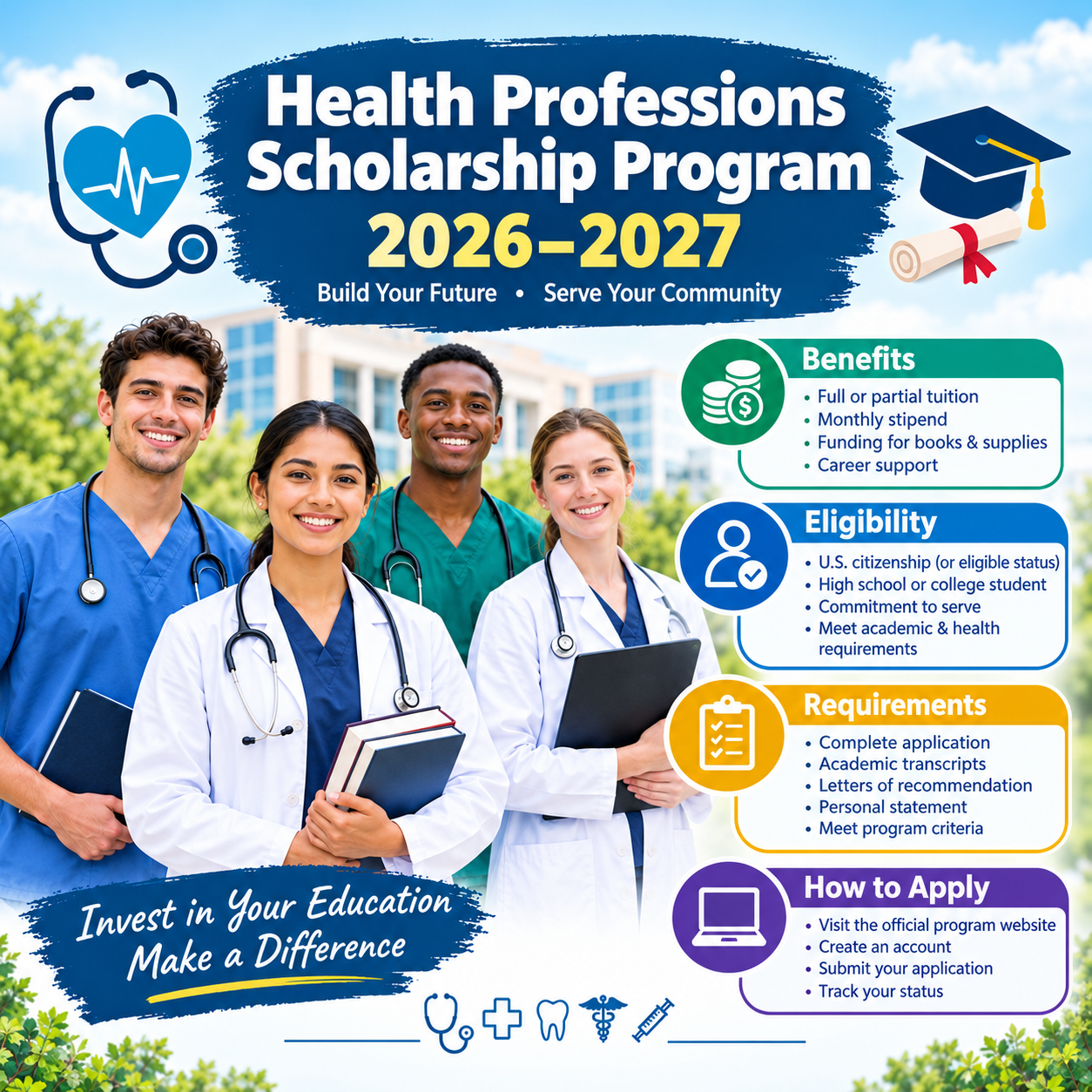
The Health Professions Scholarship Program (HPSP) is a U.S. military scholarship program that can help eligible students pay for professional education in selected healthcare fields in exchange for a military service commitment. It is offered through military branches, including the Army, Navy, and Air Force, with specific eligibility requirements, benefits, and service obligations determined by the sponsoring branch.
For students planning to become physicians, dentists, and other eligible healthcare professionals, the HPSP may provide a way to pursue professional education with substantial financial support. However, applicants should understand the military commitment, academic requirements, and application process before deciding if this opportunity fits their career goals.
Last updated: October 2026. Applicants should verify current 2026–2027 program details with the relevant military branch before making financial or enrollment decisions.
What Is the Health Professions Scholarship Program?
The Health Professions Scholarship Program is a military-sponsored education benefit designed to help eligible students pursue certain healthcare degrees while preparing to serve as commissioned officers in the U.S. military medical community.
Instead of treating the program as a conventional college scholarship, applicants should understand it as an educational funding opportunity connected to a future military healthcare career.
What Is the Purpose of HPSP?
HPSP helps participating military services recruit and educate qualified healthcare professionals. In return for financial assistance, scholarship recipients generally agree to serve in a military medical role after completing their education and satisfying applicable training requirements.
This arrangement can benefit students who are interested in both healthcare and military service. It may be less suitable for someone who wants complete freedom to choose a civilian employer immediately after graduation.
Which Military Branches Offer HPSP?
HPSP opportunities are associated with several U.S. military services, including:
- U.S. Army: Offers scholarship opportunities for eligible students in selected health professions.
- U.S. Navy: Supports qualifying students preparing for designated healthcare roles within the Navy and its medical community.
- U.S. Air Force: Offers educational sponsorship opportunities for eligible students in selected medical and other health professions.
The programs are not necessarily identical. Available professions, scholarship lengths, benefit amounts, selection criteria, and service obligations can vary by branch and applicant category.
Use the official resources of the U.S. Army Medical Recruiting, Navy Medicine, and U.S. Air Force to identify the appropriate recruiting office and current program information.
Who Should Consider This Scholarship?
HPSP may be worth exploring if you:
- Plan to attend an eligible professional healthcare program.
- Meet the relevant military service's citizenship, academic, medical, and other eligibility requirements.
- Are willing to accept the obligations associated with military service.
- Want to understand how military-sponsored education compares with loans, civilian scholarships, and other funding options.
Students should evaluate the complete arrangement rather than focusing only on the financial benefits.
What Are the HPSP Benefits for 2026–2027?
HPSP benefits can include tuition support, a monthly stipend, and certain approved educational expenses, depending on the sponsoring branch, scholarship agreement, and current program rules.
Important: Exact 2026–2027 payment amounts, covered fees, and additional benefits should be confirmed with the relevant military recruiter. Do not rely on an amount advertised for a previous academic year without checking its current applicability.
Does HPSP Cover Tuition?
Eligible scholarship agreements may cover approved tuition and required educational fees for the specified professional program. The precise coverage depends on the branch, contract, school, and expenses approved under the program.
Before accepting an offer, ask the recruiter and your university's financial aid office to clarify:
- Whether tuition is covered in full or subject to program-specific limits.
- Which mandatory fees are eligible for payment.
- Whether laboratory, examination, equipment, or other professional-school expenses are included.
- How payments are coordinated with other scholarships or financial aid.
- What happens if you withdraw, repeat a year, or change programs.
Never assume that every expense associated with medical or dental school will automatically be paid.
Is There a Monthly Stipend?
HPSP recipients may receive a monthly stipend while participating in the program, subject to applicable eligibility and payment rules. The stipend can help students manage everyday expenses while studying.
However, the exact monthly amount for 2026–2027 needs confirmation from the relevant branch. Ask whether the payment changes during different training periods and what conditions could affect eligibility.
Are There Additional Benefits?
Depending on the branch and the individual's agreement, the program may provide support connected to required military training or other approved educational expenses.
Request a written explanation of the benefits that apply to your specific offer. A general HPSP information page is not a substitute for the terms of an individual scholarship contract.
HPSP Benefits at a Glance
| Benefit category | What applicants should know |
|---|---|
| Tuition | Coverage depends on the approved program and contract. |
| Required fees | Confirm which fees qualify for payment. |
| Monthly stipend | Verify the current rate and payment conditions. |
| Books and equipment | Ask which expenses are eligible. |
| Military training | Training requirements depend on the service and program. |
| Post-graduation career | Scholarship recipients generally incur a military service obligation. |
The central consideration is the full value of the funding compared with the responsibilities required in return.
Who Is Eligible for the Health Professions Scholarship Program?
HPSP eligibility depends on the military branch, the healthcare profession, the educational institution, and the applicant's personal qualifications. Meeting the academic requirements alone does not guarantee selection.
What Academic Qualifications Are Required?
Applicants generally need acceptance to, or enrollment in, an eligible professional program, depending on the branch and scholarship category.
Eligible fields can include:
- Medicine, including Doctor of Medicine (MD) and Doctor of Osteopathic Medicine (DO) programs.
- Dentistry.
- Optometry.
- Selected nursing and advanced practice specialties.
- Clinical psychology.
- Other designated health professions supported by a particular branch.
For example, the Navy publishes specific requirements for applicants in medicine, dentistry, optometry, physician assistant studies, and clinical psychology. Its requirements vary by program.
med.navy.mil
+1
Check that your degree, institution, and year of study qualify before starting an application.
Are U.S. Citizenship and Medical Fitness Required?
For the standard active-duty HPSP pathways described by the Army, Navy, and Air Force, applicants should expect citizenship requirements and a medical qualification assessment for commissioning as an officer. The precise rules and any exceptions must be confirmed with the sponsoring branch.
Applicants may also be evaluated on age, professional qualifications, background, and other commissioning standards.
Important: International students should not assume that studying at an American university makes them eligible. If you are not a U.S. citizen, ask the appropriate recruiting office to confirm your eligibility before investing time in the application.
What Other Requirements Should You Expect?
Depending on the program, applicants may need to demonstrate:
- Admission to an approved professional school.
- Satisfactory academic progress.
- Eligibility to receive a military commission.
- Compliance with applicable medical and fitness standards.
- Completion of required background screening and documentation.
- Willingness to sign a contract that establishes service obligations.
Who May Not Qualify?
You may be ineligible for a particular HPSP opportunity if:
- Your degree or university is not approved for that scholarship.
- You do not satisfy the applicable citizenship requirements.
- You cannot meet the branch's commissioning standards.
- You have reached an applicable age limit.
- You cannot meet the academic, professional, or other contractual conditions.
These are potential barriers, not a universal rejection checklist. Ask an authorized recruiter to assess your circumstances against the rules for your chosen branch.
How Does the Health Professions Scholarship Program Work?
HPSP combines educational funding with military preparation and a future service commitment. The process begins with eligibility screening and continues through professional education, military training, graduation, and qualifying service.
Step 1: Choose a Military Branch
Start by comparing the Army, Navy, and Air Force programs that support your profession.
Consider the healthcare roles available, scholarship length, training requirements, expected assignments, and service obligations. Ask each recruiting office about its current opportunities rather than assuming every branch offers the same degree categories.
Step 2: Confirm Your School and Degree
Verify that your professional school and degree meet the relevant branch's accreditation and eligibility rules.
If you have not yet received an admission offer, ask whether you can begin the scholarship application before admission is finalized. The Navy's published guidance, for example, allows certain applicants to begin the process before receiving a medical or dental school acceptance, but the acceptance must be secured before benefits begin.
med.navy.mil
Step 3: Complete the Application and Screening
Provide the requested academic records, application forms, medical documentation, and other materials. You may also need interviews, background screening, and commissioning assessments.
Incomplete paperwork can delay review, so request a checklist directly from your assigned recruiter.
Step 4: Review and Sign the Scholarship Agreement
Before signing, understand what the scholarship pays for, when payments begin, what training is required, and how your service commitment is calculated.
Ask for written clarification about withdrawal, academic failure, changes in degree plans, and repayment or other consequences if you cannot fulfill the agreement.
Step 5: Attend Professional School and Required Training
Once accepted into the program and eligible for benefits, you continue your professional education while fulfilling the program's military requirements.
Depending on the branch, students may attend annual active-duty training and participate in military orientation or clinical activities.
Step 6: Complete Graduation, Specialty Training, and Service
After professional school, graduates generally proceed through applicable licensing, internship, residency, or specialty-training requirements and then perform their obligated military service according to the applicable contract and regulations.
For physicians, residency and other graduate medical education arrangements can significantly affect the overall timeline. Confirm how training time is treated before estimating when your service obligation will end.
How Do You Apply for HPSP in 2026–2027?
The best approach is to contact a healthcare officer recruiter early, verify your program's current application window, and prepare your documents before submitting the complete application.
HPSP Application Process
| Step | Action | Details |
|---|---|---|
| 1 | Research the branches | Compare Army, Navy, and Air Force opportunities for your profession. |
| 2 | Contact a recruiter | Confirm eligibility, available scholarships, and the current application cycle. |
| 3 | Verify admission | Check the approved degree and school requirements. |
| 4 | Prepare documents | Gather academic records, admission evidence, identification, and requested forms. |
| 5 | Complete screening | Follow instructions for interviews, medical evaluation, and background checks. |
| 6 | Review the offer | Confirm tuition, fees, stipend, training, and service obligations in writing. |
| 7 | Finalize enrollment | Complete the contract and benefit-start requirements before relying on funding. |
What Documents Should You Prepare?
The exact checklist varies by service, but you may be asked for:
- Official academic transcripts.
- Professional-school acceptance or enrollment documentation.
- Identification and citizenship documentation.
- Application forms and personal history information.
- Medical examination records and commissioning paperwork.
- Interview materials or other supporting documents requested by the recruiter.
Do not send sensitive personal documents to unofficial scholarship websites. Follow the instructions provided by the authorized military recruiting office.
When Should You Apply?
For four-year medical scholarships, the Air Force advises applicants to begin the process in the fall before the year they plan to attend medical school. Other scholarship lengths and professional fields may have different timelines.
airforcemedicine.af.mil
+1
For the 2026–2027 cycle, do not assume a single universal deadline. Contact your selected branch to ask whether applications remain open, which awards are available, and when selection decisions are expected.
Some applicants may need to allow several weeks or months for processing. The Navy publishes an estimated application processing period of approximately 12–16 weeks for its HPSP pathway, but individual cases and other branches may differ.
med.navy.mil
What Military Service Commitment Comes With HPSP?
The service commitment is one of the most important parts of HPSP because scholarship recipients generally agree to serve as military healthcare professionals after their education and applicable training.
How Long Must HPSP Recipients Serve?
The required service period depends on the branch, profession, scholarship duration, and contract terms.
For example, the Air Force's July 2026 HPSP fact sheet describes a general obligation of one year of active-duty service for each year of scholarship participation, with a minimum three-year obligation for the medical scholarship arrangements described. It also explains that graduate medical education may affect when the obligation begins.
airforcemedicine.af.mil
Do not automatically apply these terms to every profession or military branch. Ask your recruiter to explain the exact calculation for your proposed scholarship.
Does Residency Count Toward the Service Obligation?
Not necessarily. The Air Force states that time spent in a military residency or fellowship does not count toward satisfying the medical HPSP service obligation described in its fact sheet. Other pathways have their own rules.
airforcemedicine.af.mil
+1
This distinction can substantially affect your career timeline. Before signing, request an explanation of how internship, residency, fellowship, and any required additional training affect your expected service dates.
What Happens if You Leave the Program?
Leaving school, failing to complete required training, or failing to meet contractual conditions may have financial or service consequences.
The exact outcome depends on the governing agreement and applicable law. Ask for written information about repayment, release from the program, academic dismissal, medical disqualification, and other circumstances that might change your obligations.
What Mistakes Should HPSP Applicants Avoid?
Applicants can reduce preventable delays by checking eligibility carefully, organizing documents, and evaluating the service agreement alongside the scholarship benefits.
Mistake 1: Focusing Only on the Money
Full tuition support can look attractive, especially when professional-school costs are high. However, the scholarship is connected to military service, which can influence where you work, your clinical training, and your future career choices.
Compare the financial support with the length and nature of the commitment before deciding.
Mistake 2: Assuming Every Healthcare Degree Qualifies
HPSP is not a universal scholarship for all healthcare students. Eligibility varies by branch and professional specialty.
Confirm the precise degree title, accreditation requirements, school location, and scholarship availability before preparing a lengthy application.
Mistake 3: Applying Too Late
Recruiting, medical evaluations, academic verification, and contract processing take time. Starting close to your intended enrollment date can leave little room to correct missing documents.
Contact a recruiter early and ask for the current application timeline.
Mistake 4: Misunderstanding the Contract
A verbal explanation is not enough for a decision involving tuition funding and future military service.
Read the written agreement and ask questions about service length, training, repayment, assignment flexibility, and circumstances that could interrupt your education.
Mistake 5: Using Outdated Scholarship Figures
Older articles may quote stipend rates, signing bonuses, or benefit limits that no longer apply.
Use the current official program page and request written confirmation of the amounts and conditions applicable to your intended enrollment year.
What Tips Can Improve Your HPSP Application?
A strong application starts with careful preparation and a realistic understanding of military healthcare careers.
Build a Complete Application Early
Keep academic transcripts, admission documents, identification records, and other requested materials organized. Follow the recruiter's current instructions rather than relying on a checklist from another applicant.
If you are still waiting for admission, ask which application steps can be completed beforehand.
Compare Career Paths, Not Just Scholarships
Speak with healthcare professionals familiar with military and civilian practice. Consider the clinical specialties available, possible duty locations, professional development, and the amount of flexibility you want after graduation.
For students who value structured service and military medicine, HPSP may align well with their goals. Students who strongly prefer unrestricted civilian career choices may want to compare other funding options first.
Prepare Questions Before Meeting a Recruiter
Ask about the following:
- Which scholarships are available for your profession in 2026–2027?
- What is the current stipend and which expenses are covered?
- Is a signing bonus available for your specific award?
- What academic, citizenship, age, and medical requirements apply?
- When does the service obligation begin?
- How are residency and specialty training handled?
- What happens if you change schools or cannot finish your degree?
Record the answers and verify important contractual details in the official documentation.
Keep Alternative Funding Options Open
Until your scholarship is formally approved and the benefit start date is confirmed, do not assume that your tuition or living expenses are covered.
Compare university aid, civilian scholarships, eligible federal student aid, and other options for which you qualify. Review how accepting additional funding could affect your HPSP agreement.
Frequently Asked Questions About HPSP 2026–2027
Is the Health Professions Scholarship Program fully funded?
HPSP can cover approved tuition and other eligible educational costs, and it may provide a monthly stipend. The precise coverage depends on the military branch, profession, and scholarship contract. Students should obtain written confirmation of covered fees, equipment, payment conditions, and exclusions before making enrollment or borrowing decisions.
Can I apply for HPSP before medical school admission?
Some branches allow applicants to begin the process before receiving a professional-school acceptance, although an eligible admission offer may be required before benefits can begin. The Air Force recommends applying early for four-year medical scholarships. Contact the relevant recruiter to confirm the rules for your profession and intended enrollment year.
med.navy.mil
+1
Does HPSP cover dental school?
Yes, dental students may qualify for HPSP through participating military services. The Air Force, for example, lists scholarship opportunities for dental corps students. Eligibility, scholarship duration, covered expenses, and service requirements depend on the branch and current program availability.
U.S. Air Force
Can international students receive HPSP?
Standard active-duty HPSP pathways described by the Army, Navy, and Air Force generally require U.S. citizenship. International students should not assume they qualify simply because they attend an American professional school. Contact an authorized recruiter to verify the citizenship and commissioning requirements that apply to the specific program.
When is the HPSP 2026–2027 deadline?
There is no single deadline that applies to every HPSP branch and healthcare specialty. Some scholarships use rolling selections, while other opportunities follow specific review schedules. Contact your chosen military healthcare recruiter for current application availability, required documents, and the deadline relevant to your degree and enrollment date.
Final Thoughts: Is HPSP Right for You?
The Health Professions Scholarship Program can be a valuable route to funding professional healthcare education while preparing for a military medical career. Its potential benefits include tuition assistance, approved educational expenses, and a stipend, but those benefits come with training requirements and a military service commitment.
The right decision depends on your eligibility, professional goals, financial needs, and willingness to serve. Review the official requirements for the Army, Navy, or Air Force, discuss your circumstances with an authorized healthcare recruiter, and carefully examine the contract before accepting an award.
Your next step: Visit the official Air Force HPSP information page, Navy HPSP application guidance, or Army Human Resources Command HPSP information to explore the program relevant to your career plans.
Author and Review Information
Author: Ashes Jhon
Reviewed by: [Reviewer name and professional role to be added after an actual review]. This article uses official military program resources for its general guidance. A qualified reviewer should verify the final version before publication.
Last updated: October 2026.
Disclaimer: Information provided in this article is for educational purposes only and should be verified with the official organization before making application decisions. Requirements, deadlines, benefit amounts, and eligibility rules may change. Scholarship availability and selection are not guaranteed.
Disclosure: This website may earn revenue through advertising or affiliate partnerships. This does not influence our recommendations.






0 Comments