
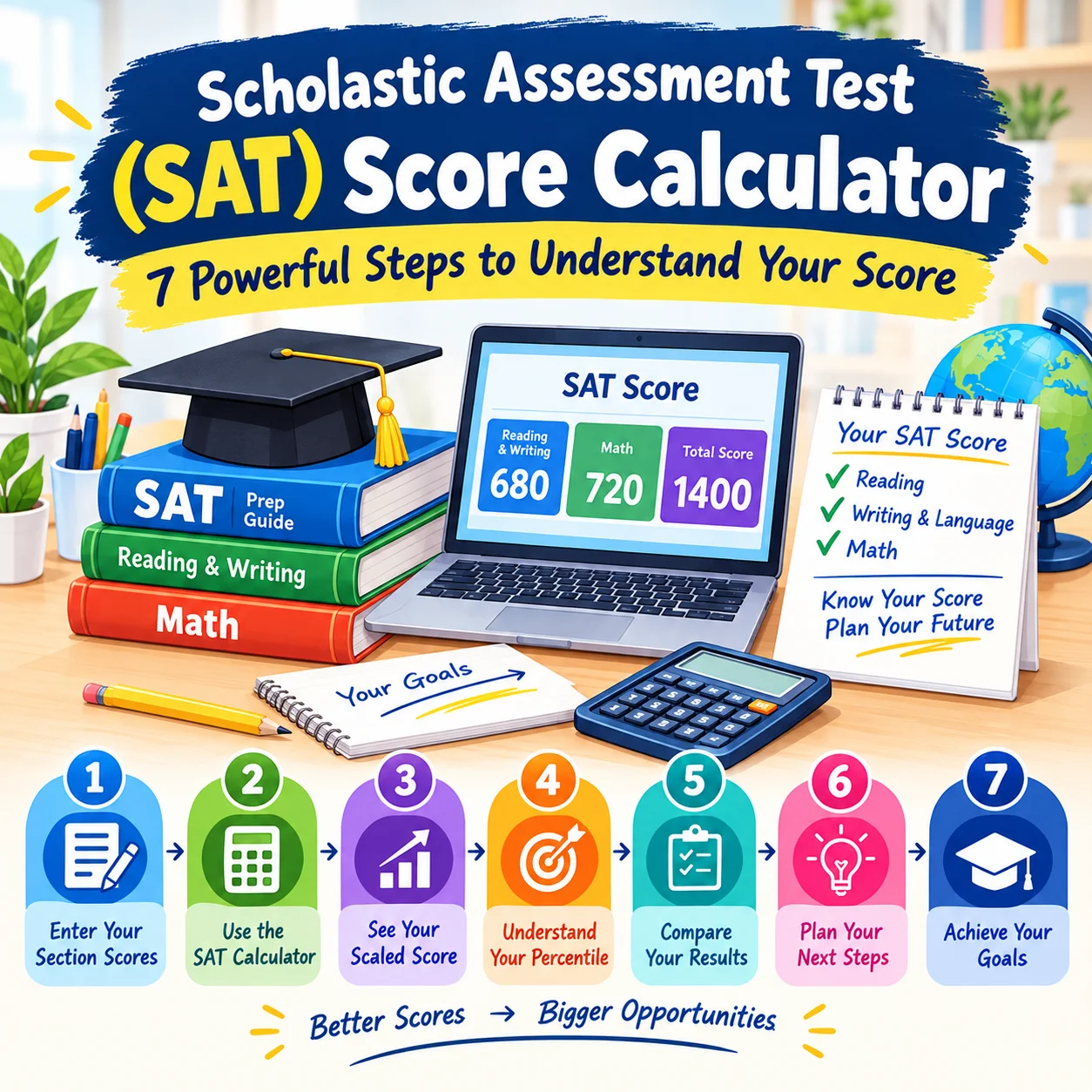
What Is a Scholastic Assessment Test (SAT) Score Calculator?
A Scholastic Assessment Test (SAT) Score Calculator helps students estimate, organize, or understand their SAT results using section scores or practice-test performance. The current SAT has two scored sections—Reading and Writing and Math—and the total score ranges from 400 to 1600.
For students preparing for college admission, an SAT score calculator can turn confusing numbers into a clearer picture. It can help you add section scores, review practice results, understand score ranges, and identify areas that deserve more preparation.
The important point is that an online calculator cannot replace an official College Board score report. The official SAT scoring process accounts for the digital test's scoring system and adaptive design, so simple calculations from the number of correct answers should be treated as estimates rather than official results.
Why Do Students Search for an SAT Score Calculator?
Students often search for an SAT calculator after completing a practice test, receiving section scores, or trying to understand how different performances might affect their total.
A calculator is especially useful when you want a quick answer to questions such as:
- What is my estimated total SAT score?
- How do my Math and Reading and Writing scores combine?
- What happens to my total if one section improves?
- What section should I focus on next?
- How can I organize my practice-test results?
For international students, the calculator can also make the U.S. college admissions system easier to understand. Students may be comparing SAT preparation with their local grading system, school marks, or other admission requirements.
What Does the SAT Score Represent?
The SAT total score is the sum of the Reading and Writing section score and the Math section score.
Each section is reported on a 200–800 scale, while the total SAT score is reported on a 400–1600 scale. College Board describes the total score as the combination of the two section scores.
That means a student with 650 in Reading and Writing and 700 in Math has a total score of 1350.
However, the relationship between correct answers and an official section score is more complicated than simply multiplying the number of correct answers by a fixed value.
How Does the SAT Scoring System Work?
The current SAT is a digital, multistage adaptive assessment. Understanding this matters because students sometimes assume that every question has a simple fixed point value.
It does not work that way.
Reading and Writing Section
The Reading and Writing section contains two modules. Questions cover areas including Information and Ideas, Craft and Structure, Standard English Conventions, and Expression of Ideas.
The section score is reported from 200 to 800.
Students therefore should not assume that getting a certain number of questions correct always produces exactly the same official score on every SAT administration.
Math Section
The Math section also contains two modules and is scored on a 200–800 scale.
Its content includes areas such as algebra, advanced math, problem-solving and data analysis, and geometry and trigonometry.
Because the digital SAT uses an adaptive structure and a statistical scoring model, the number of correct answers alone is not enough to reproduce an official score precisely.
Total SAT Score
Your total score is calculated by adding your two section scores:
Total SAT Score = Reading and Writing Score + Math Score
For example:
| Reading and Writing | Math | Total SAT Score |
|---|---|---|
| 500 | 550 | 1050 |
| 600 | 650 | 1250 |
| 650 | 700 | 1350 |
| 720 | 680 | 1400 |
| 750 | 750 | 1500 |
These examples show the arithmetic relationship between official section scores and the total score.
They do not predict the score you will receive from a particular number of correct answers.
How to Use This SAT Score Calculator?
The easiest way to use the calculator is to enter the information requested by the calculator and review the resulting estimate or total.
The exact fields may depend on how the calculator is configured, but the process should be straightforward.
Step 1: Identify Your Score Information
First, determine what information you currently have.
You may have:
- An official Reading and Writing score
- An official Math score
- A practice-test result
- The number of questions answered correctly
- Separate practice results for each section
Use official section scores when you already have them. They provide a much more reliable basis for calculating the total than trying to reverse-engineer an official score from raw correct answers.
Step 2: Enter Your Reading and Writing Score
If the calculator asks for a Reading and Writing score, enter the section score shown on your official or practice score report.
The official SAT Reading and Writing score is reported on a 200–800 scale.
Double-check the number before continuing. A small entry mistake can produce an incorrect total and may lead you to draw the wrong conclusion about your preparation.
Step 3: Enter Your Math Score
Next, enter your Math section score.
Math is also reported on a 200–800 scale.
If you are working with an official score report, use the exact number shown there. If you are using a practice test, label the result as a practice score so you do not confuse it with an official SAT result.
Step 4: Calculate Your Total
The calculator can then combine the two section scores.
For example:
Reading and Writing: 620
Math: 680
Estimated or calculated total: 1300
The arithmetic is simple because the total is the sum of the two section scores.
Step 5: Compare Your Section Performance
Do not look only at the final number.
A 1300 total can come from very different section combinations. For example, one student might have 700 Reading and Writing plus 600 Math, while another has 600 Reading and Writing plus 700 Math.
The same total can therefore hide different strengths and weaknesses.
Step 6: Identify Your Next Study Target
Use your section results to decide where your preparation time should go.
If Math is substantially lower than Reading and Writing, review your Math practice results and identify the topics causing repeated errors.
If Reading and Writing is lower, examine grammar, transitions, information-and-ideas questions, and other areas represented in your practice results.
Step 7: Verify Important Decisions With Official Information
Use the calculator for planning and understanding, but verify important admission requirements directly with the college or university.
Universities can set their own testing policies, application requirements, and score expectations. Those policies can change, so students should check the institution's current admissions page before relying on older information.
What Information Should You Enter Into the Calculator?
The correct input depends on the calculator design, but official section scores are generally the clearest starting point.
| Information | Purpose | Reliability |
|---|---|---|
| Official Reading and Writing score | Helps calculate official total | High |
| Official Math score | Helps calculate official total | High |
| Practice Reading and Writing score | Tracks preparation progress | Useful for practice |
| Practice Math score | Tracks preparation progress | Useful for practice |
| Number of correct answers | May help estimate practice performance | Limited for official prediction |
| Unofficial online estimate | Provides a rough planning figure | Use cautiously |
Why Official Scores Matter
An official score report gives you the reported SAT section scores and total score.
If you already have an official score, there is usually little reason to estimate it from raw answers. Use the official result as your primary reference.
Why Raw Correct Answers Can Be Misleading
Students sometimes expect a formula such as:
Correct Answers × Fixed Points = SAT Score
That is not an accurate way to reproduce an official SAT score.
The digital SAT uses an adaptive testing model and a scoring methodology designed to measure student performance across different forms of the assessment.
For that reason, a raw-score calculator can be useful for practice analysis, but it should not be marketed as an exact official SAT score generator.
What Is a Good Way to Interpret Your SAT Score?
There is no single SAT number that guarantees admission to every college.
A useful interpretation starts with the student's actual college list, intended program, application profile, and the testing policy of each institution.
Look at Both Sections
A total score is useful, but section scores provide more detail.
For example, a student interested in a quantitative field may want to pay particular attention to Math preparation, while a student working on reading-heavy coursework may want to closely examine Reading and Writing performance.
This does not mean one section universally matters more. Requirements vary by institution and program.
Consider College-Specific Requirements
Some institutions may be test-optional, while others may have different testing policies or requirements.
Students should check the current official admissions information for every college they are considering.
Do not rely on an old blog post, social media comment, or unofficial admissions list when making an important application decision.
Use Score Ranges Carefully
College Board reports score ranges that indicate how a student's score might vary across repeated administrations under similar conditions.
This is useful because a score should not always be viewed as a perfectly precise measurement of a student's ability.
A small difference between two scores may not represent a meaningful change in academic readiness.
What Are the Benefits of Using an SAT Score Calculator?
An SAT calculator can be valuable when it is used as a planning tool rather than a promise of admission.
It Makes Score Math Easier
Adding two section scores takes only a moment, but students preparing for applications may track several practice tests.
A calculator reduces manual work and helps keep records consistent.
It Helps Track Progress
Suppose your practice results are:
| Practice Test | Reading and Writing | Math | Total |
|---|---|---|---|
| Test 1 | 570 | 590 | 1160 |
| Test 2 | 600 | 610 | 1210 |
| Test 3 | 630 | 640 | 1270 |
The trend can help you see whether your preparation is moving in the desired direction.
Practice results are most useful when you also analyze the questions you missed.
It Helps With Goal Planning
You can work backward from a personal target.
For example, if your desired total is 1400, you might consider combinations such as 700 + 700 or 720 + 680.
The calculator makes these combinations easy to explore.
Remember that a target score is a planning objective, not a guarantee of admission or scholarship eligibility.
What Common SAT Calculator Mistakes Should You Avoid?
Mistake 1: Treating an Estimate as an Official Score
An online estimate is not the same as a College Board score.
Use official scores whenever they are available.
Mistake 2: Assuming Every Correct Answer Has the Same Value
The digital SAT's adaptive design and scoring methodology mean that a simple fixed-points-per-question formula cannot accurately reproduce every official score.
Avoid calculators that present an unofficial raw-score conversion as guaranteed.
Mistake 3: Ignoring Section Balance
Two students can have the same total score but very different section profiles.
Always review Reading and Writing and Math separately.
Mistake 4: Using Outdated Admissions Information
College testing policies change.
If a university's website says something different from an older article, use the current official university information and verify the applicable admission cycle.
Mistake 5: Making Scholarship Decisions From SAT Score Alone
Scholarship decisions can involve academic records, program requirements, residency, financial circumstances, extracurricular achievements, deadlines, and other criteria.
Never assume that reaching a particular SAT score automatically produces financial aid.
How Can You Get Better Results From Your SAT Preparation?
Start With an Official Practice Test
College Board provides full-length digital practice tests through Bluebook.
Taking an official practice test gives you a more realistic picture of the digital SAT environment than relying only on short quizzes.
Review Mistakes Instead of Only Counting Them
A missed question is useful information.
Ask yourself why you missed it:
- Did you misunderstand the question?
- Did you make a calculation error?
- Did you run out of time?
- Did you misunderstand a grammar rule?
- Did you choose an answer too quickly?
- Did you fail to recognize the relevant concept?
This type of review can be more useful than simply recording a score.
Track Your Weakest Skills
Keep a simple record of recurring mistakes.
For Math, you might notice repeated errors involving equations or data analysis.
For Reading and Writing, you might notice problems with transitions, grammar, or interpreting information.
Once you see a pattern, your study plan can become more targeted.
Give Yourself Enough Time
Last-minute preparation can create unnecessary pressure.
A longer preparation period allows you to take practice tests, review mistakes, learn concepts, and measure progress more than once.
Your personal schedule should also account for schoolwork, extracurricular responsibilities, application deadlines, and the date you intend to test.
What Should International Students Know About SAT Scores?
International students often use the SAT as one part of a U.S. college application strategy.
The SAT score itself is standardized, but admission requirements are determined by individual colleges and universities.
Check Each University Separately
Do not assume that one SAT policy applies to every U.S. institution.
Review the official admissions website of each college on your list for its current testing policy.
Consider Your Full Academic Profile
An SAT score is only one piece of an application.
International applicants may also need academic transcripts, English-language proficiency evidence, recommendations, essays, financial documents, and other materials depending on the university and applicant category.
Exact requirements vary, so [VERIFY BEFORE PUBLISHING] any institution-specific document list before publishing a detailed claim.
Pay Attention to Deadlines
Application deadlines and testing deadlines are not always the same.
Plan your test date early enough to receive scores before an application deadline, while allowing time for a retake if appropriate.
College Board states that SAT scores are typically available within a few weeks after testing, but students should check the current official score-release information for their specific test date.
What Documents and Information Should You Keep?
A simple admissions folder can make the process easier.
Keep Your Score Reports
Save official score reports and practice-test results in one place.
Record the test date, total score, Reading and Writing score, and Math score.
Keep Your University Requirements
For every college, record:
- Testing policy
- Application deadline
- Program-specific requirements
- English-language requirements
- Scholarship requirements
- Required documents
- Official admissions webpage
This approach reduces the chance of relying on outdated information.
Keep a Practice Error Log
A practice error log can be as simple as a spreadsheet.
Record the question type, reason for the mistake, correct concept, and what you will do differently next time.
Frequently Asked Questions About the SAT Score Calculator
Is the SAT Score Calculator accurate?
An SAT Score Calculator is accurate for arithmetic when you enter valid official section scores. It can also provide useful practice estimates. However, an online calculator should not claim to reproduce an official SAT score from raw correct answers with certainty because the digital SAT uses an adaptive testing and scoring system.
What is the maximum SAT score?
The maximum total SAT score is 1600. The SAT has two section scores: Reading and Writing and Math. Each section is scored from 200 to 800, and the total is the sum of those two section scores.
Can I calculate my SAT score from the number of correct answers?
You can use raw correct answers to analyze a practice test, but they should not be treated as a guaranteed method for calculating an official SAT score. College Board's scoring system is more complex, and official scores are reported on a scaled 400–1600 total-score range.
Is 1200 a good SAT score?
A 1200 SAT score can be meaningful, but there is no universal definition of a “good” score for every student or college. The better approach is to compare the score with the current testing policies and published information for the universities and programs you are considering.
Does a higher SAT score guarantee a scholarship?
No. A higher SAT score does not guarantee a scholarship. Scholarship criteria vary by institution and program and may include academic performance, financial circumstances, residency, deadlines, application materials, and other requirements. Always verify the current rules with the scholarship provider.
Final Thoughts: How Should You Use an SAT Score Calculator?
A Scholastic Assessment Test (SAT) Score Calculator is most useful as a simple planning and understanding tool.
Use it to combine section scores, organize practice results, explore possible score combinations, and identify areas for improvement.
For official decisions, always rely on your College Board score report and the current requirements published by the college, university, or scholarship provider.
If you are preparing for the SAT now, start with an official practice test, record your Reading and Writing and Math results, analyze your mistakes, and then use the calculator above to make your progress easier to understand.
Your Next Step
Check your latest practice or official section scores, enter the appropriate information into the calculator, and record the result. Then compare your preparation needs with the current official SAT and university requirements before making application decisions.
Author and Accuracy Information
Author: Ashes Jhon
Reviewed for accuracy by: [Name/Role Placeholder]
Reviewed for accuracy by an education professional specializing in scholarships and academic guidance.
Last Updated: September 2026
Requirements, deadlines, testing policies, and eligibility rules may change. Always confirm the latest information from the official organization before making application or admission decisions.
Disclaimer: Information provided in this article is for educational purposes only and should be verified with the official organization before making application decisions.
Disclosure: This website may earn revenue through advertising or affiliate partnerships. This does not influence our recommendations.







0 Comments