
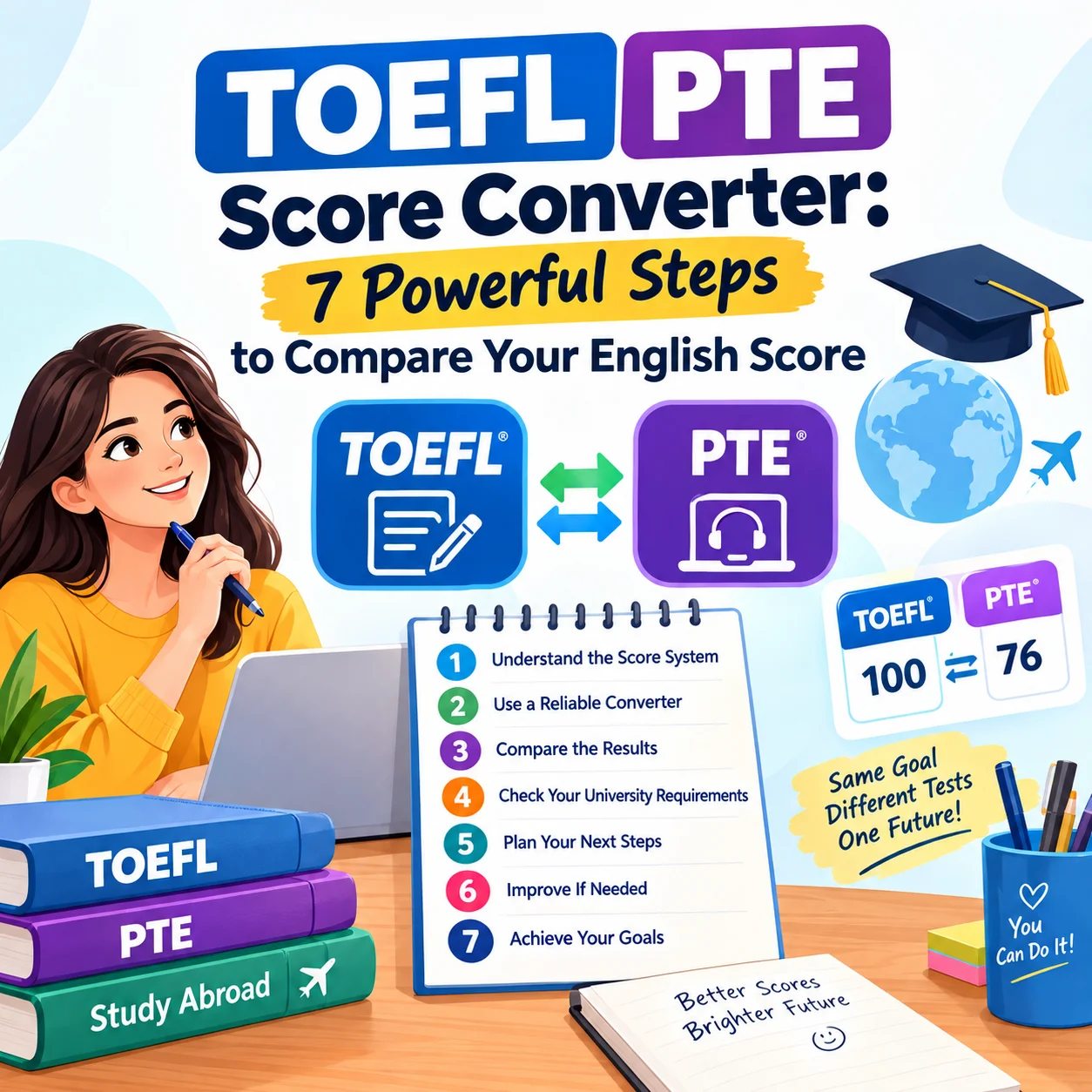
What Is a TOEFL PTE Score Converter and Why Does It Matter?
A TOEFL PTE Score Converter helps students estimate how a TOEFL iBT score relates to a PTE Academic score using published concordance information. It is especially useful when a university, scholarship, or education program lists an English-language requirement for one test but you have taken the other.
The important point is that a score converter provides an estimated comparison, not an official replacement score. Pearson states that concordance between tests contains measurement error because the examinations do not measure exactly the same construct.
For students preparing international applications, this distinction can prevent an expensive mistake. A converted score can help you understand your approximate level, but the university or organization you are applying to decides which tests and scores it accepts.
Why Are Students Searching for a TOEFL PTE Conversion?
Students commonly need a conversion when:
- A university publishes a TOEFL requirement but they have a PTE score.
- A program lists PTE Academic requirements but the student has TOEFL iBT results.
- A scholarship application asks for evidence of English proficiency.
- A student wants to compare two previous test results.
- An applicant is deciding which English test to take next.
- A counselor needs a quick approximate comparison.
The converter makes the first comparison easier without requiring students to manually study lengthy score tables.
What Does the Converter Actually Tell You?
The calculator estimates the corresponding score range between TOEFL iBT and PTE Academic based on published concordance information.
It does not determine admission eligibility, scholarship eligibility, visa eligibility, or university acceptance.
That decision always depends on the official requirements of the relevant institution or authority.
What Are TOEFL iBT and PTE Academic?
TOEFL iBT and PTE Academic are standardized English-language proficiency tests used for academic and other purposes. They use different scoring systems, so their numbers cannot be compared directly without a concordance framework.
What Is the TOEFL iBT?
TOEFL iBT is an English-language proficiency test developed by ETS and measures Reading, Listening, Speaking, and Writing skills.
Since January 21, 2026, TOEFL iBT score reports use a 1–6 scale in half-point increments. During a two-year transition period, score reports also provide a comparable overall score on the previous 0–120 scale.
This change is particularly important for students reading older TOEFL requirements.
If a university page still refers to a traditional TOEFL score such as 80, 90, or 100, check the institution's current admissions instructions before interpreting the requirement.
What Is PTE Academic?
PTE Academic is Pearson's computer-based English-language test for academic and related purposes.
Its overall score is reported on a 10–90 scale, with the score report also providing individual skill scores for Speaking, Writing, Reading, and Listening.
Because the PTE and TOEFL scales are different, a score of 70 on one test does not mean the same thing as 70 on the other.
That is exactly where a concordance-based converter becomes useful.
What Is the Difference Between TOEFL and PTE Scores?
The biggest difference is the scoring scale and reporting system.
| Feature | TOEFL iBT | PTE Academic |
|---|---|---|
| Test provider | ETS | Pearson |
| Main skills | Reading, Listening, Speaking, Writing | Reading, Listening, Speaking, Writing |
| Traditional overall scale | 0–120 | 10–90 |
| Current TOEFL reporting | 1–6, with comparable 0–120 score during transition | 10–90 |
| Individual skill scores | Yes | Yes |
| Score validity | 2 years | 2 years |
ETS confirms that TOEFL iBT scores remain valid for two years from the test date. Pearson likewise states that PTE Academic Score Reports are valid for two years from the test date.
Why Can't You Simply Divide or Multiply Scores?
The two tests are designed and scored differently.
A mathematical formula such as “PTE × 1.5 = TOEFL” would create a false sense of precision. Published concordance tables are based on research rather than a simple arithmetic conversion.
Pearson specifically cautions that predicting a score on one test from another contains measurement error.
That is why this calculator should be treated as an estimate for comparison, not as an official score-equating service.
How Does the TOEFL PTE Score Converter Work?
The calculator uses a published score-concordance relationship to provide an approximate comparison between the two scoring systems.
Step 1: Select Your Test
Start by identifying the score you actually received.
Choose TOEFL if your official result is from TOEFL iBT. Choose PTE if your result is from PTE Academic.
Do not mix PTE Academic with another PTE product unless the calculator specifically supports it.
Step 2: Enter Your Score
Enter your overall score exactly as shown on your score report.
For example, a student might enter a PTE Academic overall score of 70 or a traditional TOEFL iBT total score of 90.
Avoid entering a section score when the calculator asks for the overall score.
Step 3: Select the Conversion Direction
Choose the result you want to estimate.
For example:
PTE → TOEFL
or
TOEFL → PTE
This tells the converter which corresponding score information to display.
Step 4: Review the Estimated Result
The calculator will show an approximate corresponding score.
Remember that a concordance result is not necessarily an exact one-to-one equivalent. Pearson's published table itself includes ranges and “no data” areas for some scores.
Step 5: Compare the Result With Your Requirement
Now look at the official university, scholarship, or program requirement.
For example, imagine a university says that applicants need a particular TOEFL score but you have a PTE Academic result.
The converter can help you understand the approximate relationship, but you should not assume that the university will automatically accept your PTE score.
Step 6: Check the Official Admissions Page
This is the most important step after using any score converter.
Confirm:
- Accepted English tests
- Minimum overall score
- Minimum section scores
- Test version
- Score validity period
- Application deadline
- Score-reporting procedure
Universities can set their own requirements, and Pearson advises applicants to confirm specific requirements with their institution.
Step 7: Use the Result as a Planning Tool
Use the converted result to decide your next practical action.
You might need to send your existing score, take another test, improve a particular skill, or contact the admissions office for clarification.
How to Use This TOEFL PTE Converter?
Use the calculator below to estimate the relationship between your TOEFL iBT and PTE Academic score.
What Information Should You Enter?
Enter the overall score requested by the calculator.
Use the score from your official result rather than a practice-test estimate whenever possible.
If you have only section scores, first determine whether the calculator supports section-level conversion. Do not substitute an individual Reading, Listening, Speaking, or Writing score for an overall score.
Example: Converting a PTE Score
Suppose a student has a PTE Academic overall score of 70.
The student can enter 70 into the PTE-to-TOEFL direction of the calculator and review the estimated TOEFL equivalent.
Pearson's published concordance table places PTE Academic 70 alongside a TOEFL iBT range of approximately 102, under the older 0–120 TOEFL scale.
The result should still be checked against the university's current requirements.
Example: Converting a TOEFL Score
Suppose another student has a traditional TOEFL iBT score of 90.
Pearson's published concordance table associates TOEFL iBT 90 with approximately PTE Academic 61.
This demonstrates why looking only at the numerical value can be misleading. The two scales use completely different score ranges.
What TOEFL PTE Conversion Table Can You Use?
Pearson has published a concordance table between PTE Academic and TOEFL iBT.
Some examples from the published table include:
| TOEFL iBT | Approximate PTE Academic |
|---|---|
| 120 | 84 |
| 115–116 | 80 |
| 110–111 | 76 |
| 105 | 72 |
| 102 | 70 |
| 99–100 | 68 |
| 95–96 | 65 |
| 91–92 | 62 |
| 90 | 61 |
| 87–88 | 59 |
| 85 | 57 |
| 83–84 | 56 |
| 79–80 | 53 |
| 76–77 | 51 |
| 72–73 | 49 |
| 70–71 | 48 |
| 65–66 | 46 |
| 60–62 | 44 |
| 54–56 | 42 |
| 48–51 | 40 |
| 40–44 | 38 |
These values come from Pearson's published concordance information and should be treated as estimates rather than guarantees of institutional acceptance.
Why Are Some Scores Shown as Ranges?
A range can represent several scores that correspond approximately to another test score.
For example, the published table maps TOEFL 95–96 to PTE 65.
That does not mean every person who receives either score has identical English proficiency. It means the research found a useful statistical relationship between the score scales.
What Are the Main Limitations of a Score Converter?
A score converter is helpful, but it has clear limitations.
A Converted Score Is Not an Official Score
A university does not normally treat a calculator-generated conversion as a replacement for an official test result.
If the university requires PTE Academic, submitting a converted TOEFL estimate may not satisfy the requirement.
Different Tests Measure Skills Differently
TOEFL and PTE both assess the four major English skills, but their tasks, scoring systems, test design, and delivery methods differ.
Pearson explicitly notes that the tests do not measure exactly the same construct.
Universities Set Their Own Requirements
There is no universal “passing score” established by TOEFL for every university.
ETS states that institutions set their own TOEFL score requirements.
Therefore, a conversion result cannot tell you by itself if you qualify for a specific course.
Requirements Can Change
Universities may update accepted tests, minimum scores, section requirements, or test-version rules.
Always use the current admissions page for your target program.
What Common Mistakes Should Students Avoid?
Mistake 1: Treating the Conversion as Exact
The first mistake is assuming that a converted score has the same status as an official result.
Use the number for orientation, not as proof of eligibility.
Mistake 2: Confusing Overall and Section Scores
A university might require both an overall score and minimum scores in individual skills.
A student who meets the overall requirement could still fall below a required Speaking, Writing, Reading, or Listening threshold.
Mistake 3: Using an Outdated TOEFL Scale Without Checking the Date
TOEFL changed its reporting scale on January 21, 2026.
Current score reports use the 1–6 scale, while the comparable 0–120 score is being provided during the transition period.
Students should therefore check the date of their TOEFL test and the format used by the university's requirement.
Mistake 4: Assuming Every PTE Product Is the Same
PTE Academic and other PTE products can have different purposes and acceptance rules.
For example, Pearson distinguishes PTE Academic from PTE Academic UKVI, with UKVI being relevant to certain UK visa applications.
Check the exact test name requested by the institution or immigration authority.
Mistake 5: Waiting Until the Deadline to Verify Scores
An applicant who discovers a test mismatch shortly before an application deadline may have limited options.
Check language requirements before booking the test and again before submitting the application.
Read more: University of Gujrat (UOG) CGPA Calculator — 7 Powerful Steps to Calculate Your CGPA Accurately
What Tips Can Help You Get Better Results From the Calculator?
Start With the Official Requirement
Do not begin with the question, “What TOEFL score equals my PTE score?”
Start with, “What English test and score does my target program officially require?”
Then use the converter to understand your existing result.
Keep Your Score Report Available
Having the official score report nearby reduces simple entry mistakes.
Check the overall score, section scores, test date, and exact test name.
Check Section Requirements Separately
An overall conversion can hide an important section-level issue.
If a program specifies minimum Speaking or Writing scores, compare those requirements using the institution's own guidance.
Leave Time for a Retake
If your current result does not satisfy the official requirement, plan ahead.
A retake may require preparation time, registration availability, and additional score-reporting time.
Confirm Before Spending Money
Before registering for another test, contact the university or check its official admissions page.
A short verification can prevent paying for a test that the program does not accept.
How Can the Converter Help With Scholarships?
A TOEFL PTE Score Converter can help scholarship applicants understand their approximate English proficiency position when scholarship information references a different test.
However, it does not establish scholarship eligibility.
Check the Scholarship's Exact Language Requirement
Scholarship organizations may specify an accepted test, minimum score, minimum section result, or alternative evidence of English proficiency.
Read the current scholarship instructions carefully.
Keep Academic Requirements Separate
English proficiency is only one possible application requirement.
A scholarship may also consider academic qualifications, financial criteria, citizenship, study level, institution, field of study, documents, or application timing.
Do not use an English-score conversion as a substitute for checking the full eligibility criteria.
Verify Before Submission
If the scholarship instructions mention only TOEFL and you have PTE, ask the scholarship provider whether PTE Academic is accepted.
Do not assume that a published concordance automatically means the scholarship accepts the alternative test.
What Documents Should Students Prepare?
The exact documents depend on the university, scholarship, or program.
Common application materials may include:
- Official English-language test score report
- Academic transcripts
- Degree or enrollment documents
- Passport or identification document
- Personal statement or study plan
- Recommendation letters, if required
- Proof of financial information, when applicable
- Scholarship-specific forms
[VERIFY BEFORE PUBLISHING] Exact document requirements should be replaced with the current requirements of the specific institution or scholarship before publication.
How Long Are TOEFL and PTE Scores Valid?
Both TOEFL iBT and PTE Academic generally have a two-year validity period from the test date.
ETS states that TOEFL iBT scores are valid for two years. Pearson states that PTE Academic scores are valid for two years from the test date.
Why Does the Test Date Matter?
Suppose you took an English test long before applying.
Even if your English ability has remained strong, an institution may require a valid score within its specified period.
Always check the program's current policy rather than relying only on the general validity period.
Frequently Asked Questions About TOEFL PTE Score Conversion
Is TOEFL 90 equal to PTE 61?
Pearson's published concordance table associates a traditional TOEFL iBT score of 90 with a PTE Academic score of approximately 61. This is a research-based comparison, not an official score transformation. A university can still require a different test or minimum score.
Is PTE 70 equal to TOEFL 100?
PTE Academic 70 is associated with a TOEFL iBT score of approximately 102 in Pearson's published concordance table. Therefore, calling it exactly “TOEFL 100” would oversimplify the published relationship. Always check the current requirement of your institution.
Can I submit a converted score instead of taking TOEFL?
A calculator-generated conversion does not normally replace an official English-language test score. If an institution specifically requires TOEFL iBT, ask its admissions office if it accepts PTE Academic or another test instead. The institution's current admissions policy is the controlling requirement.
Is PTE accepted by universities?
PTE Academic is accepted by many universities, but acceptance varies by institution, program, country, and test version. Pearson advises students to confirm the requirements of their chosen institution before applying.
Does TOEFL PTE conversion guarantee admission?
No. A score conversion cannot guarantee admission, scholarship selection, visa approval, or acceptance of an alternative English test. It only provides an approximate comparison between score scales. Academic requirements, English-test rules, documents, deadlines, and other admission conditions must be checked separately.
What Should You Do After Using the Converter?
The best next step is to compare your estimated result with the official requirement for your exact university, course, scholarship, or visa pathway.
If the requirement is unclear, contact the relevant admissions or scholarship office before submitting an application.
For international students, this small verification step can be more valuable than relying on a generic conversion table.
Final Takeaway: Use the Converter as a Smart Planning Tool
A TOEFL PTE Score Converter makes it easier to understand the approximate relationship between two different English-language score systems.
The most important lesson is simple: conversion is not acceptance.
Use the calculator to understand your approximate score relationship, then verify the official test, score, section requirements, validity rules, and application instructions for your target program.
Your next step is to check the official requirements and use the calculator above to estimate your TOEFL-to-PTE or PTE-to-TOEFL score relationship.
Last Updated
Last Updated: September 2026
Requirements, deadlines, accepted tests, score scales, and eligibility rules may change. Always confirm the latest information from the official organization before making application decisions.
Disclaimer
Information provided in this article is for educational purposes only and should be verified with the official organization before making application decisions. A score conversion is an estimate and does not guarantee admission, scholarship eligibility, visa approval, or acceptance of an alternative English-language test.
Disclosure: This website may earn revenue through advertising or affiliate partnerships. This does not influence our recommendations.
About the Author
Author: Ashes Jhon
This article is written for students and education seekers who need clear guidance when comparing English-language test scores.
Reviewed by: [Name/Role Placeholder]
“Reviewed for accuracy by an education professional specializing in scholarships and academic guidance.”







0 Comments