
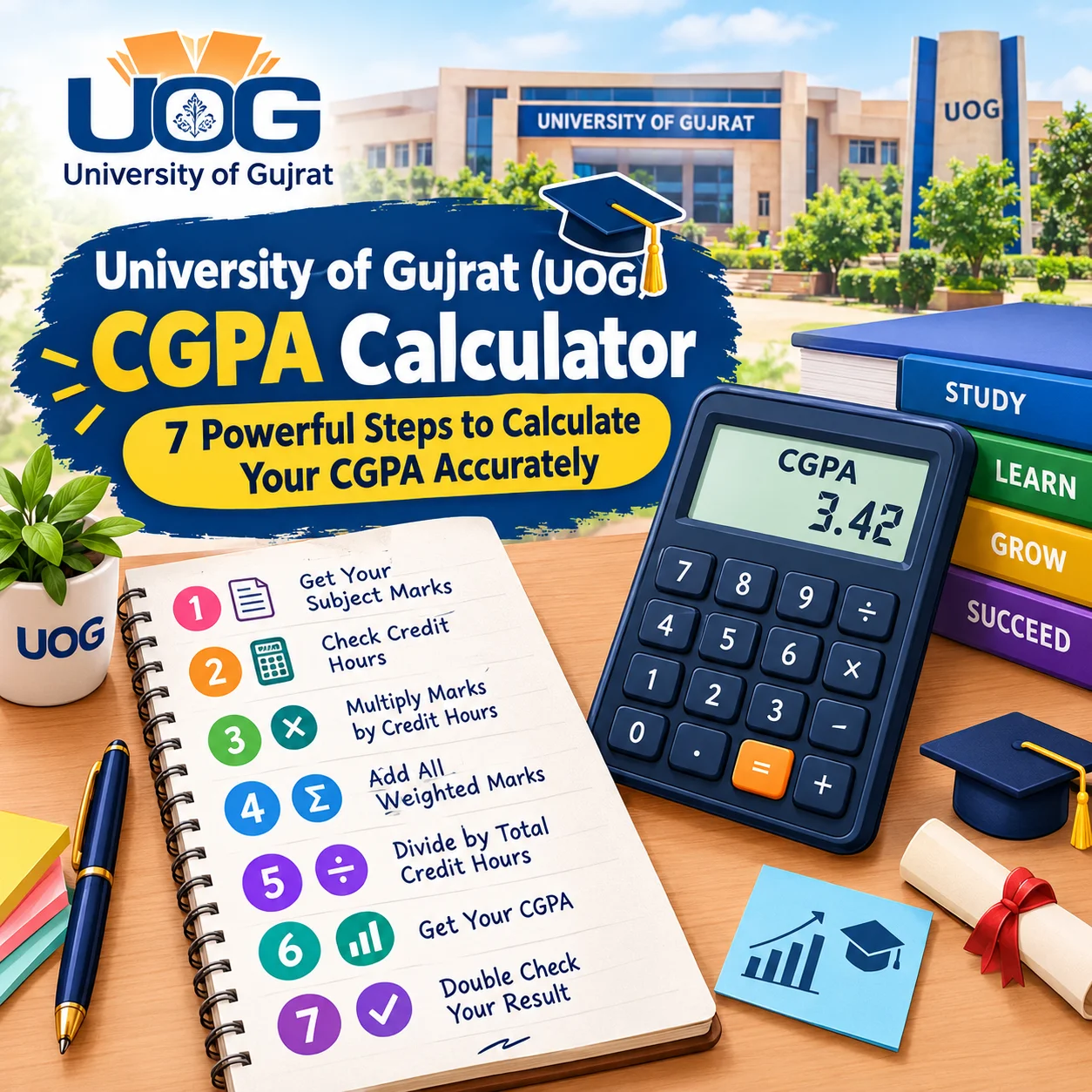
What Is the University of Gujrat CGPA Calculator?
The University of Gujrat (UOG) CGPA Calculator is a simple academic tool that helps students calculate their Grade Point Average and cumulative CGPA from course grades and credit hours. It is especially useful for UOG students who want to understand their semester performance, track academic progress, or estimate their cumulative result.
The calculator works on the basic principle of assigning grade points to courses and weighting those points according to credit hours. HEC's semester-system guidance describes CGPA as the total of course credit hours multiplied by grade points, divided by the total credit hours taken. (Higher Education Commission)
For students planning admissions, scholarships, or future studies, an accurate CGPA can provide a useful picture of academic standing. However, a calculator should be treated as an estimation and not as a replacement for the official transcript issued by the university.
Why Do Students Need a UOG CGPA Calculator?
Students often know their individual course grades but find it difficult to determine their overall academic average.
This becomes more confusing after several semesters because courses can have different credit hours. A three-credit-hour course should not have exactly the same effect on CGPA as a one-credit-hour course.
A calculator simplifies that process by applying the credit-hour weighting consistently.
What Does CGPA Mean?
CGPA stands for Cumulative Grade Point Average.
It represents a student's overall academic performance across the courses included in the calculation. Unlike a single-semester GPA, CGPA considers results accumulated across multiple semesters.
The exact academic rules, grading arrangements, and treatment of particular courses should always be checked against the applicable UOG regulations and the student's official transcript.
How to Use the UOG CGPA Calculator?
The easiest way to calculate your academic average is to enter each course's credit hours and corresponding grade point into the calculator.
Use the calculator here:
Step 1: Collect Your Course Information
Before entering anything, open your latest UOG transcript or result information.
For each course, identify:
- Course name
- Credit hours
- Letter grade
- Grade point, if provided
- Semester information, if required by the calculator
Having the transcript beside you reduces the chance of entering incorrect information.
Step 2: Enter the Credit Hours
Enter the number of credit hours for each course.
For example, if one course carries 3 credit hours, enter 3 in the appropriate field.
Credit hours matter because they determine how strongly a course contributes to the weighted GPA calculation.
Step 3: Enter the Grade or Grade Point
Enter the grade or grade point shown on your academic record.
Do not convert percentages into grade points using a random online conversion table. Different institutions can use different grading and conversion rules.
If your transcript already provides a grade point, use the official figure.
Step 4: Add All Relevant Courses
Continue adding courses until you have entered all courses required for your calculation.
For a semester GPA, use the courses from that semester.
For a cumulative calculation, include the courses that are supposed to be included under the applicable academic rules.
Step 5: Check Your Entries
Before calculating, review every number.
A single incorrect credit-hour value can change the result. This is especially important when comparing your result with your official transcript.
Step 6: Calculate Your Result
After entering the required information, select the calculator's calculate option.
The tool should use the entered credit hours and grade points to produce the calculated academic average.
The general weighted calculation is:
CGPA = Total Quality Points ÷ Total Credit Hours
Quality points are calculated by multiplying a course's credit hours by its grade point.
Step 7: Compare the Result With Your Official Record
Use the calculator as a checking and planning tool.
If your calculated figure differs from the official transcript, do not automatically assume the calculator is wrong or that the university record is wrong. Check the grading scale, repeated courses, excluded courses, transferred credits, rounding rules, and any applicable UOG regulations.
How Does a CGPA Calculation Work?
A CGPA calculation is based on weighted academic performance rather than simply averaging course grades.
The Basic CGPA Formula
The general formula is:
CGPA = Σ(Credit Hours × Grade Point) ÷ Σ(Credit Hours)
Suppose a student has the following illustrative results:
| Course | Credit Hours | Grade Point |
|---|---|---|
| Course A | 3 | 3.00 |
| Course B | 3 | 3.50 |
| Course C | 2 | 4.00 |
| Course D | 3 | 2.50 |
The quality points would be:
- Course A: 3 × 3.00 = 9.00
- Course B: 3 × 3.50 = 10.50
- Course C: 2 × 4.00 = 8.00
- Course D: 3 × 2.50 = 7.50
Total quality points = 35.00
Total credit hours = 11
Therefore:
CGPA = 35 ÷ 11 = 3.18
This is an illustrative example only. It does not establish the grading scale or academic rules applicable to every UOG program.
Why Credit Hours Matter
Imagine two courses have different grades, but one is worth three credit hours and the other is worth one.
The three-credit-hour course has a larger effect on the weighted average. That is why simply adding grades and dividing by the number of subjects can produce an inaccurate result.
What Information Should You Enter Into the Calculator?
The calculator requires reliable academic information because the quality of the result depends on the accuracy of your inputs.
Course Credit Hours
Credit hours tell the calculator how much weight a course carries.
Always copy the credit hours from your official course information rather than estimating them.
Grade Points
Grade points are numerical values associated with academic grades.
If your official record gives grade points, use those values rather than trying to recreate them from memory.
Completed Courses
For a semester calculation, enter the courses belonging to that semester.
For a cumulative calculation, use the courses that your academic regulations require for cumulative performance.
Repeated or Improved Courses
Repeated courses require special attention.
Do not assume that every university handles repeated courses in exactly the same way. The treatment of an improved, repeated, failed, or replaced course can affect the calculation.
For an official academic decision, consult the applicable UOG regulations or your department.
What Is the Difference Between GPA and CGPA?
GPA and CGPA measure academic performance over different periods.
GPA
GPA generally refers to the grade point average for a specific academic period, such as one semester.
It can help students identify how they performed recently.
CGPA
CGPA represents cumulative academic performance across the courses included in the calculation.
A strong semester can improve a student's cumulative result, but the effect depends on the student's existing credit hours and previous performance.
Quick Comparison
| Feature | GPA | CGPA |
|---|---|---|
| Coverage | Usually one semester or period | Multiple academic periods |
| Purpose | Measures recent performance | Measures cumulative performance |
| Credit hours | Important | Important |
| Useful for tracking | Semester progress | Overall academic progress |
| Official result | Check transcript | Check transcript |
Why Is Your CGPA Important for University Planning?
Your CGPA can be relevant to academic progression, applications, scholarships, internships, and postgraduate admissions.
However, the required academic threshold is not universal.
Postgraduate Admissions
UOG's published admission material shows that CGPA requirements can differ according to the program and level of study. For example, its graduate admission information has used 2.50/4.00 as a minimum for certain MS/MPhil admission criteria, while published PhD criteria specify a minimum 3.00/4.00 in the semester system for the stated eligibility route. (University of Gujrat)
These figures should not be treated as a universal UOG requirement for every program or admission cycle.
Scholarship Applications
Scholarship organizations may establish their own academic eligibility requirements.
A student's CGPA can therefore be important, but meeting a particular CGPA threshold does not automatically guarantee scholarship selection.
Always read the current scholarship announcement and its official eligibility criteria.
Academic Planning
CGPA can also help you evaluate your academic progress.
If your current result is below your personal target, you can use the calculation to understand how future semesters could affect your cumulative average.
What Are Common CGPA Calculation Mistakes?
Small data-entry mistakes can create surprisingly different results.
Mistake 1: Averaging Grades Without Credit Hours
A common mistake is to add grade points and divide by the number of subjects.
This ignores the different credit-hour weights of courses.
Use the weighted formula instead.
Mistake 2: Using the Wrong Grade Scale
Students sometimes find a grading chart online and assume it applies to their university.
That can produce an incorrect result.
Use the grading information applicable to your program and academic record.
Mistake 3: Confusing GPA With CGPA
A semester GPA is not automatically your cumulative CGPA.
The two calculations can cover different sets of courses.
Mistake 4: Entering Incorrect Credit Hours
A course entered as four credit hours instead of three can significantly alter the weighted calculation.
Check every course against your transcript.
Mistake 5: Ignoring Repeated Courses
Repeated or improved courses can involve specific academic rules.
If your record contains such courses, verify how they should be treated before relying on a self-calculated result.
Mistake 6: Treating the Calculator as an Official Transcript
An online calculator estimates a result from the information entered into it.
Your university transcript remains the appropriate official academic record.
How Can You Improve Your CGPA?
Improving CGPA requires attention to both grades and credit-hour distribution.
Focus on High-Credit Courses
A high-credit course can have a greater effect on your weighted academic average.
That makes proper preparation for major courses particularly important.
Monitor Your Performance Every Semester
Do not wait until graduation to check your academic position.
Calculate your semester GPA and review your cumulative progress regularly.
This gives you more time to identify subjects that need additional attention.
Understand Your Course Assessment
Before examinations, review the assessment structure for each course.
Assignments, quizzes, presentations, midterms, practical work, and final examinations can all contribute to the final grade depending on the applicable course rules.
Ask for Academic Guidance Early
If your performance is falling behind your target, speak with the relevant instructor, academic adviser, or department.
Early guidance is generally more useful than waiting until the final semester.
How Can Students Use CGPA for Scholarship Planning?
CGPA can be one part of a scholarship application, but scholarship decisions usually depend on the specific program's published requirements.
Read the Official Eligibility Criteria
Check the scholarship provider's current announcement.
Look specifically for:
- Minimum CGPA
- Required degree level
- Enrollment status
- Financial criteria
- Required documents
- Application deadline
- Nationality or residency requirements
- Other academic conditions
Never rely solely on an old social-media post or an unofficial website.
Prepare Your Academic Documents
Keep accessible copies of relevant documents such as:
- Academic transcript
- Degree or enrollment evidence
- Identification documents where required
- Scholarship application forms
- Supporting financial documents where applicable
The exact requirements vary by scholarship.
Do Not Assume One CGPA Rule Applies Everywhere
One scholarship might specify a minimum CGPA while another may use percentage, class/division, or another academic criterion.
Always follow the current official instructions.
What Should You Do If Your Calculated CGPA Looks Wrong?
First, check your input data.
Check the Credit Hours
Compare every credit-hour value with your transcript or official course record.
Check Grade Points
Make sure the grade points correspond to the correct grading system.
Check Course Treatment
Look for repeated courses, transferred courses, withdrawals, incomplete grades, or other unusual entries.
Check Rounding
Your calculator may display more or fewer decimal places than the university transcript.
A small difference caused by rounding does not necessarily indicate a substantive academic discrepancy.
Contact the Appropriate UOG Office
If the difference remains unexplained, ask the relevant UOG academic or examination office for clarification.
The University of Gujrat publicly lists its Revised Semester System Rules 2025 and Semester System Rules among its university policies, so students should consult the applicable official rules when an academic calculation requires formal verification. (University of Gujrat)
What Are the Best Tips for Using a CGPA Calculator?
Keep Your Transcript Nearby
Entering information directly from your academic record reduces errors.
Calculate Before Important Applications
If you are preparing for admission or a scholarship, check your academic figures before submitting an application.
Save Your Semester Results
Keeping a simple record of semester GPA, credit hours, and cumulative CGPA makes future calculations easier.
Never Guess Missing Information
If your transcript does not clearly show a value, verify it with the appropriate university source.
Use Official Requirements for Decisions
A calculator can tell you what your entered data produces.
It cannot determine scholarship eligibility, admission eligibility, degree completion, or academic approval.
Frequently Asked Questions About the UOG CGPA Calculator
Is the University of Gujrat CGPA Calculator official?
The calculator provided on this page is a calculation tool and should not be confused with an official UOG transcript or academic decision. Students should compare important results with their official university records and applicable UOG rules.
How is CGPA calculated?
CGPA is generally calculated by multiplying each course's credit hours by its grade point, adding the resulting quality points, and dividing by total credit hours. HEC's semester-system guidance gives this weighted approach for CGPA calculation. (Higher Education Commission)
Can I calculate my semester GPA with this calculator?
Yes, a CGPA calculator can also be useful for a semester-level calculation when the tool accepts the courses from one semester. Enter only the relevant semester's courses and credit hours when calculating a semester GPA.
Can I use my CGPA for scholarship applications?
You can use your official CGPA when a scholarship application asks for it. However, the calculator result itself does not establish scholarship eligibility. Always compare your academic result with the scholarship provider's current official requirements.
Why is my calculated CGPA different from my transcript?
Differences can result from incorrect credit hours, grade points, repeated-course treatment, transferred credits, excluded courses, or rounding rules. If you cannot identify the difference, consult the applicable UOG academic rules or the relevant university office.
Final Takeaway: Use Your CGPA as a Planning Tool
The University of Gujrat (UOG) CGPA Calculator can make academic calculations much easier by applying credit-hour weighting to your course results.
Its biggest practical benefit is not simply producing a number. It helps students understand how individual courses contribute to overall academic performance and gives them a clearer way to monitor progress.
For the most reliable result, enter information directly from your academic record and check unusual cases against the applicable UOG rules.
If you are preparing for admission, scholarship applications, or academic planning, use the calculator above first, then verify important eligibility requirements through the relevant official source.
Official Sources and Verification
For current academic policies, students should prioritize official University of Gujrat and Higher Education Commission information.
- University of Gujrat — Official Website
- University of Gujrat Academic Programs
- University of Gujrat Graduate Admission Policy
- HEC Undergraduate Education Policy
- HEC Semester System Examination Guidelines
Last Updated
Last Updated: September 2026
Requirements, academic regulations, deadlines, and eligibility criteria may change. Always confirm the latest information from the University of Gujrat, HEC, or the relevant scholarship provider before making an academic or application decision.
Disclaimer
Information provided in this article is for educational purposes only and should be verified with the official organization before making application, admission, scholarship, or academic decisions.
Disclosure: This website may earn revenue through advertising or affiliate partnerships. This does not influence our recommendations.
Author and Review Information
Author: Ashes Jhon
Reviewed by: [Education Professional Name/Role Placeholder]
Reviewed for accuracy by an education professional specializing in scholarships and academic guidance.







0 Comments