
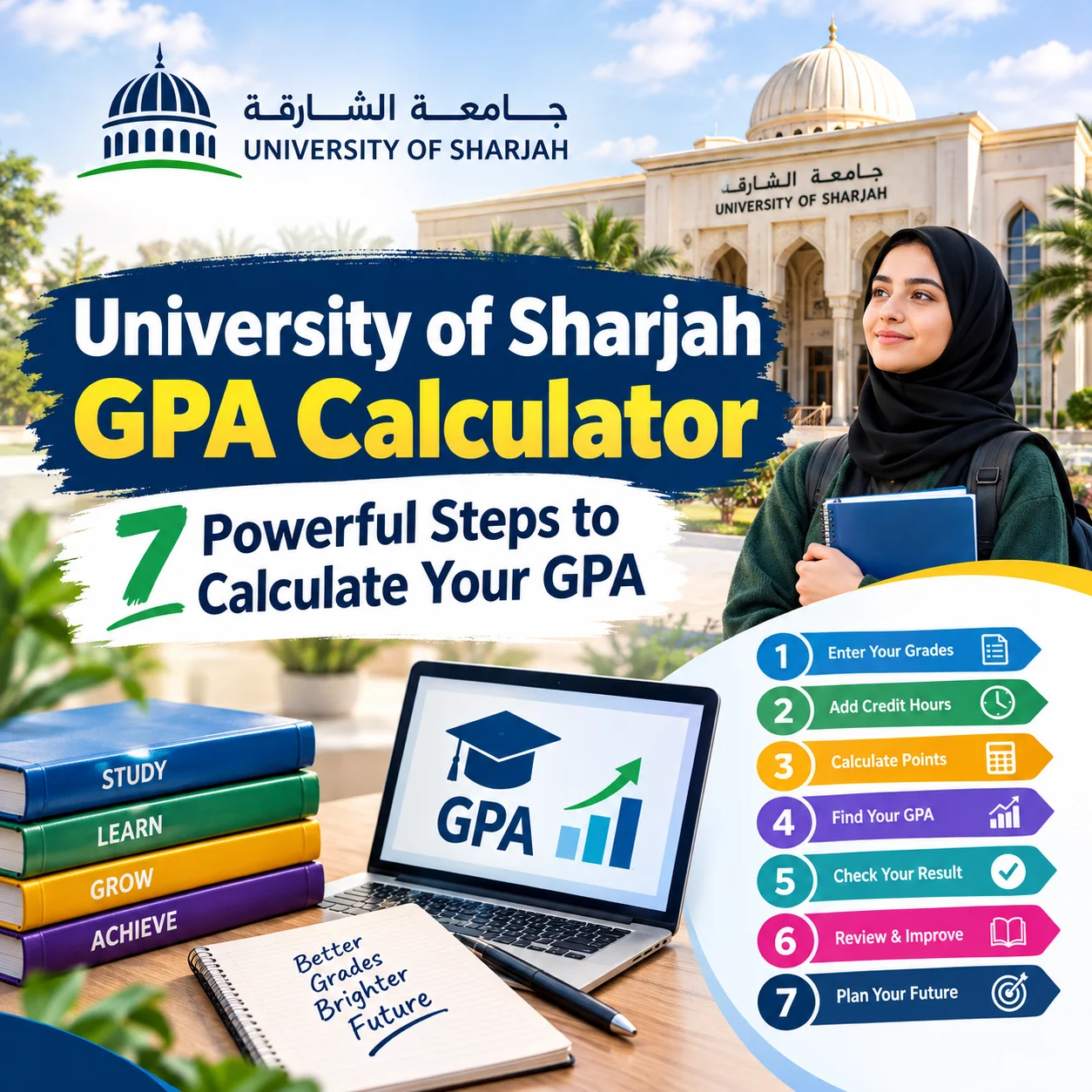
What Is the University of Sharjah GPA Calculator?
The University of Sharjah GPA Calculator helps students estimate their semester GPA or cumulative GPA by combining course grades with credit hours. The University of Sharjah uses a four-point grading system for diploma, undergraduate, and postgraduate programs, although passing requirements can differ by academic level.
For students, the calculator is useful because GPA calculations can become confusing when several courses have different credit hours or when a course has been repeated. Instead of calculating every course manually, you can enter your academic information and quickly review the resulting average.
The University of Sharjah's official Registration Department also provides a CGPA calculator that uses course credit hours and grades to calculate GPA information.
Why Do Students Use a GPA Calculator?
Students use a GPA calculator to understand their academic standing, estimate a semester result, check cumulative progress, and explore how expected grades could affect their overall average.
A calculator can also make academic planning easier. For example, if you know your current CGPA and the credit hours you plan to take, you can estimate the effect of different grades before final results are released.
What Does GPA Mean at the University of Sharjah?
GPA generally refers to the average grade points earned during a particular semester, while CGPA represents the cumulative average across the student's courses to that point.
According to the University of Sharjah, the average is calculated by multiplying the grade points for each course by its credit hours and dividing the total by the applicable credit hours.
This means a three-credit course can have a greater effect on the calculation than a one-credit course.
How Does the University of Sharjah Grading System Work?
The University of Sharjah uses a four-point grading system for diploma, undergraduate, and postgraduate programs. However, the passing grade varies by academic level, so students should check the rules applicable to their specific program.
University of Sharjah Undergraduate Grade Scale
For semester-based undergraduate and postgraduate diploma programs, the 2025–2026 University of Sharjah catalog lists the following grade-point scale:
| Letter Grade | Grade Points | Percentage Range |
|---|---|---|
| A | 4.0 | 90–100 |
| B+ | 3.5 | 85 to less than 90 |
| B | 3.0 | 80 to less than 85 |
| C+ | 2.5 | 75 to less than 80 |
| C | 2.0 | 70 to less than 75 |
| D+ | 1.5 | 65 to less than 70 |
| D | 1.0 | 60 to less than 65 |
| F | 0.0 | Below 60 |
The current University catalog also identifies different minimum passing grades for different levels: D for bachelor's and postgraduate diploma programs, C+ for master's programs, and B for doctoral programs.
How Are GPA Categories Described?
For the semester-based scale, the 2025–2026 University of Sharjah catalog describes GPA ranges as follows:
| GPA Range | University Designation |
|---|---|
| 3.60–4.00 | Excellent |
| 3.00–less than 3.60 | Very Good |
| 2.50–less than 3.00 | Good |
| 2.00–less than 2.50 | Satisfactory |
| Less than 2.00 | Fail |
These classifications should not be confused with admission, scholarship, graduation, or program-specific requirements. A particular opportunity may impose its own academic criteria.
How Is GPA Calculated at the University of Sharjah?
The University of Sharjah GPA calculation uses grade points and credit hours. Each course's grade points are multiplied by its credit hours, and the resulting values are divided by the relevant total credit hours.
The Basic GPA Formula
The basic calculation can be expressed as:
GPA = Total Grade Points ÷ Total Credit Hours
For each course:
Course Grade Points = Grade Points × Credit Hours
Consider a simple example:
| Course | Credit Hours | Grade | Grade Points | Quality Points |
|---|---|---|---|---|
| Course 1 | 3 | A | 4.0 | 12.0 |
| Course 2 | 3 | B+ | 3.5 | 10.5 |
| Course 3 | 3 | B | 3.0 | 9.0 |
| Course 4 | 3 | C+ | 2.5 | 7.5 |
| Total | 12 | — | — | 39.0 |
The estimated GPA is:
39 ÷ 12 = 3.25
This example demonstrates why simply averaging letter-grade points without considering credit hours can produce an incorrect result when courses have different credit values.
Why Credit Hours Matter
Credit hours determine how strongly a course contributes to the overall calculation.
For instance, a four-credit course with a 4.0 grade contributes 16 quality points, while a two-credit course with the same grade contributes 8 quality points.
That difference becomes important when students calculate a semester GPA manually.
How to Use the University of Sharjah GPA Calculator?
The University of Sharjah GPA Calculator can make the calculation process much easier when you have your course grades and credit-hour information available.
Use the calculator below to begin:
Step 1: Gather Your Academic Information
Before entering anything, collect your latest academic record, transcript, or course results.
You will generally need course names, credit hours, grades, and, for a cumulative calculation, information about your current academic standing.
Using your official academic record reduces the chance of entering an incorrect grade or credit value.
Step 2: Enter Your Current Grade Information
In University of Sharjah GPA calculator enter the courses you want to include in the calculation and select the appropriate grades.
Check each entry carefully. A small input error can change the final result, especially when the affected course has several credit hours.
Step 3: Add the Correct Credit Hours
Enter the credit hours assigned to each course.
Do not assume every course carries the same number of credits. Your official course or academic record should be the reference point.
Step 4: Check Repeated Courses
Repeated courses require additional attention because the University of Sharjah has specific rules for repeated courses.
The University of Sharjah CGPA calculator guidance states that when a course is repeated, the higher grade is counted, while the courses and grades remain visible on the transcript with special coding.
If your situation involves a repeated course, review the official university calculation rules rather than manually assuming that both attempts should be included.
Step 5: Review Your Entries
Before calculating, check:
- Course names
- Credit hours
- Letter grades
- Repeated-course information
- Current grade points, if applicable
- Previous GPA or CGPA information when required
This short review can prevent avoidable calculation mistakes.
Step 6: Calculate Your GPA
After entering the required information, use the calculator's calculation function.
The result provides an estimate based on the information entered. The University's official calculation method uses grade points weighted by credit hours.
Step 7: Compare the Result With Your Academic Record
Use the calculated result as a planning and checking tool.
Your official transcript and university academic record remain the appropriate sources for your formally recorded GPA or CGPA. If your calculator result differs from your official record, investigate the difference instead of assuming the calculator is authoritative.
What Is the Difference Between GPA and CGPA?
GPA usually refers to performance within a specific semester, while CGPA covers cumulative academic performance over the relevant period of study.
Semester GPA
Semester GPA represents the average of the courses included for a particular semester.
For example, if you complete five courses during one semester, the semester GPA reflects the weighted grade-point performance of those courses.
Cumulative GPA
CGPA represents the cumulative average based on the courses included in the calculation up to that point.
The University of Sharjah states that CGPA includes the aggregate of points obtained in courses studied up to the calculation date, subject to the University's applicable rules.
The University's guidance also states that CGPA is rounded to the nearest two decimal places.
What Should You Check Before Using the Calculator?
The most important preparation is having accurate academic information.
Check Your Official Grades
Use grades from an official transcript, student record, or confirmed course result whenever possible.
Avoid calculating from memory, especially if you are reviewing several semesters.
Check Your Credit Hours
Credit hours are an essential part of the weighted calculation.
A wrong credit-hour entry can produce a noticeably different result, so verify the number for each course.
Check Your Program Level
University of Sharjah requirements can differ between bachelor's, postgraduate diploma, master's, and doctoral programs.
The current university information identifies different passing thresholds for these levels.
What Common GPA Calculation Mistakes Should You Avoid?
Students often make calculation errors because GPA appears simpler than it actually is.
Mistake 1: Averaging Grades Without Credit Hours
Adding grade points together and dividing by the number of courses only works in limited situations where the relevant courses carry equal credit hours.
For weighted university GPA calculations, credit hours need to be considered.
Mistake 2: Entering the Wrong Letter Grade
A B+ and B do not carry the same point value under the University's four-point grading scale.
Always compare your entry with your official academic record.
Mistake 3: Treating Repeated Courses Incorrectly
Repeated courses can complicate CGPA calculations.
University of Sharjah's GPA calculator current guidance states that the higher grade is counted for a repeated course, while the transcript continues to show the course history.
Mistake 4: Confusing GPA With Admission Requirements
A calculated GPA does not automatically establish eligibility for admission, scholarships, graduation, or another academic opportunity.
Those requirements may depend on the specific program, college, scholarship, or institution.
Mistake 5: Ignoring Updated University Rules
Academic policies can change.
The University of Sharjah publishes current catalogs, regulations, and services through its official channels, so students should verify important academic decisions against the latest university information.
How Can You Improve Your GPA Calculation Accuracy?
Accurate inputs are more important than complicated calculations.
Keep a Semester Record
After each semester, record your courses, credit hours, grades, and official GPA.
A simple personal academic record makes future calculations much easier.
Use Your Transcript as the Reference
Your transcript provides the academic information you should use when checking a calculation.
If your personal estimate conflicts with the official record, contact the appropriate university office for clarification.
Separate Planning From Official Results
A GPA calculator is valuable for planning, estimating, and understanding academic performance.
It should not replace the official academic record when submitting information for a scholarship, application, transfer, graduation process, or other formal purpose.
Use Scenario Calculations Carefully
You can use expected grades to explore possible outcomes.
For example, you might calculate one scenario assuming an A in a three-credit course and another assuming a B+. This can help you understand the mathematical effect of different grades without treating an estimated result as guaranteed.
Can the Calculator Help With Academic Planning?
Yes. A GPA calculator can help students understand how individual courses contribute to their overall academic average.
Planning Your Next Semester
Suppose your current CGPA is lower than your target. You can use your current credit-hour information and possible future grades to understand how much improvement different results could produce.
The important point is to view these numbers as estimates.
Understanding the Impact of High-Credit Courses
A higher-credit course has more influence on the weighted average than a lower-credit course with the same grade.
Understanding this relationship can help students organize their study time around their actual academic workload.
Preparing for Scholarship Applications
Some scholarships may include academic requirements.
A GPA calculator can help you monitor your academic standing, but the scholarship provider's official eligibility rules should always be used to determine whether you meet a requirement.
What Does the University of Sharjah Official Calculator Include?
The University of Sharjah's Registration Department provides a CGPA Calculator service for students.
Its published user guide shows fields for total grade points and total credit hours, course information, credit hours, expected grades, and repeated-course information. It also provides options for calculating current, projected semester, and projected cumulative GPA.
Who Provides the Official Calculator?
The calculator is provided through the University of Sharjah's Registration Department.
The University's current service directory lists CGPA Calculator among the services provided by the Office of the Registrar.
For formal academic decisions, students should prioritize the University's own academic records and current regulations.
Read more: Universiti Teknologi MARA (UiTM) CGPA Calculator: 7 Powerful Steps to Calculate Your CGPA
Frequently Asked Questions
Is the University of Sharjah GPA calculated on a 4.0 scale?
Yes. The University of Sharjah states that it uses a four-point grading system for diploma, undergraduate, and postgraduate programs. The exact passing requirements depend on the academic level and applicable regulations.
How do I calculate my GPA at the University of Sharjah?
Multiply each course's grade points by its credit hours, add the resulting quality points, and divide by the applicable total credit hours. The University of Sharjah's official calculator follows this weighted approach.
How are repeated courses handled?
University of Sharjah guidance states that when a course is repeated, the higher grade is counted in the CGPA calculation. Previous attempts can remain visible on the transcript with special coding.
What is the difference between GPA and CGPA?
GPA generally describes the average for a particular semester, while CGPA describes the cumulative average based on courses included up to that point. The University of Sharjah uses both semester and cumulative grade-point averages in its academic system.
Can I use a GPA calculator for official applications?
A calculator can help you estimate or check your GPA, but official applications should use the GPA or CGPA shown in the required academic documentation. If an application asks for a specific calculation method, follow the instructions of that institution or organization.
Final Thoughts: Use Your GPA Calculator With Confidence
The University of Sharjah GPA Calculator is a practical way to understand how grades and credit hours affect academic performance. The key is to enter accurate information and understand the difference between a semester GPA and cumulative GPA.
For the most reliable result, use your official academic record, follow the University's current grading rules, and pay particular attention to repeated courses and credit hours. University policies, academic requirements, and program rules can change, so verify important decisions through the University of Sharjah's official sources.
Next step: Gather your latest grades and credit hours, use the calculator above to estimate your GPA, and compare the result with your official academic record.
Author and Accuracy Information
Written by: Ashes Jhon
Reviewed by: [Name/Role Placeholder]
Reviewed for accuracy by an education professional specializing in scholarships and academic guidance.
Last Updated: September 2026
Requirements, deadlines, grading rules, and eligibility conditions may change. Always confirm the latest information from the official University of Sharjah source before making academic or application decisions.
Disclaimer: Information provided in this article is for educational purposes only and should be verified with the official organization before making application decisions.







0 Comments