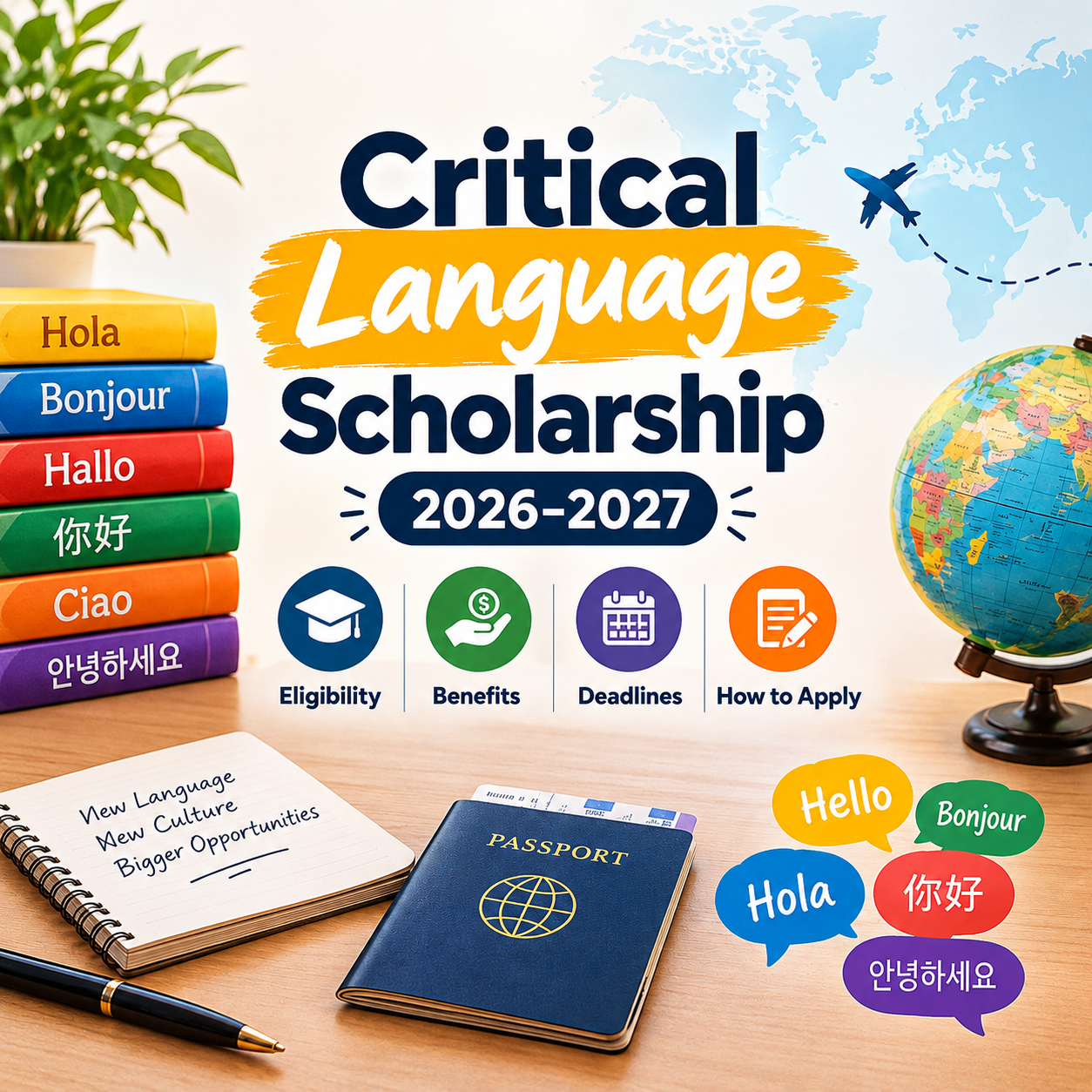
The Critical Language Scholarship (CLS) Program 2026–2027 is a U.S. Department of State-funded initiative that helps eligible American undergraduate and graduate students develop proficiency in strategically important foreign languages through intensive summer study. The program offers approximately eight weeks of language instruction and cultural immersion, with overseas and virtual options depending on the language and proficiency level. Official CLS website
The 2027 application is now open, and the published deadline is November 17, 2026, at 8:00 p.m. Eastern Time. Students interested in languages such as Arabic, Chinese, Japanese, Korean, Persian, Portuguese, Russian, Hindi, and Swahili should review the official requirements before preparing their applications.
For students interested in international relations, research, business, public service, or cross-cultural communication, the CLS Program can be an opportunity to build practical language skills without arranging an independent summer language program.
What Is the Critical Language Scholarship Program?
The Critical Language Scholarship Program is a competitive, merit-based summer language initiative sponsored by the U.S. Department of State and administered with support from American Councils for International Education. Its purpose is to strengthen Americans' language proficiency and intercultural competence in languages important to U.S. engagement around the world.
Why Was the CLS Program Created?
The program addresses the need for Americans who can communicate effectively across linguistic and cultural boundaries. Language proficiency can help professionals understand local perspectives, interpret information accurately, and build relationships across countries.
For example, a student studying international affairs who develops Arabic proficiency may be better prepared to examine regional research, communicate with speakers, and understand cultural context. A student interested in international business may benefit from studying Chinese or Portuguese.
These are potential educational and professional advantages, not guarantees of employment or career advancement.
Who Administers the Program?
The U.S. Department of State sponsors the CLS Program, while American Councils for International Education supports its implementation. The official CLS website publishes application instructions, language options, eligibility requirements, and selection information.
Students should use these official resources rather than relying entirely on social media posts or third-party scholarship summaries.
What Makes CLS Different From a Regular Language Course?
CLS combines intensive language instruction with an immersive learning environment. The program is designed to deliver the equivalent of a full academic year of language study in approximately eight weeks.
Depending on the language and placement, students may participate in structured classes, cultural activities, and opportunities to use the language in everyday settings. This concentrated approach requires consistent attendance, active participation, and substantial effort.
What Are the Benefits of the Critical Language Scholarship?
The CLS Program offers an intensive language-learning experience supported by the U.S. Department of State. Its main value is the opportunity to develop language proficiency and intercultural understanding in a structured program.
Intensive Language Instruction
Participants study their selected language through an intensive academic schedule. The program's goal is to accelerate language development through regular instruction and practical application.
Students should expect to devote significant time to vocabulary, listening, speaking, reading, writing, and cultural learning. A short summer program can be demanding, particularly for students balancing unfamiliar surroundings with intensive coursework.
Cultural Immersion
Language learning involves more than memorizing grammar and vocabulary. Cultural immersion helps students understand communication styles, social expectations, and the contexts in which expressions are used.
For instance, understanding how greetings, professional introductions, or polite disagreement work in another culture can make communication more effective. Such learning is valuable for students preparing for international study, research, or cross-cultural collaboration.
Academic and Professional Development
CLS experience may complement studies in international affairs, public policy, business, education, regional studies, and other disciplines.
Students should explain their own academic or professional goals in the application rather than relying on general claims about the importance of foreign languages. A clear connection between language learning and a realistic future plan can help reviewers understand why the program fits the applicant.
Overseas and Virtual Study Options
The 2027 program includes both overseas and virtual opportunities, depending on the language and starting proficiency level. These formats are not interchangeable choices for every language.
Applicants should consult the official language and level information before selecting a program format.
Is the CLS Program Fully Funded?
The CLS Program is a U.S. government-funded exchange initiative, but applicants should consult the official 2027 award and participation documents for the precise coverage, arrangements, and responsibilities applicable to their offer.
Do not assume that every personal expense, travel arrangement, or incidental cost is covered unless the current official guidance confirms it. Review award conditions carefully before making financial commitments.
What Languages Are Offered Through CLS in 2027?
The official 2027 program lists nine languages, with available study formats and levels varying by language.
| Language | General areas of application |
|---|---|
| Arabic | Diplomacy, regional studies, international affairs |
| Chinese (Mandarin) | Business, research, international engagement |
| Hindi | Media, education, regional studies |
| Japanese | Technology, business, cultural studies |
| Korean | International affairs, technology, cultural studies |
| Persian | Regional studies, research, international affairs |
| Portuguese | Business, international development, cultural studies |
| Russian | Regional studies, research, international affairs |
| Swahili | Education, development, regional studies |
These examples describe possible areas of relevance, not guaranteed career outcomes. Language availability, placement, and prerequisites must be confirmed on the official CLS languages page.
Can Beginners Apply?
Yes, beginner-level opportunities are available for certain languages. For 2027, beginner Arabic, Chinese, Japanese, Korean, and Russian are offered virtually, while the remaining listed languages are offered overseas at the available levels described by the program.
The program also offers higher proficiency levels for eligible applicants with previous language study. Applicants must select the level that matches their expected preparation by the summer program.
How Much Previous Language Study Is Required?
The official program distinguishes among beginner, advanced beginner, intermediate, and advanced levels. The expected preparation varies by level and language.
Applicants should review the official language levels and prerequisites page rather than guessing their proficiency. Choosing an inaccurate level may create problems during application review or placement.
Who Is Eligible for the Critical Language Scholarship 2027?
Applicants must satisfy the CLS citizenship, age, enrollment, academic-progress, and language-specific requirements. Meeting the minimum requirements allows a student to apply but does not guarantee selection.
You Must Have
According to the published 2027 eligibility guidance, applicants must:
- Be a U.S. citizen or U.S. national when applying.
- Be at least 18 years old by May 15, 2027.
- Be enrolled in an accredited U.S. degree-granting program at the undergraduate or graduate level when applying.
- If enrolled in an associate or bachelor's program, complete at least one full year of study—two semesters or three quarters—by the beginning of the summer 2027 program.
- Meet the prerequisites for the selected language and proficiency level.
- Submit only one application for one language and one program format for the application year.
- Be able to meet the program's participation requirements.
The official guidance also addresses graduating seniors and students enrolled in one-year master's programs. Applicants in these circumstances should review the specific rules rather than assume they are excluded.
You May Not Qualify If
You may be ineligible if:
- You are not a U.S. citizen or national.
- You are a permanent resident awaiting naturalization at the application deadline.
- You do not meet the minimum age requirement.
- You are not enrolled in a qualifying degree-granting program when applying.
- You have not met the applicable academic-progress requirement by the program start.
- You submit multiple applications for different languages.
- You fall within a specified employment or family-related exclusion.
Additional restrictions apply to certain current or recent U.S. Department of State employees, their immediate family members, and individuals connected to specified contractors or grantees. The official eligibility page explains the applicable restrictions and exceptions.
Important: International students studying at U.S. universities are not automatically eligible. The program requires U.S. citizenship or nationality, so enrollment at an American institution alone is insufficient.
Is There a Minimum GPA Requirement?
Applicants should read the current application instructions for any academic information or documentation required. Do not assume that a particular GPA guarantees eligibility or selection.
The published selection criteria emphasize commitment to language learning, readiness for an intensive immersive experience, and the connection between language proficiency and academic or professional goals.
How Does the CLS Scholarship Application Work?
The CLS application process requires students to select a suitable language and proficiency level, provide the requested application information, and explain their motivation and future plans.
Step 1: Review the Official Requirements
Begin with the official eligibility page. Check citizenship, age, enrollment, academic-progress, and any applicable language prerequisites.
Confirm that you can participate for the full required program period before proceeding.
Step 2: Select One Language and the Correct Level
Choose the language that best aligns with your interests and future plans. Review the prior-study requirements and the available virtual or overseas format.
Avoid selecting a language simply because it appears prestigious. Your application should explain why that particular language matters to your academic or professional development.
Step 3: Read the Application Instructions
Use the official CLS resource library to find the current application instructions, brainstorming worksheet, and other preparation materials.
These resources can help you organize your ideas before entering information into the application system.
Step 4: Prepare Your Application Responses
Your responses should explain your commitment to learning the language, your readiness for an intensive program, and your plans to continue studying after the summer.
Use specific examples. Instead of writing that a language will help your career, explain how it connects to a research interest, an academic project, a future role, or a concrete learning objective.
Step 5: Submit Before the Deadline
The published deadline for the 2027 application is November 17, 2026, at 8:00 p.m. Eastern Time.
Submit through the official application portal linked from the CLS website. Do not wait until the final minutes, when technical issues or missing information could interfere with submission.
Step 6: Monitor Official Communications
After applying, monitor the email account used in your application and check the official program communications for updates or requests.
Selection results, acceptance instructions, and participation arrangements should be followed according to the information sent to applicants.
What Documents and Information Should Applicants Prepare?
Applicants should follow the current application instructions for the exact required materials. The following checklist is a practical preparation aid, not a substitute for the official document list.
- Personal and contact information.
- Details of current degree enrollment and academic progress.
- Information needed to establish eligibility.
- Accurate details about previous language study.
- Responses explaining language-learning goals and motivation.
- A realistic plan for continuing language study after the program.
- Any additional documents or information specifically requested by the application portal.
How Can You Organize Your Application?
Create a working folder for application instructions, academic information, draft responses, and any supporting materials the official checklist requires.
Use consistent, accurate information across all sections. If your enrollment status or academic circumstances are unusual, confirm how to report them through official guidance or the program's contact address.
What Is the CLS 2027 Application Timeline?
The official application opened in October 2026, and the deadline is in November 2026. The summer program takes place in 2027, with final arrangements communicated through the official program.
| Stage | Timing or action |
|---|---|
| Application opens | October 2026 |
| Published deadline | November 17, 2026, at 8:00 p.m. Eastern Time |
| Review period | Follow official program communications |
| Award and participation decisions | Follow the dates and instructions issued by CLS |
| Summer language program | 2027; consult official participation materials |
Do not rely on unofficial predictions for selection announcements or travel dates. Program dates and instructions may change, and applicants should use the latest official communications.
What Common Mistakes Should CLS Applicants Avoid?
Small mistakes can make an application less clear or prevent an applicant from meeting program rules. Careful preparation is especially important when explaining academic goals and language-learning commitment.
Mistake 1: Ignoring Citizenship Requirements
Students sometimes assume that international enrollment makes them eligible. CLS requires U.S. citizenship or nationality, so applicants should confirm this requirement before investing time in an application.
Mistake 2: Choosing an Unavailable Language Level
Applicants should not exaggerate or underestimate their previous language study. Read the official level descriptions and select the level that matches the program's requirements.
Mistake 3: Writing Vague Motivation Statements
Statements such as "I love learning languages" may communicate enthusiasm but do not explain the applicant's specific goals.
A stronger response describes the applicant's interests, why the target language is relevant, and how the skills will be used after the program.
Mistake 4: Failing to Explain Future Language Study
The selection criteria consider applicants' plans to continue developing their language skills. Describe practical next steps, such as taking additional courses, using language-learning resources, participating in conversation groups, or integrating the language into academic work.
Mistake 5: Leaving the Application Until the Last Day
A late start can lead to incomplete responses, overlooked instructions, or technical problems. Set an earlier personal deadline and review every section before submission.
Mistake 6: Treating Selection as Guaranteed
CLS is competitive and merit-based. Meeting the eligibility rules does not guarantee an award, and applicants should maintain realistic alternative plans for language study.
Tips for Preparing a Stronger CLS Application
A well-prepared application demonstrates purpose, realistic planning, and readiness for an intensive learning experience.
Connect the Language to a Specific Goal
Explain how the selected language fits your degree, research, professional interests, or long-term learning plan. Concrete connections are more informative than broad statements about globalization.
Demonstrate Commitment With Real Examples
Discuss language classes, independent study, cultural learning, related coursework, or other genuine experiences. Applicants should never invent language proficiency, activities, or achievements.
Previous experience should be described accurately, even if it is limited. Beginner applicants can still explain their motivation and the steps they plan to take.
Show That You Understand the Program's Intensity
An eight-week intensive program requires sustained effort. Explain how you will approach demanding coursework, participate in an immersive environment, and manage your time.
Make Your Continued-Learning Plan Practical
Describe what you intend to do after the summer, including available courses, independent practice, academic projects, or other realistic opportunities. If resources are limited at your institution, explain how you would work around that limitation.
Ask for Feedback Before Submitting
Review your application for clarity, accuracy, and consistency. A faculty member, language instructor, or campus study-abroad advisor may help you identify vague explanations or overlooked details.
For campus support, consult the CLS advisor directory.
Frequently Asked Questions About the Critical Language Scholarship
Is the Critical Language Scholarship open for 2027?
Yes. The official CLS website announced that the 2027 application is open. The published deadline is November 17, 2026, at 8:00 p.m. Eastern Time. Applicants should review the official application portal for current instructions and submit before the deadline.
Can international students apply for the CLS Program?
The program requires applicants to be U.S. citizens or nationals. An international student who studies at an accredited U.S. university does not qualify solely because of that enrollment. Permanent residents awaiting naturalization are also ineligible under the published rules. Review the official eligibility page for the complete requirements.
How long does the Critical Language Scholarship last?
The CLS Program generally provides approximately eight weeks of intensive summer language study. Its goal is to deliver the equivalent of a full academic year of language instruction. The format, placement, and participation arrangements depend on the selected language and the current program guidelines.
Which languages are available for CLS 2027?
The official 2027 program lists Arabic, Chinese, Hindi, Japanese, Korean, Persian, Portuguese, Russian, and Swahili. The available proficiency levels and virtual or overseas formats vary. Applicants should review the official language page before deciding which program to select.
Does meeting the eligibility requirements guarantee selection?
No. Eligibility establishes whether an applicant may apply, not whether they will receive an award. The CLS Program uses a competitive, merit-based selection process. Applicants should prepare clear responses, explain their language-learning goals, and make realistic alternative plans in case they are not selected.
Final Thoughts: Is the Critical Language Scholarship Worth Exploring?
The Critical Language Scholarship can be a valuable opportunity for eligible U.S. students who want to build language proficiency through an intensive summer program. Its strongest fit is for applicants who can connect a target language to clear academic or professional goals and who are ready to continue learning after the program.
Start by checking your eligibility, reviewing the available languages and proficiency levels, and reading the official application instructions. If you qualify, prepare your responses early and submit by the published deadline.
Your next step: Visit the official Critical Language Scholarship website to review the 2027 requirements and begin your application.
Author Information
Author: Ashes Jhon
Reviewed for accuracy: [VERIFY BEFORE PUBLISHING — add the name and qualifications of a genuine education professional if an independent review has been completed.]
Last updated: October 2026
Disclaimer: This article is for educational purposes only. Eligibility rules, program details, deadlines, and participation requirements may change. Verify all application decisions and requirements through the official CLS Program website.
Disclosure: If this website earns revenue through advertising or affiliate partnerships, disclose that relationship here. Advertising or affiliate relationships should not influence scholarship information or recommendations.




0 Comments