
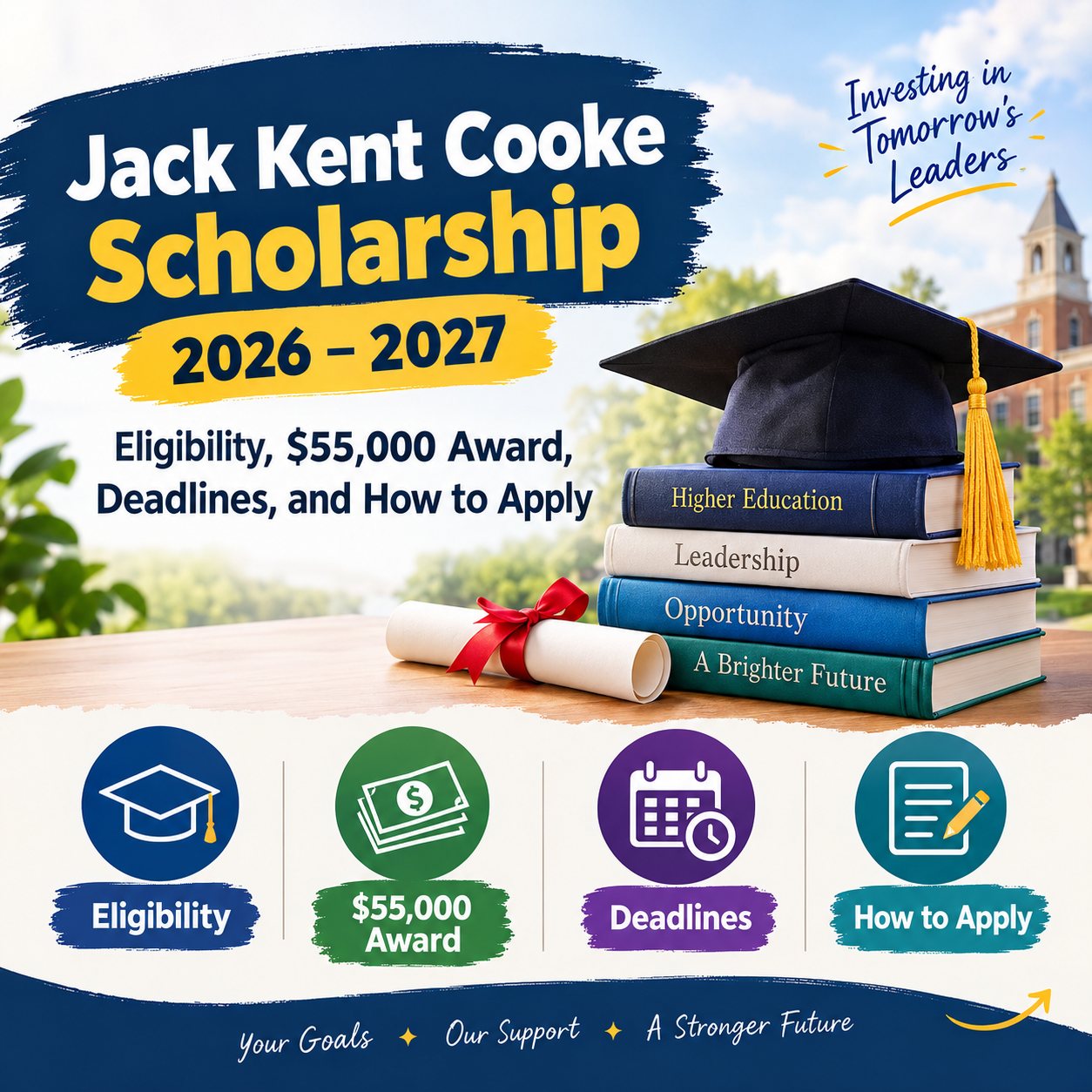
The Jack Kent Cooke Scholarship 2026–2027 refers to competitive scholarship opportunities offered by the Jack Kent Cooke Foundation to academically talented students with financial need. Eligible high school seniors and community college students may receive up to $55,000 per year, depending on the program, their educational costs, and other financial assistance.
The Foundation's two relevant undergraduate programs are the Cooke College Scholarship Program and the Cooke Undergraduate Transfer Scholarship. Both support students pursuing bachelor's degrees at accredited four-year institutions in the United States, but they serve different applicants and have different deadlines.
For the 2027 college-entry cycle, the College Scholarship application closes on November 11, 2026, while the Undergraduate Transfer Scholarship application closes on December 9, 2026. Both applications opened on August 19, 2026. These dates are published by the Foundation and should be reconfirmed before submission.
This guide explains eligibility, financial benefits, application requirements, deadlines, common mistakes, and practical ways to prepare a strong application.
What Is the Jack Kent Cooke Scholarship?
The Jack Kent Cooke Scholarship is a group of educational funding programs administered by the Jack Kent Cooke Foundation, a nonprofit organization dedicated to helping high-achieving students with financial need access educational opportunities.
What Is the Purpose of the Foundation?
The Foundation aims to reduce financial barriers that prevent academically promising students from pursuing higher education. Its support combines scholarship funding with educational advising and other opportunities designed to help recipients progress toward their academic goals.
Rather than evaluating financial circumstances alone, the Foundation considers academic achievement alongside financial need, personal qualities, leadership, persistence, and service.
Which Scholarship Program Should You Choose?
Your current educational level determines which undergraduate scholarship may fit your circumstances.
| Program | Intended applicants | Maximum published award |
|---|---|---|
| Cooke College Scholarship | Eligible high school seniors entering a four-year college in fall 2027 | Up to $55,000 per year |
| Cooke Undergraduate Transfer Scholarship | Eligible community college students or recent graduates transferring to a four-year college in fall 2027 | Up to $55,000 per year for up to three years |
These are maximum potential awards, not guaranteed payments. Actual funding depends on the student's approved educational costs and other financial assistance.
The Foundation also offers the Cooke Young Scholars Program for eligible middle school students. That is a separate opportunity with different eligibility requirements and application procedures.
Why Does This Scholarship Matter?
College expenses extend beyond tuition. Students may need to pay for accommodation, meals, books, required fees, transportation, and other educational necessities.
The Cooke Foundation's funding model can help eligible recipients manage these costs while receiving guidance about college selection, financial aid, and their academic journey.
Official information is available through the Jack Kent Cooke Foundation's scholarship directory.
Who Is Eligible for the Jack Kent Cooke Scholarship 2026–2027?
Eligibility depends on the specific program. Applicants should review every academic, enrollment, financial, and documentation requirement before starting an application.
Eligibility for the Cooke College Scholarship
To apply for the 2027 college-entry cycle, applicants must generally meet these requirements:
- High school status: Complete four years of high school in the United States, a U.S. territory, or on a U.S. military base, and plan to graduate in spring 2027.
- College enrollment: Intend to enroll in an accredited four-year college or university beginning in fall 2027.
- Academic performance: Have a minimum cumulative unweighted GPA of 3.75.
- Standardized testing: Submit a score from at least one eligible SAT, ACT, AP, or IB examination. The Foundation does not specify a minimum score for this application.
- Financial need: Demonstrate unmet financial need. Families with annual gross income up to $95,000 may be considered, subject to a comprehensive financial review.
Meeting these minimum requirements does not guarantee selection. The Foundation evaluates applicants competitively, considering the full application rather than one academic measure.
Eligibility for the Undergraduate Transfer Scholarship
The transfer program is designed for students progressing from a U.S. community college or other eligible two-year institution to a bachelor's degree.
Applicants must generally:
- Have sophomore status at an accredited U.S. community college or two-year institution by January 1, 2027, or qualify as a recent graduate under the Foundation's published rules.
- Plan to enroll full-time in an accredited four-year bachelor's degree program in fall 2027.
- Have a cumulative undergraduate GPA of at least 3.50 on a 4.0 scale, or the equivalent.
- Demonstrate unmet financial need.
- Meet the program's restrictions concerning previous enrollment at a four-year institution.
The Foundation's current guidance states that eligible recent graduates must have graduated since spring 2022. Students who previously attended a four-year institution, including one outside the United States, are not eligible for this transfer scholarship under the published rules.
Applicants should confirm all details on the official Undergraduate Transfer Scholarship application page.
What Financial Circumstances Are Considered?
The Foundation considers financial need as part of its selection process. Its published income guidance is not an automatic eligibility guarantee because the financial review also considers income and assets belonging to the student and their parents.
A household's income alone does not establish the final level of financial need. Prepare accurate financial information and follow the instructions provided in the relevant application.
Who May Not Qualify?
You may be ineligible if you:
- Do not meet the required GPA or educational-status criteria.
- Cannot demonstrate the required financial need.
- Plan to begin college outside the specified enrollment cycle.
- Apply to the transfer program after previously attending a four-year institution.
- Cannot provide the required examination results, academic records, or recommendations.
- Do not meet the applicable U.S. educational attendance requirements.
Important: These undergraduate programs have specific U.S. educational eligibility rules. International students attending secondary school or college entirely outside the United States should not assume they qualify. Review the official requirements before investing time in an application.
How Much Money Does the Jack Kent Cooke Scholarship Provide?
The Foundation advertises awards of up to $55,000 per year for eligible recipients of its College and Undergraduate Transfer Scholarship programs.
What Expenses Can the Award Cover?
Depending on the recipient's approved financial package, scholarship funding may contribute toward:
- Tuition.
- Room and board.
- Books and required fees.
- Other eligible educational expenses associated with completing a bachelor's degree.
The scholarship is described as last-dollar funding after institutional aid. In practical terms, the Foundation considers other institutional grants and scholarships when determining its contribution.
The maximum award is not a flat payment that every recipient receives. Students should review the individual award terms and coordinate their funding with the college's financial aid office.
How Long Can Students Receive Funding?
The Undergraduate Transfer Scholarship can provide up to $55,000 annually for as many as three years. The funding period depends on the time needed to complete the undergraduate degree and the Foundation's applicable conditions.
The College Scholarship Program supports students pursuing a bachelor's degree, with award amounts determined individually. Confirm the duration and renewal requirements in the official program terms.
Does the Scholarship Guarantee a Debt-Free Degree?
No. The Foundation aims to help students complete college with as little debt as possible, but it does not guarantee that every recipient will graduate without borrowing.
Actual expenses, institutional aid, personal circumstances, and the scholarship amount can affect the final financial picture. Build a realistic college budget even if you expect to receive significant assistance.
When Is the Jack Kent Cooke Scholarship Deadline for 2026–2027?
The published deadlines for the two undergraduate programs are different, so applicants should track the correct date.
| Important milestone | College Scholarship | Undergraduate Transfer Scholarship |
|---|---|---|
| Application opens | August 19, 2026 | August 19, 2026 |
| Application deadline | November 11, 2026 | December 9, 2026 |
| Semifinalist notifications | January 2027 | February 2027 |
| Recipient announcements | March 2027 | April 2027 |
The College Scholarship application is submitted through the Common App. The transfer application uses Common App for Transfer.
The Foundation's published deadlines should be treated as firm. Check the official application portal for the applicable submission time, document requirements, and any updates.
What Should You Do Before the Deadline?
Start by reviewing the application and identifying the information that other people must provide. Recommendations and transcripts can take time, particularly during busy school periods.
A practical preparation schedule is:
- Several weeks before submission: Review eligibility and contact recommenders.
- Two to three weeks before submission: Complete the main application and gather financial and academic information.
- One week before submission: Review essays, confirm recommendation requests, and check every required field.
- Before the deadline: Submit the application and confirm that it has been received successfully.
These are planning suggestions, not official Foundation deadlines for individual tasks. Start earlier if your school needs additional time to provide records.
How Do You Apply for the Jack Kent Cooke Scholarship?
The application process requires careful preparation, complete documentation, and a clear explanation of your academic goals and personal experiences.
Step 1: Select the Correct Scholarship
Identify whether you are applying as a high school senior or as a community college student transferring to a bachelor's degree program.
Do not use the requirements for one program to determine eligibility for the other. Their academic thresholds, recommendations, application systems, and deadlines differ.
Step 2: Read the Official Instructions
Visit the relevant Foundation page and review the current application requirements.
For the College Scholarship, use the official application instructions. Transfer applicants should use the Foundation's transfer scholarship instructions.
Step 3: Prepare Your Academic Records
Gather the transcripts and academic information requested by your program. Transfer applicants should pay particular attention to the requirement for records from all relevant colleges attended.
Check that names, dates, course details, and GPA information are consistent across your documents.
Step 4: Request Recommendations
College Scholarship applicants must arrange two academic recommendations and one counselor recommendation through the Common App.
At least one academic recommendation must come from an 11th-grade teacher in a core academic subject. The second may come from another eligible core-subject teacher or a professor who has worked with the applicant since ninth grade.
Transfer applicants must provide two recommendations from academic professionals familiar with their work and character, submitted through Common App for Transfer.
Ask recommenders early and provide a concise summary of your academic goals, activities, and accomplishments.
Step 5: Complete the Application and Essays
Answer every question honestly and provide specific examples that demonstrate your academic commitment, initiative, leadership, service, and persistence.
For example, rather than writing, "I am a hardworking student," explain how you managed challenging coursework while helping at home, supporting a community project, or overcoming a documented academic obstacle.
The purpose is not to present a perfect life. It is to help reviewers understand your choices, growth, and potential.
Step 6: Review Financial Information
Prepare the financial information requested by the Foundation. Ensure that figures and supporting documents are accurate and complete.
Do not exaggerate financial hardship or omit relevant information. Inconsistent financial details can create questions and delay the review.
Step 7: Submit and Monitor Your Application
Submit through the correct application platform before the deadline. Confirm that recommendations and required records have been received and check your email for official communications.
Save confirmation details and copies of your submitted materials for your own records.
Application Process at a Glance
| Step | Action | Details |
|---|---|---|
| 1 | Check eligibility | Confirm educational status, GPA, financial need, and enrollment plans |
| 2 | Choose a program | College Scholarship or Undergraduate Transfer Scholarship |
| 3 | Gather documents | Collect transcripts, testing information, and requested financial records |
| 4 | Arrange recommendations | Follow the correct program's recommendation requirements |
| 5 | Complete the application | Submit essays and all required information |
| 6 | Verify submission | Check for missing items and save confirmation |
| 7 | Follow updates | Monitor email and the official application portal |
What Documents Do You Need?
Required documents vary by program, but applicants should be prepared to provide the materials requested in the current application.
Academic Documents
These may include:
- High school or college transcripts.
- GPA and academic history.
- Eligible standardized examination scores for College Scholarship applicants.
- Information about current enrollment and expected graduation.
Transfer applicants should carefully follow the Foundation's transcript rules, including instructions concerning previous colleges attended.
Recommendations and Personal Information
You may also need:
- Academic recommendations.
- A counselor recommendation, where required.
- Essays and information about extracurricular activities.
- Details about leadership, service, work, family responsibilities, and academic goals.
Financial Documentation
The application may require information about household income, assets, and other financial circumstances.
Follow the official instructions rather than relying on a generic checklist. If a document is unavailable or your circumstances are unusual, contact the Foundation at scholarships@jkcf.org for program-related guidance.
What Mistakes Should You Avoid?
Avoidable application problems can weaken an otherwise promising submission or leave it incomplete.
Waiting Until the Last Minute
Late requests for recommendations or transcripts can leave insufficient time to resolve missing documents. Build your schedule around the official deadline, not the date you hope to finish writing.
Using Generic Essays
Statements such as "education is important to me" do not explain what makes your experience distinctive.
Describe a real challenge, the decisions you made, what you learned, and how the experience shaped your goals. Specific examples are more informative than unsupported claims.
Ignoring Financial Requirements
Do not assume that meeting the published income guidance automatically establishes eligibility. Review the full financial criteria and answer every relevant question accurately.
Choosing the Wrong Program
A high school senior applying to the transfer program, or a student who fails the transfer eligibility rules, may spend valuable time preparing an unsuitable application.
Check your educational status and enrollment plans first.
Overlooking Recommendations
Submitting your own application does not necessarily mean every recommendation has been received. Confirm the status of each required item before the deadline.
Treating the Maximum Award as Guaranteed
An advertised maximum is not an individual award offer. Base your college decisions on confirmed financial aid rather than assuming you will receive the full published amount.
How Can You Strengthen Your Application?
A strong application presents a coherent picture of academic achievement, personal responsibility, and future potential.
Show Academic Curiosity
Explain what you enjoy learning, which questions motivate you, and how you pursue knowledge beyond required assignments.
Evidence might include independent research, a meaningful project, additional coursework, or a sustained interest in a particular subject.
Demonstrate Leadership Through Actions
Leadership does not always require an official title. Organizing a study group, coordinating a community activity, mentoring younger students, or taking responsibility for a family project can demonstrate initiative.
Describe your contribution and its actual impact without inventing results.
Explain Challenges With Reflection
Applicants can describe obstacles that affected their education, finances, time, or access to opportunities when relevant.
Focus on the circumstances, your response, the lessons you learned, and the progress you made. You do not need to disclose private experiences that are unrelated to the application.
Make Your Goals Specific
Explain how your intended major connects to your interests and longer-term plans. You do not need to predict your entire career, but you should communicate why the next educational step matters.
Ask for Feedback
Ask a teacher, counselor, or trusted adviser to review your essays for clarity and accuracy. Make sure the final submission reflects your own experiences and voice.
Read more: Critical Language Scholarship 2026–2027: Eligibility, Benefits, Deadlines, and How to Apply
Frequently Asked Questions
1. Is the Jack Kent Cooke Scholarship open for 2026–2027?
Yes. For students planning to enter college in fall 2027, the College Scholarship application opened on August 19, 2026, and closes on November 11, 2026. The Undergraduate Transfer Scholarship application opened on the same date and closes on December 9, 2026. Check the Foundation's official website for current instructions and any updates.
2. How much is the Jack Kent Cooke Scholarship worth?
The College Scholarship and Undergraduate Transfer Scholarship can provide up to $55,000 per year. Transfer recipients may receive funding for up to three years. The actual amount depends on approved educational expenses and other institutional aid, so applicants should not treat the maximum as a guaranteed award.
3. What GPA is required for the scholarship?
The College Scholarship requires a minimum cumulative unweighted high school GPA of 3.75. The Undergraduate Transfer Scholarship requires a cumulative undergraduate GPA of at least 3.50 on a 4.0 scale or its equivalent. These are minimum academic requirements, not guarantees of selection. Applicants must also satisfy the relevant financial and enrollment criteria.
4. Can international students apply for the Jack Kent Cooke Scholarship?
The two undergraduate programs described in this guide have specific U.S. educational attendance and enrollment requirements. Students who attended school or college entirely outside the United States should not assume they qualify. Review the official eligibility rules for your intended program, including the transfer program's restrictions concerning previous four-year college attendance.
5. Where can I apply for the Jack Kent Cooke Scholarship?
Apply through the platform designated for your program. High school seniors use the Common App for the Cooke College Scholarship, while transfer applicants use Common App for Transfer. Start with the Foundation's official scholarship directory to access the correct instructions, deadlines, and application links.
Final Thoughts: What Should You Do Next?
The Jack Kent Cooke Scholarship 2026–2027 can provide substantial financial support and educational advising to eligible students with strong academic records and financial need. However, the right program, accurate documentation, and on-time submission are essential.
If you are a high school senior, review the November 11, 2026 deadline. If you are an eligible community college student or recent graduate, check the December 9, 2026 deadline for the transfer program.
Your next step: Visit the official Jack Kent Cooke Foundation scholarship directory, confirm your eligibility, and create a document checklist before completing your application.
Author Information
Author: Ashes Jhon
Editorial review: [VERIFY BEFORE PUBLISHING] Add the name and relevant qualifications of an actual reviewer if the article receives a professional review. Do not claim independent professional review until it has taken place.
Last Updated: October 2026
Disclaimer: This article is for educational purposes only. Scholarship requirements, deadlines, award amounts, and eligibility rules may change. Always verify current information with the official Jack Kent Cooke Foundation before making application or financial decisions.
Disclosure: If this website earns advertising or affiliate revenue, disclose that relationship here. Advertising or affiliate partnerships should not influence the accuracy or independence of scholarship guidance.
Internal Linking Suggestions
Add relevant links to existing pages on your website, if available:
- College Scholarships for High School Seniors — a guide to funding options for students entering college.
- Community College Transfer Scholarships — information about funding a bachelor's degree after two-year college study.
- How to Write a Scholarship Essay — practical advice on presenting achievements and personal experiences.
- Scholarship Application Checklist — a resource for organizing documents, recommendations, and deadlines.
- Financial Aid and College Costs Guide — an explanation of tuition, grants, scholarships, and student expenses.






0 Comments