
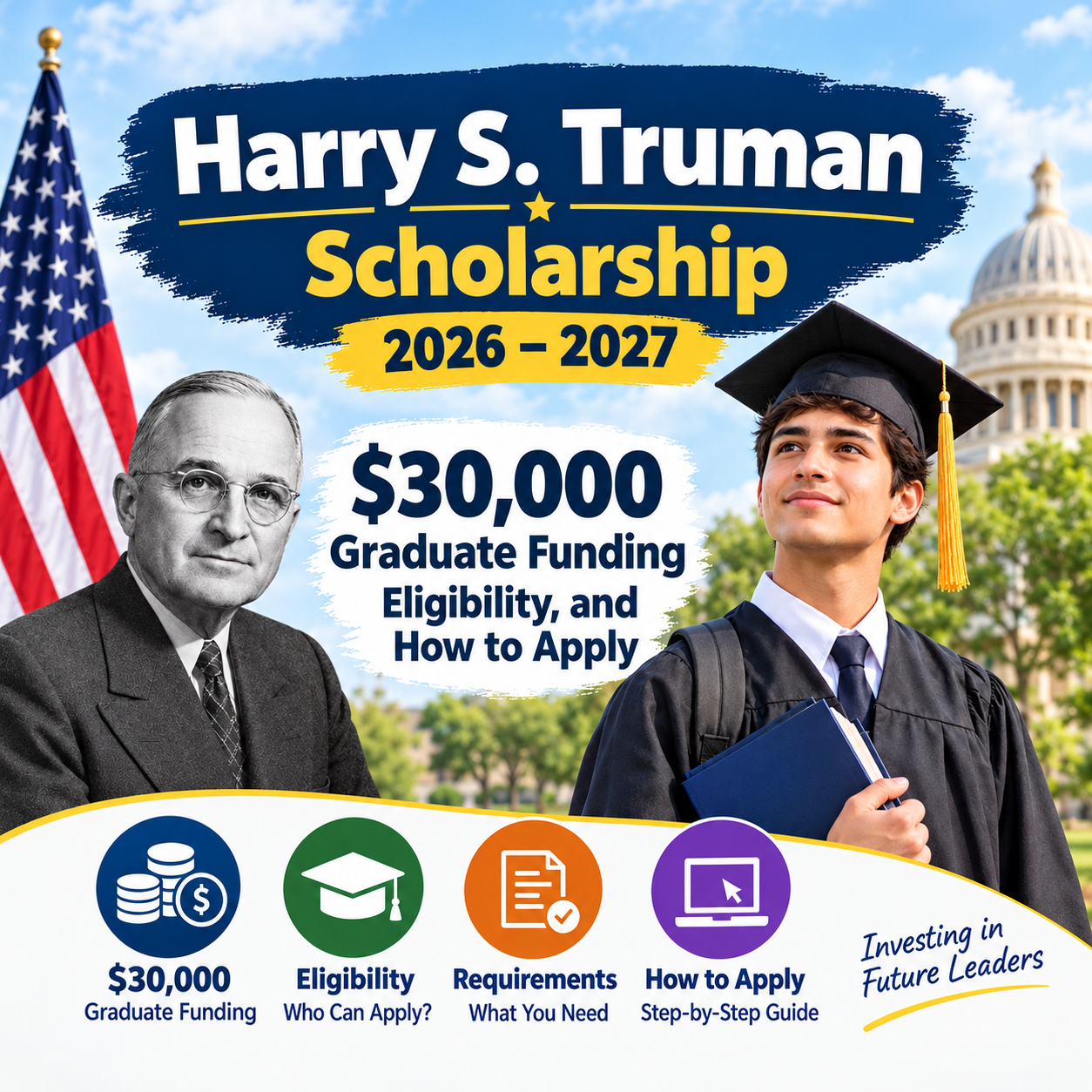
The Harry S. Truman Scholarship 2026–2027 is a competitive U.S. national scholarship for college students who demonstrate leadership, community service, and a strong commitment to public service. Selected Truman Scholars can receive up to $30,000 for graduate or professional education, along with leadership development, mentoring, and career opportunities.
The Harry S. Truman Scholarship Foundation
+1
For the 2027 competition, the official application deadline is February 2, 2027, at 11:59 p.m. in the applicant’s time zone. Students should start by contacting their college’s Truman Scholarship faculty representative, because campus nomination deadlines may be earlier.
The Harry S. Truman Scholarship Foundation
+1
What Is the Harry S. Truman Scholarship?
The Harry S. Truman Scholarship is a merit-based award established to prepare future leaders for careers in public service. It helps eligible undergraduate students pursue graduate education that supports their long-term plans to improve communities, influence policy, or serve the public.
Who established the Truman Scholarship?
The scholarship is administered by the Harry S. Truman Scholarship Foundation. It serves as a federal memorial to Harry S. Truman, the 33rd president of the United States.
Rather than focusing exclusively on academic grades, the Foundation evaluates applicants' leadership, public-service experience, communication skills, and potential to succeed in graduate school.
The Harry S. Truman Scholarship Foundation
+1
What does public service mean?
Public service includes work that benefits communities and society through government, nonprofit organizations, education, research, and other public-interest activities.
Examples include:
- Developing policies that improve access to affordable healthcare.
- Leading community programs for disadvantaged families.
- Working on environmental protection or climate policy.
- Improving educational opportunities for underserved students.
- Pursuing public-interest law or government administration.
- Using science, technology, or research to address social problems.
You do not necessarily need to plan a career as an elected politician. The Foundation recognizes public service across many professional fields.
The Harry S. Truman Scholarship Foundation
+1
Why does this scholarship matter?
Graduate education can involve substantial tuition and living expenses. Truman funding can help reduce the financial burden while connecting recipients with a community of public-service leaders.
The application process also encourages students to define a problem they care about, explain how they have contributed to solving it, and develop a credible plan for future impact.
How Much Is the Truman Scholarship Worth in 2026–2027?
The Truman Scholarship provides up to $30,000 toward graduate or professional school for selected scholars in the 2027 competition. The award is intended to support further education connected to a public-service career.
The Harry S. Truman Scholarship Foundation
+1
Scholarship benefits at a glance
| Benefit | What students should know |
|---|---|
| Graduate funding | Up to $30,000 |
| Eligible study | Graduate or professional education aligned with public service |
| Leadership development | Participation in Truman Scholars programming |
| Mentoring | Opportunities to connect with public-service leaders |
| Career opportunities | Special federal employment opportunities, including direct hiring authority |
| Graduate-school support | Opportunities for additional funding through participating graduate-school partners |
The Harry S. Truman Scholarship Foundation
+1
Is the scholarship a full ride?
No. Students should not assume that the Truman Scholarship automatically covers all graduate tuition, housing, food, travel, and other expenses.
The published award is up to $30,000 for graduate education. Additional financial support may be available through graduate-school partners, but eligibility and amounts depend on the relevant arrangements.
Before choosing a graduate program, calculate the total cost of attendance and identify other scholarships, assistantships, grants, or funding sources you may need.
Can students use the award for different graduate degrees?
The Foundation supports graduate study in a broad range of fields connected to public service, including law, public policy, public health, education, engineering, environmental management, and other disciplines.
Your proposed degree should make sense in relation to your intended career. For example, a student who wants to improve rural healthcare access might pursue public health, health policy, or a relevant professional degree. The connection between education and public-service goals is important.
Who Is Eligible for the Harry S. Truman Scholarship?
Applicants must meet the Foundation's citizenship, enrollment, academic-standing, nomination, and career-intention requirements. The 2027 competition specifically identifies students who are pursuing undergraduate education at a qualifying U.S. institution and preparing for graduate study connected to public service.
The Harry S. Truman Scholarship Foundation
+1
What are the main eligibility requirements?
For the 2027 competition, applicants generally must:
- Be U.S. citizens, U.S. nationals who are residents of American Samoa, or individuals who will obtain U.S. citizenship by the award date under the Foundation's rules.
- Be enrolled at an accredited U.S.-based institution.
- Meet the required undergraduate class standing and graduation timeline.
- Receive an official nomination from their institution.
- Plan to pursue graduate education that supports a career in public service.
The 2027 competition bulletin describes the typical candidate as a full-time junior-level student during the 2026–2027 academic year, expecting to graduate between December 2027 and August 2028, or a qualifying student completing an undergraduate degree in three years or fewer.
The Harry S. Truman Scholarship Foundation
+1
Do applicants need a particular major or GPA?
The Foundation does not restrict eligibility to one academic major. Students from a variety of disciplines may qualify if their academic plans and career goals align with public service.
The 2027 competition bulletin identifies being in the upper quarter of the class as an academic requirement. However, the Foundation also emphasizes leadership and public-service commitment rather than treating a perfect transcript as the sole measure of potential. Confirm the full current eligibility criteria before applying.
The Harry S. Truman Scholarship Foundation
+1
Who may not qualify?
You may be ineligible if you:
- Do not meet the citizenship or qualifying nationality requirements.
- Are not enrolled at a qualifying U.S.-based institution.
- Do not meet the required class standing or graduation timeline.
- Cannot secure the required institutional nomination.
- Do not intend to pursue graduate education connected to public service.
Important: Permanent residents who hold green cards but are not U.S. citizens generally do not qualify under the published rules. International students should check their status carefully rather than assume that enrollment at an American university makes them eligible.
The Harry S. Truman Scholarship Foundation
+1
How Does the Truman Scholarship Application Work?
The application process begins with institutional nomination, followed by a detailed written application and, for selected finalists, an interview. Students cannot simply bypass their college's nomination process by submitting an independent application.
The Harry S. Truman Scholarship Foundation
+1
Step 1: Find your Truman Scholarship advisor
Visit the official Truman Scholarship Advisor Locator to identify your institution's faculty representative.
Ask about the internal nomination deadline, selection criteria, required documents, and campus application process. Some colleges begin selecting nominees well before the Foundation's February deadline.
Step 2: Prepare your leadership and service record
Create a list of your most meaningful activities, including community projects, student organizations, volunteering, research, advocacy, and employment.
For each activity, record your responsibilities, the problem you addressed, your personal contribution, and the results you can demonstrate.
Step 3: Complete the written application
Once nominated, you will receive instructions for accessing the online application. The application includes short essays, a proposed public-service career path, and a policy proposal addressing an issue relevant to your goals.
The Harry S. Truman Scholarship Foundation
+1
Step 4: Obtain recommendations and transcripts
The application requires three additional recommendation letters, alongside the institutional nomination letter and academic transcript.
Choose recommenders who can speak directly to your leadership, public-service commitment, and academic potential. Give them enough time to prepare specific, evidence-based letters.
Step 5: Prepare for the finalist interview
The Foundation selects finalists for interviews with regional review panels. Candidates should be ready to explain their proposed graduate education, policy interests, leadership decisions, and long-term plans for public service.
The Harry S. Truman Scholarship Foundation
+1
What Is the Application Timeline for 2026–2027?
The following dates are published on the Foundation's official website for the 2027 competition. The campus nomination deadline may be earlier than the national deadline.
The Harry S. Truman Scholarship Foundation
+1
| Application stage | Official date |
|---|---|
| Application deadline | February 2, 2027 |
| Foundation receipt confirmation | February 8, 2027 |
| Finalists notified | February 15, 2027 |
| Finalist confirmation deadline | February 18, 2027, at 9 a.m. ET |
| Finalist announcement | February 19, 2027 |
| Regional review panels | March 1–April 15, 2027 |
| Scholars announced | April 23, 2027 |
| Truman Scholars Leadership Week | May 25–30, 2027 |
How should you plan around these dates?
October–November 2026: Contact your advisor, check eligibility, and learn your institution's internal selection process.
November–December 2026: Develop your activity record, discuss graduate-school plans, identify recommenders, and research a policy issue.
December 2026–January 2027: Refine your essays and policy proposal, verify supporting information, and coordinate with your advisor.
Before February 2, 2027: Confirm that every required component has been submitted successfully.
These are suggested preparation periods, not official campus deadlines. Begin earlier if your institution requires an early nomination application.
What Documents and Materials Do You Need?
Applicants need a complete application supported by academic records, recommendations, and institutional nomination materials.
The Harry S. Truman Scholarship Foundation
+1
Application preparation checklist
Your application checklist
0 of 8Confirm citizenship and academic eligibilityContact the Truman faculty representativeComplete the campus nomination processPrepare leadership and public-service essaysDevelop the policy proposal and verify its sourcesRequest three recommendation lettersArrange the academic transcriptReview all application fields and submit before the deadline
How should you write the policy proposal?
The policy proposal should identify a meaningful public problem and recommend a realistic response. The Foundation's candidate guidance calls for a concise memo directed to the government official best positioned to address the issue, with a limit of 500 words under the published instructions.
The Harry S. Truman Scholarship Foundation
A strong proposal generally explains:
- The problem: What is happening, and who is affected?
- The evidence: What reliable research or data establishes the problem?
- The solution: What specific policy or action do you recommend?
- The implementation: Who could carry it out, and what obstacles might arise?
For example, a student concerned about unequal access to school mental-health services could examine counselor availability, identify a policy gap, and propose a practical funding or service-delivery change.
Avoid writing a proposal that merely describes a problem. The reader needs to understand your recommendation and why it could work.
What Are the Most Common Truman Scholarship Application Mistakes?
Applicants can weaken an otherwise promising application by overlooking nomination requirements, describing activities without showing impact, or presenting vague career goals.
Mistake 1: Focusing only on grades
Strong academic performance matters, but it cannot replace a meaningful record of leadership and service.
The Foundation specifically explains that applicants with excellent grades but limited public-service involvement or leadership are unlikely to be competitive.
The Harry S. Truman Scholarship Foundation
Mistake 2: Listing activities without explaining results
A long list of clubs and volunteer positions does not automatically demonstrate leadership.
Explain what you initiated, improved, organized, or learned. If you helped expand a tutoring program, for instance, describe your contribution and use verified participation figures if you have them.
Mistake 3: Choosing an unclear career direction
Applicants should explain how their proposed graduate education will prepare them for a public-service career.
You do not need to predict your entire professional future. You do need a credible connection between the issue you care about, the skills you need, and the work you hope to perform.
Mistake 4: Starting too late
The institutional nomination stage can require substantial preparation. Waiting until January to contact an advisor may leave insufficient time for internal selection, recommendations, and revisions.
Mistake 5: Using unsupported claims in essays
A policy proposal should rely on trustworthy research, accurate data, and properly identified sources.
Check every statistic and factual claim. A persuasive argument loses credibility if its evidence is outdated, misleading, or incorrectly cited.
How Can You Improve Your Chances of Becoming a Truman Scholar?
You cannot guarantee selection, but you can prepare an application that clearly demonstrates leadership, sustained service, and a realistic vision for change.
Show leadership through concrete actions
Leadership is not limited to holding the title of president or director. It can include identifying an unmet need, organizing volunteers, building partnerships, or improving an existing program.
Describe the decisions you made and the contribution you personally delivered.
Demonstrate sustained public-service commitment
Explain how your activities connect to the community or issue you hope to serve. A coherent record of involvement is generally more persuasive than unrelated activities collected primarily to strengthen a résumé.
Choose recommenders strategically
Ask people who have directly observed your work and can provide detailed examples. A recommendation that explains how you responded to a difficult challenge is more informative than one containing only broad praise.
Research your intended graduate degree
Identify programs that offer the knowledge, practical training, or professional qualifications you need. Your plans should be ambitious but realistic, with a clear explanation of how further education will support your public-service goals.
Prepare for questions about your policy proposal
Practice explaining the problem, evidence, proposed solution, costs or implementation challenges, and likely consequences. Be willing to discuss weaknesses in your proposal rather than treating it as a flawless plan.
Read more: ROTC Scholarship 2026–2027: Eligibility, Benefits, Requirements, and How to Apply
Frequently Asked Questions
1. What is the deadline for the Harry S. Truman Scholarship 2026–2027?
The deadline for the 2027 Truman Scholarship competition is February 2, 2027, at 11:59 p.m. in the applicant's time zone. The complete nomination package must be submitted by that deadline. Applicants should contact their college's Truman Scholarship faculty representative early because campus nomination deadlines may be earlier.
The Harry S. Truman Scholarship Foundation
+1
2. How much money does the Truman Scholarship provide?
Selected Truman Scholars receive up to $30,000 toward graduate or professional education related to public service. Scholars may also benefit from leadership programming, mentoring, and special federal employment opportunities. The award is not automatically a full ride, so applicants should compare graduate-school costs with their available funding.
The Harry S. Truman Scholarship Foundation
+1
3. Can international students apply for the Truman Scholarship?
Generally, no. The published eligibility rules require U.S. citizenship or qualifying U.S. national status for residents of American Samoa, subject to the Foundation's stated provisions. Enrollment at a U.S. university alone does not establish eligibility. Students who expect to obtain citizenship before the award date should confirm their circumstances directly with the Foundation.
The Harry S. Truman Scholarship Foundation
+1
4. Do I need a specific major or graduate degree?
No single undergraduate major is required. The Foundation considers students from different academic fields whose graduate-school plans support a career in public service. Eligible pathways may include public policy, law, public health, education, environmental management, engineering, and other relevant disciplines. Applicants should clearly explain why their chosen degree fits their intended public-service work.
The Harry S. Truman Scholarship Foundation
+1
5. Do Truman Scholars have a public-service obligation after graduation?
Yes. Under the 2027 competition bulletin, scholars must work in public service for three of the seven years following completion of a Foundation-funded graduate degree program. Failure to meet the obligation or provide the required proof may lead to repayment of funding and interest, subject to the Foundation's rules and applicable appeals process.
The Harry S. Truman Scholarship Foundation
Final Thoughts: Is the Truman Scholarship Right for You?
The Harry S. Truman Scholarship 2026–2027 is worth exploring if you are a qualifying undergraduate student with a meaningful record of leadership, community service, and plans for a public-service career. Its value extends beyond graduate funding to include professional development, mentoring, and opportunities to build a career around issues that matter to you.
Your next step should be to review the official eligibility rules and contact your college's Truman Scholarship advisor. Start preparing your application early, develop a well-supported policy proposal, and make sure your academic plans connect clearly to your public-service goals.
Author Information, Last Updated, and Disclaimer
Author: Ashes Jhon
Reviewer: An education professional specializing in scholarships and academic guidance should review this article before publication. No individual reviewer or professional credential is claimed here.
Last Updated: October 2026.
Scholarship requirements, deadlines, funding conditions, and eligibility rules may change. Always confirm current information with the official Harry S. Truman Scholarship Foundation before making application decisions.
Disclaimer: This article is for educational purposes only and does not guarantee eligibility, nomination, selection, or funding. Applicants should verify all requirements with the official organization.
Disclosure: If this website earns revenue through advertising or affiliate partnerships, disclose that relationship transparently. Such arrangements should not influence the accuracy of scholarship information or recommendations.




0 Comments