
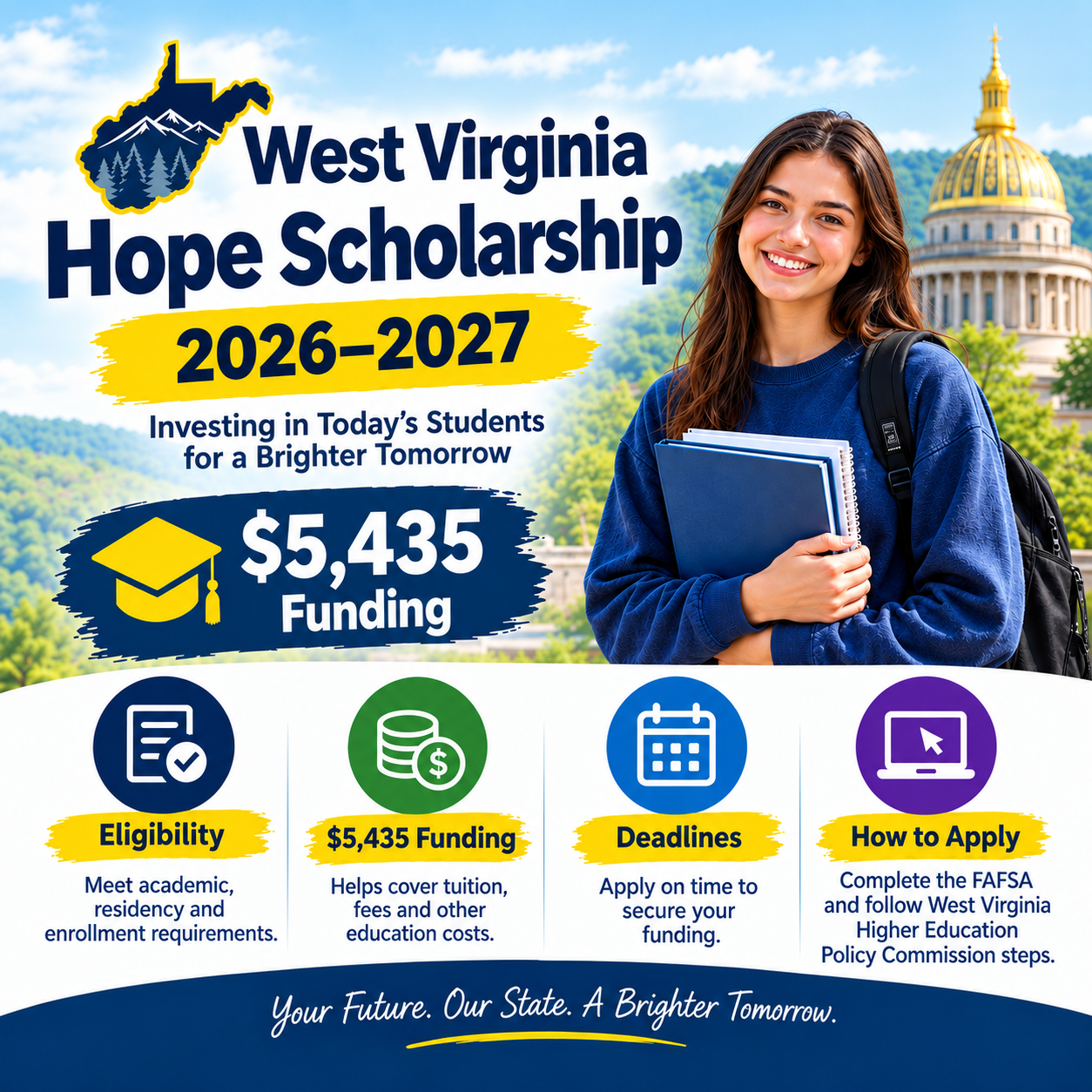
The West Virginia Hope Scholarship 2026–2027 is a state-funded education savings account program that helps eligible West Virginia families pay for approved educational expenses outside the traditional full-time public school model. The published annual award amount is $5,435.62 per eligible student, with the amount available to new applicants depending on when they apply.
Unlike a conventional college scholarship, the Hope Scholarship is designed for K–12 education. Families can use eligible funds for approved educational services, participating private school tuition, tutoring, and other qualifying expenses under program rules.
§18-31-7
+1
For the 2026–2027 school year, applications remain open during certain funding windows. As of October 19, 2026, the current application window runs from September 16 through November 30, 2026, and new applicants in that window are scheduled to receive 50% of the annual award amount, subject to approval and program requirements.
hopescholarshipwv.gov
+1
What Is the West Virginia Hope Scholarship?
The West Virginia Hope Scholarship is an education savings account (ESA) program administered by the state to give eligible families more flexibility in choosing educational options for their children.
Instead of functioning like a traditional scholarship paid directly to a college student, the program places eligible funds into an account for approved education-related expenses.
What Is the Purpose of the Hope Scholarship?
The program is intended to help families access educational opportunities that fit their children's needs, including participating private schools, qualifying home education arrangements, tutoring, and approved educational services.
For example, a family whose child needs a smaller learning environment may explore a participating private school. Another family may prefer home education supported by eligible tutoring or instructional resources.
The program does not guarantee that every expense will qualify. Parents should review the official expense rules and confirm provider eligibility before making purchases.
Who Administers the Program?
The program is administered through the West Virginia Hope Scholarship Board, with official program information available through the West Virginia State Treasurer's Office.
The primary resource for applicants is the official Hope Scholarship website. Families should use this website to review current eligibility rules, application instructions, funding schedules, and account requirements.
Is It a College Scholarship?
No. The Hope Scholarship is a K–12 education funding program, not a conventional college financial aid award.
Students planning for university may also want to investigate separate college scholarships, grants, and financial aid programs. The Hope Scholarship should not be confused with West Virginia's PROMISE Scholarship, which has separate rules for eligible college students.
How Much Is the West Virginia Hope Scholarship for 2026–2027?
The published full annual Hope Scholarship amount for 2026–2027 is $5,435.62 per student. New applicants may receive a reduced award based on the date their original application is submitted.
hopescholarshipwv.gov
+1
2026–2027 Award Amounts by Application Window
The official program schedule sets the following award percentages for new applicants. The dollar amounts below are estimates calculated from the published full award and rounded to the nearest cent.
| New application window | Award percentage | Estimated award |
|---|---|---|
| March 2–June 15, 2026 | 100% | $5,435.62 |
| June 16–September 15, 2026 | 75% | $4,076.72 |
| September 16–November 30, 2026 | 50% | $2,717.81 |
| December 1, 2026–February 28, 2027 | 25% | $1,358.91 |
| After February 28, 2027 | No 2026–2027 funding | Apply for 2027–2028 |
Source: Official Hope Scholarship new-student guidance.
hopescholarshipwv.gov
+1
These figures represent the published award amount multiplied by the applicable percentage. Confirm the amount shown in your student's approved account before making financial commitments.
What Does the Current 50% Funding Window Mean?
A new applicant submitting an application between September 16 and November 30, 2026, falls within the 50% funding window under the published schedule.
Using the full annual award of $5,435.62, that percentage equals approximately $2,717.81. The actual award remains subject to approval and the official account rules.
Families should also remember that an application deadline is not the same as an approval date. Submit all required information promptly and monitor the official portal for updates.
When Are Funds Distributed?
Beginning with the 2026–2027 school year, the program uses a quarterly funding schedule. The official website states that one-fourth of the applicable funds are to be placed into student accounts by August 15, October 15, January 15, and April 15.
hopescholarshipwv.gov
+1
Account funding depends on the student's status and the required documentation, including an active Notice of Intent where applicable. Families should not assume that an application alone means funds are immediately available.
Who Is Eligible for the West Virginia Hope Scholarship?
Eligibility for the 2026–2027 program is based on the student's circumstances, West Virginia residency, age, and applicable enrollment requirements. The state expanded access for the 2026–2027 school year, so families should consult the current rules rather than rely on older eligibility articles.
hopescholarshipwv.gov
+2
Basic Eligibility Requirements
A new applicant should check the following requirements before applying:
- West Virginia residency: The student must satisfy the program's state residency requirement.
- School-age eligibility: The student must be eligible to enroll in a West Virginia public school in grades K–12 under the current program guidance.
- Age: The student must be under 21 years old.
- Kindergarten eligibility: An incoming kindergarten student must meet the applicable age requirement, including being at least five years old before July 1.
- Educational status: The student must not have already successfully completed a secondary education program.
- Application requirements: The family must complete the official application and any required enrollment, intent, or other documentation.
The official new-student eligibility page should be treated as the final reference for current application requirements.
hopescholarshipwv.gov
+1
Are Private School and Homeschool Students Eligible?
The 2026–2027 expansion opened the program to eligible children beyond the previous public-school-focused eligibility pathway. The State Treasurer's Office specifically announced that existing private-school and traditional homeschool students who had not previously qualified could apply under the expanded program.
wvtreasury.gov
+1
This change is important for families who already pay private school tuition or educate their children at home. However, eligibility should not be assumed from school type alone; residency, age, application procedures, and any applicable Notice of Intent requirements still matter.
Who May Not Qualify?
A student may be ineligible if the student:
- Does not meet the West Virginia residency requirement.
- Is outside the program's permitted age range.
- Has already successfully completed secondary education.
- Does not meet the applicable K–12 eligibility requirements.
- Fails to complete required application or participation documentation.
These are general screening points, not a substitute for an official eligibility determination. If a child's circumstances are unusual—for example, the child recently moved to West Virginia or has changed educational arrangements—ask the Hope Scholarship Board for clarification before relying on a projected award.
Is There an Income Limit?
The published 2026–2027 eligibility guidance does not list a household income threshold as a basic requirement for new applicants. Do not confuse proposals or legislative bill text with enacted requirements. Check the current official program rules for any changes before applying.
What Expenses Can the Hope Scholarship Cover?
Hope Scholarship funds must be used for qualifying educational expenses. The state law identifies permitted expense categories, while the program's current guidance determines how families should use their accounts.
§18-31-7
+1
Examples of Qualifying Expenses
Depending on the current rules and provider requirements, qualifying expenses may include:
- Tuition and fees at a participating private school.
- Eligible tutoring services.
- Approved classes, extracurricular activities, or educational programs provided by a public school district.
- Fees for standardized assessments, advanced placement examinations, and college admission tests.
- Eligible examination preparation courses.
- Other educational goods or services specifically permitted by law and program guidance.
The West Virginia Code on qualifying expenses provides the legal framework. Families should consult the full current list before committing funds.
Can Families Use the Funds for Any School or Product?
No. A school, tutor, vendor, or product does not automatically qualify simply because it is educational.
Providers may need to participate in the program, and the expense must meet the applicable rules. Parents should verify the provider's status and retain invoices, receipts, and other records.
What Happens If a Purchase Is Not Eligible?
An expense that falls outside the approved categories may not be reimbursable or payable through the account. Improper use can also create account or compliance problems.
When in doubt, ask the program administrator before purchasing. That small step can prevent an avoidable dispute over an expense.
How Does the Hope Scholarship Application Process Work?
Families should begin with the official program portal, check eligibility, prepare the required information, and follow the instructions for the child's educational arrangement. The application schedule matters because it determines the applicable funding percentage for new participants.
hopescholarshipwv.gov
+1
Step-by-Step Application Guide
Step 1: Review the official eligibility rules
Confirm the child's age, residency, educational status, and applicable K–12 requirements. Start at the official Hope Scholarship website.
Step 2: Gather the required information
Prepare the information requested by the application, such as student and parent details, residency information, and relevant school or enrollment records. Follow the portal's checklist rather than assuming every applicant needs identical documents.
Step 3: Complete the application online
Enter information carefully, answer all required questions, and submit the application through the official portal. Save any confirmation number or submission receipt.
Step 4: Monitor your application
Check the portal and the email address associated with the application. Respond promptly if the program requests corrections or additional information.
Step 5: Confirm account activation and funding
Review the award amount, account status, payment schedule, and any required Notice of Intent. Confirm that a provider and planned expense qualify before spending.
Application Process at a Glance
| Step | Action | What to check |
|---|---|---|
| 1 | Review eligibility | Residency, age, educational status |
| 2 | Prepare information | Required records and application details |
| 3 | Apply online | Correct information and submission confirmation |
| 4 | Track the application | Requests, notices, and approval status |
| 5 | Verify funding | Award percentage, account activation, and quarterly schedule |
| 6 | Use approved funds | Eligible provider, expense, and supporting receipts |
What Documents Should You Prepare?
The precise requirements depend on the application and the student's situation. Families should be ready to provide information requested about:
- The student's identity and date of birth.
- Parent or guardian contact details.
- West Virginia residency.
- Current or intended educational arrangements.
- Any required Notice of Intent or school-related documentation.
- Other supporting information specified by the official portal.
This is a preparation checklist, not a claim that every item is mandatory for every family. Use the current official application checklist to determine exactly what must be submitted.
What Are the Important Deadlines for 2026–2027?
The application date affects the funding level available to new participants. As of October 19, 2026, the next major deadline for new applications is November 30, 2026, which closes the 50% funding window.
hopescholarshipwv.gov
+1
Key Dates to Remember
| Date | Significance |
|---|---|
| March 2, 2026 | New applications opened |
| June 15, 2026 | Last day of the 100% funding window |
| September 15, 2026 | Last day of the 75% funding window |
| November 30, 2026 | Last day of the 50% funding window |
| February 28, 2027 | Last day of the 25% funding window |
| August 15, October 15, January 15, April 15 | Scheduled quarterly funding dates |
These dates follow the published 2026–2027 schedule. Families should check the official portal for updates, account-specific deadlines, and any instructions affecting continued participation.
What If You Miss the November Deadline?
Under the published schedule, a new application submitted from December 1, 2026, through February 28, 2027, falls within the 25% funding window. After February 28, the official guidance says applicants may apply for the 2027–2028 school year instead.
hopescholarshipwv.gov
+1
Do not assume that submitting at the last minute will secure a particular funding date. Leave time to resolve technical issues and provide requested information.
What Common Mistakes Should Applicants Avoid?
Families can reduce avoidable delays by checking eligibility, deadlines, and account requirements before submitting an application or making purchases.
Applying Too Late
The most costly mistake may be missing a higher funding window. A family applying in October 2026 should understand that the published schedule provides 50% of the annual award for applications submitted from September 16 through November 30.
Use the application date that the program officially recognizes, and retain proof of submission.
Assuming Approval Is Automatic
Submitting an application does not guarantee approval or immediate access to funds. The program may need to verify eligibility or request additional information.
Monitor official communications and respond to requests as quickly as possible.
Spending Before Checking the Rules
An educational purchase may sound reasonable but still fail to meet the program's qualifying-expense requirements. Confirm the provider and expense before paying.
Keep receipts, invoices, and other required documentation for your records.
Confusing Renewal With a New Application
Existing recipients have a separate continued-participation process. For 2026–2027, the official confirmation period for existing participants ran from January 5 through June 15, 2026.
hopescholarshipwv.gov
+1
Families should follow the instructions for their actual status rather than automatically using the new-student process.
Tips for Making the Most of the Hope Scholarship
A careful plan can help families use education funding effectively while avoiding unexpected costs.
Compare Educational Options Before Committing
Estimate tuition, fees, tutoring, learning materials, and other likely expenses. Compare those costs with the award amount applicable to your child.
For instance, if a participating private school's tuition exceeds the available award, the family may need to budget for the remaining balance. The scholarship should not be treated as a promise that all education costs will be covered.
Maintain a Simple Expense Record
Create a folder for account statements, provider receipts, invoices, and official correspondence. Record the purchase date, provider, purpose, and amount for each expense.
Organized records make it easier to answer questions and identify spending that needs clarification.
Plan Around Quarterly Funding
Because funding is distributed quarterly under the 2026–2027 schedule, families should consider timing when arranging tuition payments or recurring educational services.
Confirm the funds available in the account before agreeing to a payment schedule. Do not rely on an expected future deposit as though it has already arrived.
Ask for Clarification When Rules Are Unclear
Use the official program website and contact the Hope Scholarship Board if an expense, educational arrangement, or application requirement is uncertain. Written clarification can be particularly useful before making a significant purchase.
Read more: Dr Pepper Scholarship 2026–2027: $100,000 Tuition Giveaway, Eligibility, Deadlines, and How to Apply
Frequently Asked Questions
1. How much is the West Virginia Hope Scholarship for 2026–2027?
The published full annual award is $5,435.62 per eligible student. New applicants may receive 100%, 75%, 50%, or 25% of that amount depending on their application window. As of October 19, 2026, the current window provides 50% of the annual award under the published schedule.
hopescholarshipwv.gov
+1
2. Can homeschool students apply for the West Virginia Hope Scholarship?
Yes. The 2026–2027 expansion opened eligibility to qualifying private-school and traditional homeschool students who were not previously eligible under the earlier rules. Applicants must still meet the program's current requirements and complete the necessary application and educational-intent documentation. Check the official website to confirm how the rules apply to your child's circumstances.
wvtreasury.gov
+1
3. What is the deadline for the Hope Scholarship in 2026–2027?
The published schedule offers 50% of the annual award for new applications submitted from September 16 through November 30, 2026. The following window, December 1, 2026, through February 28, 2027, offers 25%. Applications after February 28 are for the 2027–2028 school year, according to the official guidance.
hopescholarshipwv.gov
+1
4. Can Hope Scholarship funds pay for private school tuition?
Yes, tuition and fees at a participating private school are among the qualifying expenses identified in state law. However, the school and expense must satisfy the applicable program requirements. Families should confirm provider participation and account procedures before enrolling or making a payment.
§18-31-7
+1
5. Does every eligible family receive the full $5,435.62 award?
No. The full amount applies to the 100% funding window in the published 2026–2027 schedule. New applicants submitting during later windows receive a reduced percentage under that schedule. Approval and compliance with the program's requirements are also necessary, so families should confirm their actual award in the official account.
hopescholarshipwv.gov
+1
Final Thoughts: Is the West Virginia Hope Scholarship Worth Exploring?
The West Virginia Hope Scholarship 2026–2027 may give eligible families meaningful flexibility in choosing educational services for their children. Its value depends on the applicable award, the family's educational priorities, and the cost of the chosen learning arrangement.
With the current published annual award of $5,435.62, families should pay particular attention to application timing, approved expenses, quarterly funding, and the requirements for maintaining an active account.
Your next step: Visit the official West Virginia Hope Scholarship website to review the latest eligibility rules, confirm the current application window, and begin the application if appropriate.
Last Updated: October 2026
Author: Ashes Jhon
Accuracy review: This article is based on published program information and official state sources. It has not been independently reviewed by a named education professional; obtain qualified review before publishing if your website requires professional verification.
Disclaimer: This article is for educational purposes only. Award amounts, eligibility requirements, deadlines, and qualifying expenses may change. Always verify the latest information with the official program before making application or financial decisions.
Disclosure: If this website earns revenue through advertising or affiliate partnerships, disclose that relationship transparently. Advertising or affiliate relationships should not influence educational guidance.






0 Comments