
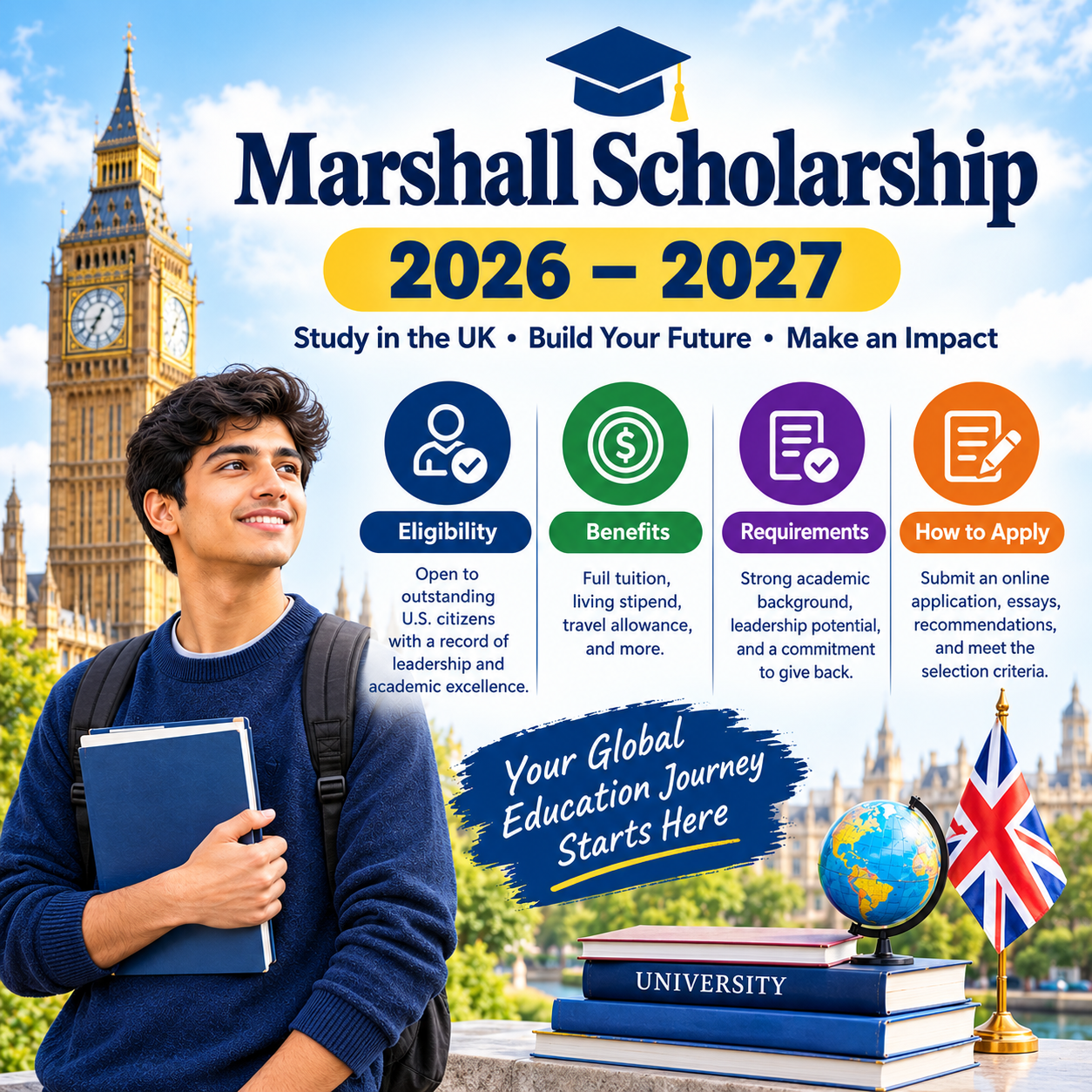
The Marshall Scholarship 2026–2027 guide explains how outstanding American students can pursue postgraduate study at universities in the United Kingdom with substantial financial support. The Marshall Scholarship funds eligible U.S. citizens who demonstrate academic excellence, leadership potential, and a commitment to strengthening relationships between the United States and the United Kingdom.
For the 2027 scholarship cycle, applications are now closed. Students planning ahead should use this guide to understand the eligibility criteria, funding benefits, application process, and preparation required for the next competition. The official Marshall Scholarships website states that applications for the 2028 cycle are expected to open in summer 2027.
What Is the Marshall Scholarship 2026–2027?
The Marshall Scholarship is a prestigious postgraduate scholarship programme that enables academically talented American students to study at universities in the United Kingdom. Established in 1953, the programme honours the ideals of the Marshall Plan and promotes educational, cultural, and intellectual exchange between the two countries.
What Is the Purpose of the Marshall Scholarship?
The programme aims to develop future leaders who can contribute to their academic fields while building lasting connections between the United States and the United Kingdom.
Its main objectives include:
- Enabling outstanding American students to pursue postgraduate education in Britain.
- Supporting research, innovation, and academic development.
- Encouraging an understanding of British society, institutions, and culture.
- Developing future leaders who can strengthen U.S.–UK relations.
- Promoting personal and intellectual growth through international education.
The scholarship is not simply a tuition award. It also provides an opportunity to experience a different academic environment, collaborate with international researchers, and develop a broader understanding of global issues.
Who Should Consider Applying?
The Marshall Scholarship is intended for U.S. citizens who have an excellent undergraduate academic record and the potential to become leaders in their chosen fields.
It may suit students interested in subjects such as science, engineering, public policy, economics, humanities, social sciences, and the creative arts. The programme does not restrict applicants to one academic discipline.
For example, a U.S. graduate interested in climate research might use the scholarship to study environmental science in Britain. Another candidate interested in international relations might pursue a postgraduate degree that supports a future career in diplomacy or public service.
In both cases, applicants must demonstrate strong academic preparation and explain how their proposed studies fit their longer-term goals.
Is the 2027 Marshall Scholarship Still Open?
No. As of October 24, 2026, applications for the 2027 Marshall Scholarship competition are closed. The official applicant deadline was September 29, 2026, followed by the institutional endorsement deadline of October 1, 2026.
Students who missed the deadline can prepare for the next competition rather than relying on an unofficial late application opportunity. Check the official Marshall Scholarships website for announcements about the 2028 cycle.
What Are the Benefits of the Marshall Scholarship?
The Marshall Scholarship provides substantial financial assistance for approved postgraduate study in the United Kingdom. Its published benefits include university fees, living expenses, travel support, and additional academic allowances, subject to the applicable programme rules.
What Expenses Does the Scholarship Cover?
The official programme describes the following benefits:
- University fees: Support for eligible tuition and university charges.
- Living expenses: An allowance to help scholars meet living costs in the United Kingdom.
- Annual book grant: Assistance with eligible academic materials.
- Thesis grant: Support for qualifying thesis-related expenses.
- Research and daily travel grants: Assistance with approved academic research and travel costs.
- International travel: Fares to and from the United States.
- Dependent spouse support: A contribution may be available where applicable.
The precise allowances and applicable conditions should be checked in the official rules for the relevant competition. Students should not assume that every personal expense will be reimbursed.
How Long Does Marshall Scholarship Funding Last?
The scholarship offers different study pathways, depending on the degree programme and the candidate's academic plans.
| Study pathway | General funding duration |
|---|---|
| One-year master's degree | One academic year, generally 12 months |
| Two consecutive one-year master's degrees | Up to two academic years |
| One two-year master's degree | Up to two academic years |
| PhD or DPhil | Three years of guaranteed funding, subject to academic progress |
| One-year master's followed by doctoral study | Two years guaranteed, with a possible discretionary third year |
These pathways are described by the official programme. The availability and conditions of extensions depend on the relevant rules, and additional funding beyond the guaranteed period may need to be secured separately.
Does the Scholarship Guarantee Admission to a UK University?
No. Receiving a Marshall Scholarship does not automatically guarantee admission to a chosen university or academic programme.
Scholarship selection and university admission are separate requirements. Candidates must meet the relevant university's admission criteria, including any course-specific academic qualifications, application deadlines, English-language requirements where applicable, and supporting documentation.
Students should therefore research university programmes early rather than waiting for the scholarship decision before considering admission requirements.
Who Is Eligible for the Marshall Scholarship 2026–2027?
The 2027 Marshall Scholarship has specific citizenship, academic, graduation-date, and previous-study requirements. Applicants must satisfy the official eligibility rules before their applications can be considered.
What Academic Qualifications Are Required?
For the 2027 competition, applicants must meet these academic requirements:
- Hold or be on track to hold their first undergraduate degree from an accredited four-year college or university in the United States by the time the scholarship begins.
- Have an undergraduate GPA of at least 3.7 on a 4.0 scale at the time of application.
- Have graduated from their first undergraduate college or university after April 2024.
- Meet the relevant degree and enrolment conditions specified in the official candidate rules.
The programme does not accept a rounded GPA to meet its minimum threshold. A student whose actual GPA is 3.68, for example, should not assume it qualifies because a transcript or informal calculation rounds it to 3.7.
Is U.S. Citizenship Mandatory?
Yes. Marshall Scholarships are available to citizens of the United States, not simply to people who live in the country or qualify for U.S. financial aid.
Permanent residents who are not U.S. citizens do not meet this requirement. Eligible dual citizens may apply if they satisfy the citizenship and academic rules, including the requirement for an undergraduate degree from an accredited U.S. institution.
Can Students Who Have Studied in the UK Apply?
The rules restrict candidates who have studied for, or hold, a degree or degree-equivalent qualification from a British university. They also exclude applicants who took GCSEs or A levels at school in the UK.
However, the official FAQ distinguishes this from certain study-abroad experiences in Britain that do not lead to a British degree. Candidates with previous UK education should read the official eligibility guidance carefully rather than assume that every visit or exchange programme makes them ineligible.
Who May Not Qualify?
You may not qualify for the 2027 competition if you:
- Are not a U.S. citizen.
- Earned your undergraduate degree outside the United States.
- Have an undergraduate GPA below 3.7 on the required 4.0 scale.
- Graduated from your first undergraduate institution before the permitted date.
- Have a disqualifying British degree or equivalent qualification.
- Do not meet another condition in the official rules.
These requirements apply to the 2027 competition. Anyone preparing for the 2028 cycle must check its published rules before making a final eligibility decision.
How Does the Marshall Scholarship Selection Process Work?
The Marshall Scholarship selection process evaluates more than grades. The official programme uses three equally weighted criteria: academic merit, leadership potential, and ambassadorial potential.
Academic Merit
Academic merit demonstrates that an applicant is prepared to succeed in a demanding postgraduate programme.
A strong application should connect academic achievements with the proposed course of study. Relevant research, advanced coursework, independent projects, and intellectual curiosity can help explain why the applicant is ready for the next academic step.
Leadership Potential
Leadership potential concerns an applicant's capacity to contribute, take responsibility, and help others work toward meaningful goals.
Leadership does not have to mean holding the title of president or director. Organising a community initiative, mentoring younger students, coordinating a research team, or improving an organisation's work may all provide useful examples.
The important point is to explain the applicant's actual contribution, the challenges encountered, and the results achieved. Specific evidence is more informative than simply describing oneself as a leader.
Ambassadorial Potential
Ambassadorial potential reflects the ability to build understanding between the United States and the United Kingdom.
Candidates should demonstrate curiosity about other perspectives, respect for cultural differences, and an interest in constructive international relationships. Experiences involving collaboration, public service, cultural exchange, or international research may help illustrate these qualities.
Applicants should connect these experiences to their future plans rather than relying on general statements about wanting to study abroad.
How to Apply for the Marshall Scholarship
The application process involves preparation, online submission, institutional endorsement, regional review, and potentially an interview. For future applicants, early coordination with the undergraduate institution is essential because university deadlines may fall before the national deadline.
Step-by-Step Application Process
Step 1: Confirm eligibility
Check citizenship, undergraduate institution, GPA, graduation date, and previous UK study against the rules for the correct competition year.
Step 2: Contact your undergraduate institution
Speak with the fellowship adviser or designated campus official about internal deadlines, institutional endorsement, and the application process.
Step 3: Research UK universities and courses
Identify suitable postgraduate programmes and explain how their academic strengths support your educational and career objectives.
Step 4: Prepare the application
Complete the required online sections, personal statements, academic details, and recommendation requests according to the official instructions.
Step 5: Submit for institutional endorsement
The undergraduate institution reviews the application and, if it chooses to endorse the candidate, submits it to the appropriate regional committee.
Step 6: Prepare for selection and university admission
Monitor official communications, prepare for a possible interview, and follow the relevant UK university admission requirements.
The official application guidance confirms that applicants submit through the online system to their undergraduate institution. The institution is responsible for endorsement and final submission.
What Documents Should Applicants Prepare?
The exact requirements depend on the competition's official instructions. Applicants should review the relevant application rules and prepare the following items where required:
- Undergraduate transcripts and academic records.
- Details of degrees, institutions attended, and graduation dates.
- Personal statements and supporting essays.
- Three letters of recommendation.
- Information about proposed UK universities and postgraduate courses.
- Evidence or descriptions of academic achievements, leadership, and service.
- Any additional information requested in the official application system.
The 2027 application required three recommendations and an institutional endorsement. Future applicants should confirm the corresponding requirements for their own cycle before submitting.
Marshall Scholarship Application Timeline
The following dates describe the 2027 competition, not a confirmed 2028 schedule.
| Milestone | 2027 competition |
|---|---|
| Application opened | May 29, 2026 |
| Applicant deadline | September 29, 2026 |
| Institutional submission deadline | October 1, 2026 |
| Interviews | Scheduled for mid-November 2026 |
| 2028 applications | Expected to open in summer 2027 |
The 2027 deadlines and interview schedule are published by the official Marshall Scholarships programme. The 2028 opening is an announced expectation; its final dates and rules should be checked when published.
How Can You Prepare a Strong Marshall Scholarship Application?
A strong application connects academic achievement, leadership, and future goals into one convincing explanation. Applicants should show why their chosen UK programme is appropriate for their ambitions and how their experiences demonstrate the qualities the selection committee values.
Write a Specific and Convincing Personal Statement
Your personal statement should explain your academic interests, motivation for studying in the UK, and longer-term plans. Avoid writing a general essay about how prestigious the scholarship is.
Instead, identify a particular academic question, research interest, or professional goal. Explain how your proposed course will help you address it and why the UK institution is a suitable place to pursue that work.
For example, a student interested in public health might discuss previous community research, identify a specific area of health policy they want to investigate, and explain how the proposed postgraduate programme supports their future public-service ambitions.
The example is illustrative, not a guarantee of selection.
Choose UK Universities Carefully
Your university choices should reflect genuine academic fit rather than reputation alone.
Research the curriculum, faculty interests, research facilities, relevant projects, and opportunities for collaboration. Read the admission requirements for each course and check if the programme matches your proposed scholarship pathway.
The Marshall programme also advises applicants to consider their course choices carefully and explain why their selected institutions are suitable.
Request Recommendations Early
Strong recommendations provide an independent perspective on your academic ability, character, and potential.
Approach recommenders who know your work well enough to provide specific examples. A professor who can discuss your research skills or intellectual development may be more helpful than someone who knows you only by name.
Give each recommender enough time, your current résumé, relevant academic information, and a clear explanation of your proposed study plans. Follow the official instructions for requesting and submitting recommendations.
Prepare for the Interview
Shortlisted candidates may be invited to an interview with their regional selection committee. The official 2027 schedule places interviews in November 2026.
Preparation should include:
- Explaining why you selected your proposed course and university.
- Discussing your academic interests and future objectives.
- Providing clear examples of leadership and community contribution.
- Reflecting on the relationship between the United States and the United Kingdom.
- Answering questions about your experiences honestly and thoughtfully.
Practise explaining your ideas aloud, but avoid memorising scripted answers. A clear, natural explanation of your goals is more useful than a polished response that does not reflect your actual experiences.
What Common Marshall Scholarship Application Mistakes Should You Avoid?
Applicants can weaken an otherwise promising application by overlooking eligibility details, missing internal deadlines, or failing to explain their academic choices. Careful planning helps reduce these avoidable risks.
Ignoring the GPA and Graduation Rules
Do not rely on assumptions about GPA rounding or graduation eligibility. Check the precise requirements for the competition you intend to enter and confirm how your undergraduate record will be evaluated.
If your academic circumstances are unusual, consult the official programme or your institutional adviser.
Missing Your University's Internal Deadline
The university endorsement deadline can differ from the applicant deadline. A candidate who waits until the final day may discover that their institution has already closed its internal nomination process.
Contact your fellowship adviser well before the application opens, and ask for a written schedule of required submissions.
Choosing a Course Without Researching It
A course should be relevant to your academic interests and realistic career plans. Simply naming a famous university does not explain why its programme is appropriate.
Compare course content, research opportunities, faculty expertise, and entry requirements. Be prepared to explain why your choices make sense.
Writing Vague Statements About Leadership
Statements such as “I am passionate about helping people” provide limited evidence on their own.
Describe what you actually did, the problem you addressed, the decisions you made, and what you learned. Use specific examples without exaggerating your responsibilities or claiming results you cannot support.
Treating Scholarship Selection as University Admission
Scholarship selection does not guarantee admission to a particular UK university. Applicants must satisfy the relevant admission requirements and complete any required university application.
The official FAQ explains that universities make their own admission decisions.
What Should Students Do Before the 2028 Marshall Scholarship Opens?
Students interested in the next cycle can use the period before summer 2027 to develop a realistic application plan. Although the next opening is expected in summer 2027, the official rules and deadlines for that cycle should be confirmed when released.
A Practical Preparation Checklist
Application preparation
0 of 8 completedCheck the official eligibility rules when the next cycle is publishedReview your undergraduate GPA and graduation dateContact your university's fellowship or scholarship adviserResearch suitable UK postgraduate coursesBuild relationships with potential recommendersPrepare examples of academic achievement and leadershipDraft and revise your personal statementsCreate a calendar for university and scholarship deadlines
Reset checklist
Where Can You Find Official Updates?
Use the official eligibility page to review citizenship, academic, and graduation requirements.
Visit the official application guidance for application instructions, recommendation requirements, and institutional endorsement information. The official FAQ page also answers questions about previous UK study, university admission, and application preparation.
These sources should take priority over third-party articles, social media posts, and outdated scholarship listings.
Frequently Asked Questions About the Marshall Scholarship 2026–2027
1. Is the Marshall Scholarship fully funded?
The Marshall Scholarship provides substantial funding that includes eligible university fees, living expenses, book and thesis grants, research and daily travel grants, and travel between the United States and the UK. Support for a dependent spouse may also be available in applicable circumstances. The exact benefits and conditions depend on the official programme rules, so applicants should verify the relevant funding terms before planning their budgets.
2. Can international students apply for the Marshall Scholarship?
The Marshall Scholarship is specifically for U.S. citizens. Applicants must also meet the undergraduate institution, GPA, graduation-date, and previous-study requirements. International students who are not U.S. citizens are not eligible, even if they live in the United States or hold permanent residency. Students who do not qualify should investigate scholarships offered by their intended UK university or other funding programmes suited to their citizenship.
3. What GPA is required for the Marshall Scholarship?
For the 2027 competition, applicants needed an undergraduate GPA of at least 3.7 on a 4.0 scale. The official programme does not accept rounded GPAs to meet the threshold. The GPA requirement applies to the undergraduate degree specified in the eligibility rules, not simply to a higher GPA earned in a later postgraduate programme. Applicants should check the published rules for their intended competition year.
4. When will applications for the Marshall Scholarship 2028 open?
The official Marshall Scholarships website states that applications for the 2028 cycle will open in summer 2027. The precise opening date and application deadlines should be confirmed through the programme's official website when the next cycle's information becomes available. Prospective applicants can prepare beforehand by researching UK courses, contacting their university adviser, and identifying suitable recommenders.
5. Does receiving a Marshall Scholarship guarantee admission to Oxford or Cambridge?
No. The Marshall Scholarship does not guarantee admission to the University of Oxford, the University of Cambridge, or any other UK university. Each institution makes its own admissions decisions, and candidates must satisfy the relevant course requirements. Applicants should research admission deadlines early because some programmes have deadlines that fall before scholarship decisions are announced.
Final Thoughts: Is the Marshall Scholarship Worth Preparing For?
The Marshall Scholarship offers eligible American students an opportunity to pursue postgraduate education in the UK while receiving substantial financial support. Its selection process values academic merit, leadership potential, and the ability to strengthen understanding between the United States and the United Kingdom.
For students who missed the 2027 deadline, the next practical step is to prepare for the anticipated 2028 cycle. Review the eligibility rules, explore suitable postgraduate courses, build relationships with recommenders, and contact your undergraduate institution about its endorsement process.
Start with the official Marshall Scholarships website, confirm the latest requirements, and prepare your application well before the next deadline. You can also explore related scholarship guides and postgraduate funding resources to compare other opportunities.
Author: Ashes Jhon
Reviewed by: Education professional or scholarship adviser — reviewer verification required before publication. No independent professional review is claimed in this draft.
Last updated: October 2026
Disclaimer: Information provided in this article is for educational purposes only and should be verified with the official organization before making application decisions. Requirements, deadlines, funding conditions, and eligibility rules may change.
Disclosure: If this website earns revenue through advertising or affiliate partnerships, disclose that relationship here. Remove this statement if it does not apply.



0 Comments