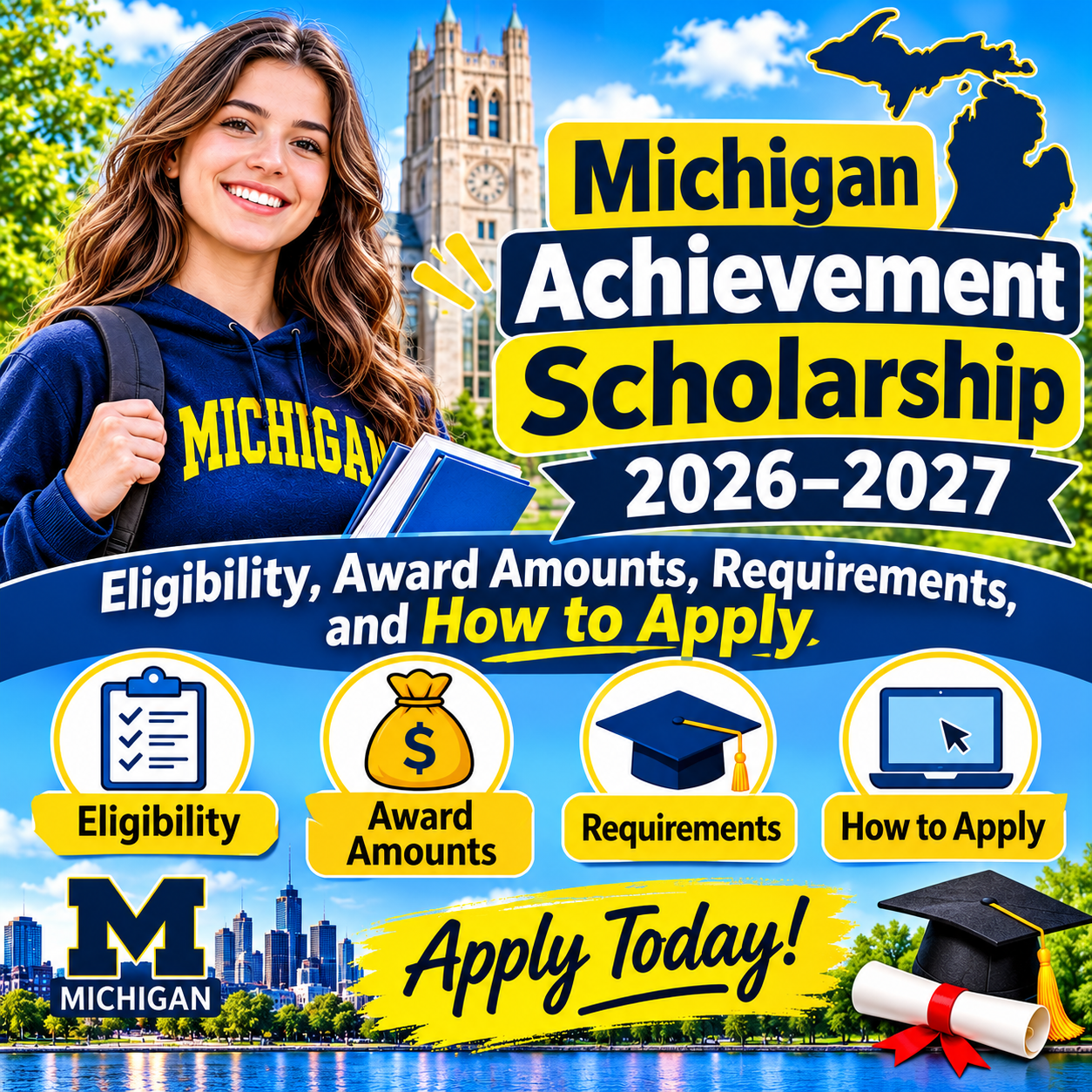
The Michigan Achievement Scholarship 2026–2027 is a state-funded financial aid program that helps eligible Michigan residents pay for college, university, and approved career training. Depending on the educational pathway, qualifying students may receive up to $27,500 over five years at eligible four-year institutions or substantial tuition assistance through the Community College Guarantee.
The program is particularly valuable for recent high school graduates and students who need financial support to continue their education without taking on excessive student loan debt.
However, students often have questions about the award amount, residency rules, FAFSA requirements, participating institutions, and application deadlines. There are also important eligibility changes for the 2026–27 academic year that students should understand before making college decisions.
This guide explains the program, its financial benefits, eligibility requirements, application process, renewal conditions, and practical steps to avoid common mistakes.
What Is the Michigan Achievement Scholarship?
The Michigan Achievement Scholarship is a state financial aid initiative administered by the Michigan Department of Lifelong Education, Advancement, and Potential (MiLEAP) through MI Student Aid.
Its purpose is to make higher education and career training more affordable for Michigan residents.
Why Was the Scholarship Created?
The program was established to reduce financial barriers that prevent students from attending college or completing career-focused education.
College expenses can include:
- Tuition and mandatory fees
- Books and educational materials
- Course-related expenses
- Other eligible education costs, depending on the pathway
By reducing eligible education expenses, the scholarship can make it easier for families to plan for college.
Who Benefits From the Program?
The program supports eligible students pursuing different educational pathways, including:
- Students attending Michigan public universities.
- Students attending eligible private colleges and universities in Michigan.
- Students attending eligible community colleges.
- Students attending participating Tribal colleges.
- Students enrolling in approved career training programs.
Not every pathway has the same award calculation or eligibility conditions. Students should identify the correct program before estimating their financial assistance.
Is It a Scholarship or a Student Loan?
The Michigan Achievement Scholarship is grant-based financial assistance, not a conventional student loan.
Eligible recipients generally do not repay the scholarship simply because they received it. However, institutional withdrawal policies, enrollment changes, and other program rules can affect payments.
It is important to distinguish this assistance from loans that must be repaid with interest.
How Much Is the Michigan Achievement Scholarship Worth in 2026–2027?
The amount depends on the institution and educational pathway. The state advertises up to $5,500 annually for qualifying students attending eligible four-year institutions.
Michigan Public and Private University Awards
Students attending eligible Michigan public universities or private colleges and universities may qualify for:
Up to $5,500 per year
The program can provide assistance for up to five years, subject to eligibility and funding rules.
| Award detail | Amount |
|---|---|
| Maximum annual award | $5,500 |
| Maximum eligibility period | 5 years |
| Potential maximum total | $27,500 |
The $27,500 figure represents the maximum possible amount over five years, not an automatic payment to every student.
Actual awards depend on eligibility, enrollment, institutional certification, and applicable financial aid calculations.
Community College Guarantee
Students attending eligible Michigan community colleges may qualify for the Community College Guarantee, which operates within the Michigan Achievement Scholarship program.
This pathway is designed to make community college tuition and mandatory fees more affordable.
Eligible students may receive tuition assistance based on the program's applicable cost calculations, including eligible tuition and mandatory fees up to the established in-district rate.
The Community College Guarantee should not be confused with the separate $5,500 annual university award.
Career Training Assistance
Students interested in technical education and career preparation may also qualify through the Michigan Achievement Skills Scholarship pathway.
Approved training programs can help students prepare for employment in eligible high-demand industries.
Important: Award limits, approved programs, and payment calculations differ across pathways. Confirm the current 2026–27 figures with MI Student Aid and the participating institution before relying on an estimated award.
How Is the $5,500 University Award Calculated?
The four-year award has two components:
| Component | Maximum annual amount |
|---|---|
| Michigan Achievement Scholarship Minimum Award | $2,500 |
| Michigan Achievement Scholarship Last-Dollar Award | $3,000 |
| Total | $5,500 |
The Minimum Award and Last-Dollar Award can be applied toward the student's cost of attendance, subject to program calculations.
For example, a student may qualify for the full $2,500 Minimum Award and $3,000 Last-Dollar Award if sufficient eligible costs remain after other gift aid is considered.
This is why two students attending different universities may receive different amounts.
Is There Additional Money for Community College Students?
Yes. Eligible community college and Tribal college students may receive an additional Michigan Achievement Bonus if they qualify for a Federal Pell Grant.
The bonus is $1,000 per academic year, subject to the applicable semester limits and cost-of-attendance rules.
The official 2026–27 program manual provides detailed award calculations for both in-district and out-of-district students. michigan.gov+2
Who Is Eligible for the Michigan Achievement Scholarship 2026–2027?
Students must satisfy the program's residency, education, financial, enrollment, and institutional requirements. Eligibility is not automatic simply because someone lives in Michigan or graduates from high school.
Basic Eligibility Requirements
For the college and university pathways, applicants generally must:
- Complete the current academic year's FAFSA.
- Be a Michigan resident since July 1 of the previous calendar year.
- Be a U.S. citizen, permanent resident, or approved refugee.
- Have graduated from high school with a diploma or certificate of completion, or earned a high school equivalency certificate in 2023 or later.
- Have a Student Aid Index (SAI) of 30,000 or less, subject to the applicable exception for qualifying previous recipients.
- Enroll full-time at an eligible institution.
- Be an undergraduate student.
- Meet the institution's Satisfactory Academic Progress (SAP) requirements.
- Not be in default on a federal student loan.
- Begin enrollment at an eligible institution within 15 months of high school graduation or earning a high school equivalency certificate.
The institution determines full-time enrollment according to its applicable policies. michigan.gov+2
Does a Student Need to Graduate From a Michigan High School?
No. This is an important change for the 2026–27 academic year.
Previously, Michigan high school graduation was part of the program's eligibility rules. The state removed this restriction for 2026–27.
Students who graduated from an out-of-state high school in 2023 or later may now qualify if they meet the remaining Michigan residency, FAFSA, enrollment, and other program requirements.
For example, a student who graduated from an Ohio high school but has established the required Michigan residency may be eligible.
This change does not remove the Michigan residency requirement. Out-of-State Student Process+1
Is There a Minimum GPA Requirement?
There is no specific GPA requirement for initial Michigan Achievement Scholarship eligibility.
However, students must maintain their institution's Satisfactory Academic Progress requirements to continue receiving the award.
SAP policies can include academic performance, credit completion, and maximum time limits. Students should check their college's financial aid policy instead of assuming that the absence of a scholarship-specific GPA requirement means academic performance does not matter.
Do Students Need to Demonstrate Financial Need?
Financial need is important for the four-year college and university pathway.
Students generally need an SAI of 30,000 or less, as determined through the FAFSA.
There is a specific exception for students who received the Michigan Achievement Scholarship during academic year 2023–24 and completed the 2026–27 FAFSA. The state considers these qualifying students to have met the financial need requirement regardless of their current SAI.
The definition of having received the award includes students who received a payment or were certified as exceeding their cost of attendance. michigan.gov+1
Who May Not Qualify?
An applicant may be ineligible if they:
- Do not meet Michigan residency requirements.
- Have not completed the required high school education or equivalency.
- Fail to submit the required FAFSA.
- Do not meet the applicable financial need requirement for the four-year pathway.
- Enroll outside the 15-month initiation period.
- Attend an institution that does not participate in the program.
- Are not enrolled full-time when full-time enrollment is required.
- Are in default on a federal student loan.
- Fail to satisfy institutional SAP requirements.
Some exceptions and special circumstances exist. Students should ask their college's financial aid office to review their individual situation.
How Does the Michigan Achievement Scholarship Work?
The scholarship works through three educational pathways. Students should select the pathway that matches their educational plans.
Pathway 1: Four-Year Public and Private Universities
Students attending eligible Michigan public universities and private nonprofit colleges may receive up to $5,500 annually.
This option is particularly useful for students planning to complete bachelor's degrees.
Eligible students must complete the FAFSA and meet the applicable residency, financial need, enrollment, and academic requirements.
Pathway 2: Community College Guarantee
The Community College Guarantee helps eligible students attend participating Michigan community and Tribal colleges.
Its main benefit is assistance with:
- In-district tuition.
- Eligible contact hours.
- Mandatory fees.
The last-dollar calculation accounts for other eligible gift aid. Out-of-district students can also qualify, but the scholarship calculation is limited by the applicable in-district tuition and fee amount.
Eligible students may receive support for up to three years through this pathway. michigan.gov+1
Pathway 3: Michigan Achievement Skills Scholarship
Students interested in short-term career training may qualify for the Michigan Achievement Skills Scholarship.
This pathway is different from traditional university financial aid.
It provides up to $2,000 per eligible career training program. Students do not need to complete the FAFSA for this particular scholarship.
Approved training programs may prepare students for careers in technical and high-demand occupational fields.
The state also allows eligible students who complete this pathway to pursue additional college education through the appropriate Michigan Achievement Scholarship pathway, subject to its requirements. michigan.gov+1
How Do You Apply for the Michigan Achievement Scholarship?
The application process depends on the pathway you select. For the college and university pathways, completing the FAFSA is the essential first step.
Step 1: Complete the FAFSA
Visit the official Federal Student Aid FAFSA website.
Complete the 2026–27 FAFSA if you plan to attend college between fall 2026 and summer 2027.
Provide accurate information about your financial circumstances and follow the instructions for any required contributors.
Step 2: Provide Accurate Residency Information
Michigan residency is an important eligibility condition.
Check that your FAFSA information accurately reflects your residency and that of the applicable parent or contributor if you are a dependent student.
If you recently moved to Michigan, ask the financial aid office how to document your residency history.
Step 3: Apply to an Eligible Institution
Choose a participating college, university, community college, or Tribal college.
Confirm that your selected institution participates in the correct scholarship pathway.
Admission to a college and scholarship eligibility are separate processes. Receiving an admission offer does not automatically guarantee financial aid.
Step 4: Check Your MiSSG Student Portal
The MiSSG Student Portal is the state's system for students to access Michigan financial aid information.
Create or access your account through the official MI Student Aid website.
Check your eligibility information and respond to requests for additional documentation.
Step 5: Complete Verification if Required
Some FAFSA applicants are selected for verification.
If selected, provide the documents requested by your financial aid office. These may include tax information or other records needed to confirm the details submitted on your FAFSA.
Do not ignore verification notifications because incomplete verification can delay financial aid processing.
Step 6: Review Your Financial Aid Offer
Once your college processes your information, review your financial aid offer.
Check the Michigan Achievement Scholarship amount, other grants, institutional scholarships, and any remaining tuition balance.
Contact the financial aid office if the scholarship is missing or the amount differs from your expectations.
What Is the Application Process for Each Pathway?
| Step | Action | Details |
|---|---|---|
| 1 | Identify pathway | University, community college, or career training |
| 2 | Complete FAFSA | Required for college pathways |
| 3 | Apply to institution | Select a participating institution |
| 4 | Create MiSSG account | Monitor eligibility and updates |
| 5 | Submit documents | Complete verification if requested |
| 6 | Review award | Confirm assistance with the financial aid office |
Important distinction: The Skills Scholarship requires its own application through the MiSSG Student Portal. It is not automatically awarded through the FAFSA process.
What Are the Important Deadlines for 2026–2027?
The Michigan Achievement Scholarship has different application procedures and deadlines depending on the educational pathway.
College and University Pathway Deadline
According to the 2026–27 State Programs and Procedures Manual, the final day for students to become eligible for the Michigan Achievement Scholarship for the 2026–27 academic year is:
Final eligibility date
August 6, 2027
Friday · 2026–27 academic year
Although this is the published final eligibility date, students should complete their FAFSA and resolve any outstanding requirements much earlier. Waiting until the last moment can create processing problems. michigan.gov
Career Training Application Deadline
The Michigan Achievement Skills Scholarship has a separate application deadline.
| Application detail | Date |
|---|---|
| 2026–27 application opens | March 1, 2026 |
| Application deadline | August 1, 2027 |
| Maximum award | $2,000 per eligible program |
Students should apply through the MiSSG Student Portal and confirm that their training provider and program are approved. michigan.gov+1
When Should Students Apply?
The best approach is to complete the FAFSA as soon as possible, apply to colleges early, and monitor the MiSSG portal regularly.
Students should also check individual college financial aid deadlines because institutional admission and scholarship processing schedules may differ from state program deadlines.
What Documents Should You Prepare?
Preparing your information in advance can make the financial aid process easier.
Documents and Information to Keep Ready
Depending on your circumstances, you may need:
- Social Security number or other required identification information.
- Parent or contributor information, if applicable.
- Federal tax information requested through the FAFSA.
- High school diploma or certificate of completion.
- High school equivalency documentation, if applicable.
- Michigan residency documentation, if requested.
- College admission and enrollment information.
- Additional documents requested during FAFSA verification.
For career training applicants, the training provider must verify high school completion and Michigan residency under the applicable program rules.
Practical advice: Do not send sensitive documents to unofficial websites or individuals claiming they can guarantee scholarship approval. Use the official FAFSA, MiSSG, and college financial aid channels.
How Can You Maintain the Scholarship After Receiving It?
Receiving the scholarship for one academic year does not mean that future payments are automatic.
Students must continue meeting the applicable renewal requirements.
Complete the FAFSA Every Year
Students must submit a new FAFSA for each academic year they want to receive the college or university scholarship.
A previous award does not replace the current year's FAFSA.
Maintain Full-Time Enrollment
Students must remain enrolled full-time under their institution's definition.
Before dropping a class or changing enrollment status, speak with the financial aid office.
A reduction in course credits can affect scholarship eligibility and payment calculations.
Maintain Satisfactory Academic Progress
Students must meet their college's SAP policy.
This may involve maintaining acceptable grades, completing sufficient attempted credits, and progressing toward their degree within the institution's permitted timeframe.
Continue Meeting Residency Requirements
Students must maintain their Michigan residency status.
Changes in residency or personal circumstances should be discussed with the financial aid office before assuming that future payments will continue.
Understand the Five-Year Limit
The college and university scholarship may be available for up to five academic years in total.
However, students generally cannot use more than three years at eligible community or Tribal colleges.
Students enrolled in an eligible bachelor's degree program at a Michigan community college may qualify for up to five years under the applicable rules. michigan.gov+1
What Common Mistakes Should Students Avoid?
Even students who appear to meet the eligibility requirements can experience delays or lose eligibility because of avoidable mistakes.
1. Assuming FAFSA Submission Guarantees Approval
Completing the FAFSA is necessary, but it does not guarantee a scholarship.
Students must also satisfy the other eligibility conditions, including residency, enrollment, and financial requirements where applicable.
2. Missing the 15-Month Enrollment Requirement
Eligible students must initiate the scholarship within 15 months of graduating from high school or earning an equivalency certificate.
This requirement is especially important for students taking a gap year.
For example, a student who graduates in spring 2026 should plan to begin at an eligible institution within the applicable period rather than delaying college without checking the rules.
3. Choosing a Nonparticipating Institution
Not every educational institution qualifies.
Before accepting admission, verify the institution's participation in the relevant scholarship pathway.
4. Ignoring FAFSA Verification Requests
Some students assume their financial aid application is complete once they submit it.
However, additional information may be requested.
Ignoring these requests can delay eligibility confirmation and award adjustments.
5. Confusing the Three Scholarship Pathways
The university scholarship, Community College Guarantee, and Skills Scholarship have different award calculations and application procedures.
A student planning to attend a technical training program should not assume that completing the FAFSA automatically applies for the Skills Scholarship.
6. Assuming the Maximum Award Is Guaranteed
The advertised $5,500 annual university award is a maximum, not a guaranteed payment.
Other financial assistance, cost-of-attendance limits, and individual eligibility circumstances can affect the final amount.
What Tips Can Improve Your Scholarship Planning?
A thoughtful financial aid plan can help students avoid unnecessary expenses and make better educational decisions.
Compare Colleges Before Accepting Admission
Do not compare universities based only on their advertised tuition.
Compare the full cost of attendance, including housing, transportation, books, meals, and mandatory fees.
A college with higher tuition may offer institutional grants that make its final cost more affordable.
Combine Eligible Financial Aid Opportunities
Explore additional financial assistance, including:
- Federal Pell Grants.
- Institutional scholarships.
- Private scholarships.
- Other eligible Michigan state grants.
- Community foundation scholarships.
Ask your financial aid office how different awards interact with the Michigan Achievement Scholarship.
Keep Copies of Important Documents
Maintain a secure folder containing your FAFSA confirmation, scholarship correspondence, enrollment information, and verification documents.
This makes it easier to respond to questions and resolve processing issues.
Contact Financial Aid Before Making Enrollment Changes
If you need to transfer, reduce your course load, or take a semester off, ask how the decision may affect your eligibility.
Getting advice before making changes can prevent unexpected financial problems.
Check Official Updates Regularly
Scholarship rules and funding arrangements can change through state budget decisions.
Use the official MI Student Aid website rather than relying exclusively on old blog posts, social media discussions, or third-party scholarship listings.
Frequently Asked Questions About the Michigan Achievement Scholarship
1. How much is the Michigan Achievement Scholarship for 2026–2027?
Eligible students attending qualifying Michigan public universities or private nonprofit colleges may receive up to $5,500 annually for up to five years. This represents a potential maximum of $27,500. Community college and career training awards have different calculations and eligibility conditions.
2. Do I need to complete the FAFSA to receive the Michigan Achievement Scholarship?
Yes. Students applying through the university and Community College Guarantee pathways must complete the current academic year's FAFSA. However, students applying for the Michigan Achievement Skills Scholarship do not need the FAFSA. They must submit the separate Skills Scholarship application through MiSSG.
3. Can out-of-state high school graduates qualify?
Yes. Beginning with academic year 2026–27, graduating from a Michigan high school is no longer required. Students who graduated from an out-of-state high school in 2023 or later may qualify if they satisfy the Michigan residency, financial, enrollment, and other applicable eligibility requirements.
4. Is there a minimum GPA requirement?
There is no separate GPA requirement for initial Michigan Achievement Scholarship eligibility. However, recipients must meet their institution's Satisfactory Academic Progress policy to maintain their financial assistance. Students should check their college's academic progress rules because those requirements can affect future scholarship payments.
5. Is the Michigan Achievement Scholarship renewable?
Yes. Eligible students may receive the scholarship for up to five academic years, subject to the applicable pathway limits. University and community college students must complete the FAFSA annually, maintain Michigan residency, satisfy enrollment requirements, and meet their institution's SAP standards.
Final Thoughts: Is the Michigan Achievement Scholarship Worth Applying For?
The Michigan Achievement Scholarship 2026–2027 offers an important opportunity for eligible Michigan residents to reduce the cost of college, university, and career training.
Its three pathways provide different forms of assistance, making the program relevant to students pursuing bachelor's degrees, community college education, and occupational training.
The most important steps are to understand your eligibility, complete the correct application, choose an approved institution, and monitor your financial aid status.
Your next step: Visit the official MI Student Aid website, complete the appropriate application, and contact your institution's financial aid office if you need help confirming your award.
Author Information
Written by: Ashes Jhon
Reviewed by: Education professional specializing in scholarships and academic guidance (reviewer identity and credentials to be confirmed before publication).
Last Updated: November 11, 2026.
Important Notice: Scholarship requirements, award amounts, deadlines, and eligibility rules may change. Always confirm the latest information with MI Student Aid and your participating institution.
Disclaimer: Information provided in this article is for educational purposes only and should be verified with the official organization before making application decisions. Scholarship eligibility and award amounts are not guaranteed.
Disclosure: If this website earns revenue through advertising or affiliate partnerships, those relationships should be disclosed transparently. Advertising does not determine scholarship eligibility or official award decisions.





0 Comments