
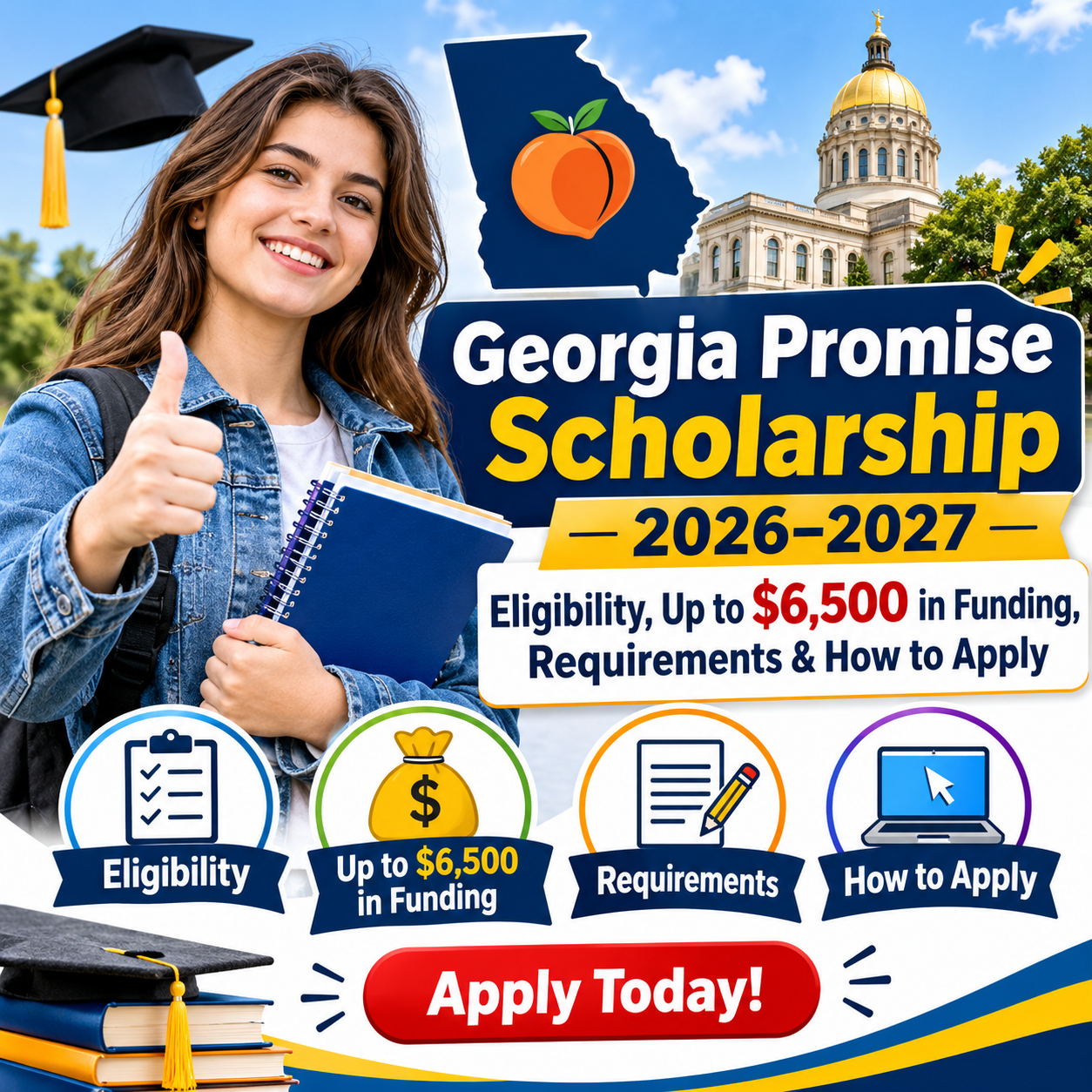
The Georgia Promise Scholarship 2026–2027 is a state-funded school choice program that helps eligible Georgia families pay for private school tuition, homeschooling expenses, tutoring, and other approved educational services. It is designed primarily for students who live in the attendance zones of qualifying lower-performing Georgia public schools.
The program gives parents greater flexibility in choosing an educational environment for their children. However, eligibility depends on specific residency, school attendance, age, and application requirements. Families should also understand that the advertised funding amount and the amount available for the 2026–2027 school year are not necessarily the same.
This guide explains the program, eligibility requirements, funding, application process, important documents, and practical steps families can take before applying.
What Is the Georgia Promise Scholarship?
The Georgia Promise Scholarship is an education savings account program established under Georgia Senate Bill 233 (SB 233), signed into law in 2024. It is administered by the Georgia Education Savings Authority (GESA).
Unlike a traditional college scholarship, this program supports K–12 education. It gives qualifying families access to state funding for approved nonpublic education expenses.
What Is the Main Purpose of the Program?
The program aims to expand educational choices for families who believe another learning environment may better meet their children's needs.
Parents can use approved funding to support private school education, home study, tutoring, curriculum, and certain specialized educational services.
Who Benefits From the Georgia Promise Scholarship?
The program is intended for eligible Georgia students in kindergarten through grade 12.
Potential beneficiaries include:
- Students transitioning from qualifying Georgia public schools.
- Children entering kindergarten who meet the program's residency and attendance-zone requirements.
- Families considering an approved participating private school.
- Eligible families choosing a qualifying home study program.
- Students who need approved tutoring or specialized educational support.
Is It a Traditional Scholarship or an Education Savings Account?
The Georgia Promise Scholarship operates as an education savings account rather than an unrestricted cash award.
Approved funds are deposited into a student account through the program's online platform. Parents then direct the money toward eligible schools, services, and educational products.
The program is established by Georgia law and administered through GESA. Georgia Student Finance Commission+2
How Much Is the Georgia Promise Scholarship Worth in 2026–2027?
The Georgia Promise Scholarship provides up to $6,500 per eligible student for the 2026–2027 academic year.
This is the maximum annual funding amount established for the program. It is not a guaranteed payment to every family, and the amount available for eligible expenses may be affected by administrative deductions.
What Is the Maximum Scholarship Amount?
The official program website confirms the following:
| Funding detail | 2026–2027 information |
|---|---|
| Maximum annual award | $6,500 |
| Payment schedule | Four quarterly installments |
| Administrative deduction | Up to 5% |
| Fund management | Student education savings account |
| Unused funds | Up to 50% may roll over |
The Georgia Education Savings Authority may withhold up to 5% of scholarship proceeds for administrative purposes. Therefore, families should not automatically assume that the entire $6,500 will be available for purchases. Access Achieve Succeed+2
How Are Scholarship Payments Distributed?
Funding is distributed quarterly through the Odyssey platform.
Parents must complete the required acceptance and opt-in procedures before accessing the funds. They are also responsible for initiating payments to participating private schools and approved providers.
Can Unused Scholarship Money Carry Over?
Yes. According to the program's published guidance, up to 50% of the funds awarded for an academic year may carry over to the following academic year.
For example, if a student receives $6,500, the maximum potential rollover is $3,250.
This does not mean the entire remaining balance can automatically be transferred. The program's rollover rules and account requirements still apply. Access Achieve Succeed+1
Who Is Eligible for the Georgia Promise Scholarship 2026–2027?
Eligibility depends on the student's public school enrollment history, residential attendance zone, and the parent's Georgia residency.
Meeting the basic requirements does not guarantee an award because applications may be subject to verification, prioritization, and available program capacity.
You Must Have: Student Enrollment Eligibility
A student generally must meet one of these two conditions:
- Currently enrolled in a Georgia public school and enrolled in a Georgia public school for the previous two consecutive full semesters.
- Entering kindergarten as a rising kindergarten student.
An important distinction is that a student who qualifies through public school enrollment may choose an approved private school or home study arrangement.
Families should not assume that a child who has already been homeschooled for two semesters automatically meets the initial enrollment requirement.
You Must Live in an Eligible Attendance Zone
The student must reside in the attendance zone of at least one public school included on the official eligible school list.
The Governor's Office of Student Achievement (GOSA) identifies qualifying schools based on their performance ratings.
Important: Your child does not necessarily need to attend the lower-performing school listed by the state. Living in the attendance zone of a qualifying school is what matters.
For example, a family may have a child attending a different school but still satisfy the attendance-zone requirement because their residential address falls within the zone of another eligible public school. goews.georgia.gov+1
You Must Meet the Georgia Residency Requirement
A parent or guardian generally must have lived in Georgia for at least one year.
An exception applies to active-duty military families who relocated to Georgia within the previous year. These families must provide the required military documentation.
Does Household Income Affect Eligibility?
Income is important for application prioritization and access to certain application windows.
The program's published guidance identifies 400% of the Federal Poverty Level (FPL) as an important threshold.
Families with household income at or below 400% FPL receive priority consideration in the applicable selection process. The program's guidance also restricts consideration of applicants above this threshold to the first two annual application windows.
Because application-window rules can affect eligibility for a particular semester, families should check the current application instructions before submitting an application. mygeorgiapromise.org+2
You May Not Qualify If:
- Your child does not meet the required Georgia public school enrollment or kindergarten-entry condition.
- Your residence is outside all eligible attendance zones.
- Your parent or guardian does not meet the residency requirement and no military exception applies.
- Your child is not eligible under the applicable program rules.
- Your family selects a nonparticipating private school and expects the scholarship to pay its tuition.
- Your child returns to public school after entering the program.
The program also has rules governing the combination of Promise Scholarship funds with other scholarship programs. Families should review those restrictions before making financial commitments. mygeorgiapromise.org+1
What Expenses Does the Georgia Promise Scholarship Cover?
The scholarship can cover several approved education expenses, but parents must use the program's approved marketplace and provider arrangements.
Not every educational purchase or private school qualifies.
Private School Tuition and Fees
Eligible funds may cover tuition and fees at participating private schools.
The school must meet GESA's participation requirements and appear on the approved private school list.
Before choosing a school, parents should confirm its participation status and the grade levels it is approved to serve.
Curriculum, Textbooks, and Educational Materials
Approved educational expenses may include:
- Qualifying curriculum.
- Supplemental educational materials.
- Required textbooks for eligible courses.
- Approved educational resources.
Parents should verify the eligibility of specific products before purchasing them.
Tutoring and Academic Support
Tutoring services may qualify when provided by an educator certified by the Georgia Professional Standards Commission (PSC).
This can help students who need additional support in mathematics, reading, writing, or other academic subjects.
Specialized Educational and Therapeutic Services
Certain services provided by qualified physicians or licensed therapists may be eligible.
These include approved services involving:
- Occupational therapy.
- Physical therapy.
- Speech-language therapy.
- Behavioral therapy.
- Other authorized therapeutic services.
Only services included in the approved program arrangements should be treated as eligible expenses.
Transportation Assistance
The program permits up to $500 per year for qualifying transportation expenses to and from approved private schools or service providers.
Families should review the current reimbursement and documentation procedures before assuming that a transportation expense will be covered. mygeorgiapromise.org+1
How Does the Georgia Promise Scholarship Work?
The Georgia Promise Scholarship works through an application, eligibility verification, award decision, parent opt-in, and quarterly funding process.
Understanding the sequence is important because leaving public school before receiving official approval can create unnecessary problems.
Step 1: Check Your Child's Eligibility
Start by visiting the official Georgia Promise Scholarship website.
Use the family pre-screen tool to check:
- Your residential attendance zone.
- Your child's public school enrollment history.
- Your family's Georgia residency.
- Other applicable eligibility conditions.
The pre-screen tool provides an initial indication. It does not replace the official application review.
Step 2: Explore Participating Educational Options
Before applying, research the educational arrangements available to your family.
You can explore:
- Participating private schools.
- Approved educational service providers.
- Qualifying home study arrangements.
- Eligible tutoring and curriculum options.
Compare tuition, additional fees, academic programs, transportation, and the learning environment.
Step 3: Submit the Online Application
Parents and guardians must complete the student application through the official program website.
The application is processed through Odyssey, the platform supporting program administration and student accounts.
Provide accurate information and upload the requested documents.
Step 4: Wait for Eligibility Verification and the Award Decision
After submission, the application may show a status such as eligible, under review, or ineligible.
An eligible status does not mean that the scholarship has been awarded.
Final award decisions are made after the application window closes. Selection may depend on the program's priority rules and available capacity. Applications are not approved simply because they were submitted first.
Step 5: Complete the Parent Opt-In Process
Once the student is approved and receives the official award letter, the parent or guardian must complete the required opt-in process.
This includes confirming the student's educational selection and accepting participation through the parent portal.
Step 6: Receive Quarterly Funding
After the required procedures are completed, the student's account receives quarterly funding.
Parents can direct the funds toward approved schools, educational services, and eligible marketplace purchases.
Important: The student must remain enrolled in public school until the official award letter is received. After receiving the award, the family must follow the program's withdrawal and opt-in instructions. mygeorgiapromise.org+2
Georgia Promise Scholarship 2026–2027 Application Dates
The Georgia Promise Scholarship uses multiple application periods during the year.
As of November 2, 2026, the final application window for the 2026–2027 academic year is open.
Spring 2027 application window
Currently open
November 1–30, 2026
Apply through the official Georgia Promise Scholarship website.Visit official application website
2026 Application Schedule
| Application period | Dates | Status |
|---|---|---|
| First period | March 1–31, 2026 | Closed |
| Second period | May 1–31, 2026 | Closed |
| Third period | August 1–31, 2026 | Closed |
| Fourth period | November 1–30, 2026 | Open |
These are the published 2026 student application periods. The November window is for students seeking participation in the Spring 2027 semester. Georgia Education Savings Authority+1
When Will Families Receive Funding?
Funding is provided through quarterly account deposits after approval and completion of the required participation steps.
The application window determines the semester for which a student is considered. Families applying in the later windows should not assume they will receive a full year's funding.
What Happens If You Miss the November Deadline?
If you miss the final 2026 application period, check the official website for the next academic year's application schedule.
Do not assume that a late application will be accepted outside the published window.
What Documents Are Required to Apply?
Parents should prepare documents before beginning the online application.
Having clear, accurate documentation can help prevent verification delays.
Required Identification Documents
Prepare:
- A Georgia driver's license or state identification card.
- A current document confirming the parent's residential address.
Proof of Georgia Residency
Acceptable residency documents identified in the program handbook include:
- Recent utility bill.
- Lease agreement.
- Mortgage statement.
- Property deed.
- HUD closing disclosure statement.
Active-duty military families who recently relocated may need to submit military orders instead.
Household Income Documentation
The program identifies the most recent federal Form 1040 as an income verification document.
Certain approved benefit documents may also be accepted, including documentation relating to SNAP, Medicaid, TANF, LIHEAP, SSDI, or SSI.
Check the current portal instructions for the exact documents accepted for your application.
Student Enrollment Records
For students qualifying through public school attendance, prepare evidence of enrollment for the previous two consecutive semesters.
Examples include:
- Report cards.
- Academic transcripts.
- School enrollment records.
- Attendance reports.
Rising kindergarten applicants generally do not need the previous public school enrollment records. mygeorgiapromise.org+1
Georgia Promise Scholarship Application Process: Step-by-Step Table
The following table summarizes the application journey for families.
| Step | Action | Details |
|---|---|---|
| 1 | Check eligibility | Review attendance-zone and residency requirements. |
| 2 | Use the pre-screen tool | Check your child's potential eligibility. |
| 3 | Research schools | Compare participating private schools and home study options. |
| 4 | Gather documents | Prepare identification, residency, income, and enrollment records. |
| 5 | Apply online | Complete the Odyssey student application. |
| 6 | Monitor your status | Respond to verification requests if necessary. |
| 7 | Receive the award decision | Wait until the application window closes. |
| 8 | Complete opt-in | Confirm participation and educational selections. |
| 9 | Access funding | Use quarterly deposits for approved educational expenses. |
How Long Does the Application Review Take?
The program does not promise an identical review period for every family.
Applications are reviewed after the relevant application window closes, and final decisions depend on verification and selection procedures.
Parents should monitor their Odyssey accounts and email notifications rather than relying on an assumed approval date.
What Are the Common Georgia Promise Scholarship Application Mistakes?
Small application mistakes can create delays or affect a family's ability to participate.
Avoid these problems before submitting your application.
1. Checking the Wrong School
A common misunderstanding is that a child must attend a specific low-performing school.
The requirement concerns the residential attendance zone. A family may qualify through another eligible school within its attendance zone.
Always check the official attendance-zone list rather than relying only on the child's current school name.
2. Providing Incomplete Residency Documents
An outdated utility bill or inconsistent address information can make verification more difficult.
Make sure your identification and supporting documents show accurate information.
3. Leaving Public School Too Early
Do not withdraw your child simply because you have submitted an application.
Wait for the official award letter and follow the required withdrawal instructions. Applying does not mean that funding has been approved.
4. Selecting a Nonparticipating Private School
A private school may offer an excellent education but still be ineligible to receive Promise Scholarship payments.
Check the official participating school directory before making enrollment arrangements.
5. Assuming Every Educational Purchase Is Covered
The scholarship is not unrestricted spending money.
A product, service, or educational provider must meet the program's eligibility and approval requirements. Purchases made outside the approved marketplace generally cannot be reimbursed, apart from the applicable transportation exception.
6. Missing Application and Verification Deadlines
Families should monitor the application portal and respond promptly to requests for additional information.
If an application is marked ineligible, review the reason carefully. The published program timeline provides an appeal process, with appeals generally required within 30 days of receiving the relevant notice and appeal link. mygeorgiapromise.org+2
What Tips Can Help Families Get Better Results?
A well-planned application starts before the application portal opens.
These practical recommendations can help parents make informed decisions.
Check the Official Attendance-Zone List First
Your residential address is an important part of eligibility.
Review the 2026–2027 eligible school list published by the Governor's Office of Education and Workforce Strategy.
You can find the list through the official Georgia school eligibility resources.
Compare the Total Cost of Private Schools
Do not compare schools based only on advertised tuition.
Consider additional charges, including registration fees, uniforms, transportation, technology, books, and other expenses.
A school that appears affordable initially may have additional costs that the scholarship does not cover.
Understand the Difference Between Approval and Eligibility
An application can pass preliminary eligibility checks without receiving a final award.
Wait for official confirmation before changing your child's educational arrangements.
Keep Copies of All Documents
Save digital copies of identification, enrollment records, residency documents, and application confirmations.
This makes it easier to respond if the program requests clarification.
Understand Annual Testing Requirements
Students participating in the program must complete an annual state-wide assessment or an approved nationally norm-referenced test measuring academic progress in mathematics and language arts.
Participating private schools administer the required tests for their students. Families using home study or other nonparticipating educational arrangements must follow the applicable testing and reporting procedures.
The published program timeline identifies June 30 as the annual deadline for uploading testing documentation. Confirm the current year's instructions before relying on that date. mygeorgiapromise.org+1
Review the Rules for Continued Participation
Students generally remain eligible until they return to public school, graduate from high school, move out of Georgia, or reach the applicable age limit.
The handbook identifies age 20 as the general limit and age 21 for students receiving special education services.
Families may also be asked to complete annual recertification or verification.
Can Homeschool Students Receive the Georgia Promise Scholarship?
Yes. Eligible students may use the program to support qualifying home study arrangements.
However, families should understand an important enrollment restriction: students generally must have completed the required two consecutive semesters in a Georgia public school or be entering kindergarten to qualify initially.
What Are the Home Study Requirements?
Georgia home study programs must comply with state requirements under O.C.G.A. § 20-2-690(c).
These include:
- Submitting an annual declaration of intent to homeschool by September 1.
- Providing instruction in reading, language arts, mathematics, social studies, and science.
- Providing the equivalent of 180 school days during each 12-month period.
- Providing at least four and one-half hours of instruction per school day.
- Meeting standardized testing requirements at least every three years under the home study rules.
- Preparing an annual academic progress assessment.
Families participating in the Promise Scholarship must also satisfy the program's separate annual testing and reporting requirements.
Can an Existing Homeschool Student Apply?
A student who has been homeschooled without the required preceding Georgia public school enrollment generally cannot qualify through the public school enrollment route.
An entering kindergarten student may qualify through the separate kindergarten eligibility route, provided the other requirements are satisfied.
Parents should confirm their circumstances with GESA before making educational decisions. mygeorgiapromise.org+1
Can Families Choose Any Private School?
No. The Georgia Promise Scholarship does not automatically cover tuition at every private school in Georgia.
A school must meet the program's requirements and be approved as a participating private school.
What Should Parents Check Before Selecting a School?
Confirm the following:
- The school appears on the current participating private school list.
- The school is approved for your child's intended grade level.
- The school accepts Promise Scholarship payments.
- Its tuition and fees fit your family's financial plans.
- You understand which expenses are not covered by the scholarship.
Can Families Use the Scholarship at a Nonparticipating Private School?
No. A nonparticipating private school cannot receive Promise Scholarship funds.
Parents can still consider other educational arrangements, including qualifying home study, but should not assume that tuition at an unapproved school will be covered.
What Happens If a Student Returns to Public School?
Returning to public school generally ends the student's participation in the Georgia Promise Scholarship.
The program is designed to support students receiving eligible nonpublic educational services, rather than students simultaneously remaining enrolled in the public school system.
Can a Student Apply Again Later?
The program handbook explains that a student who previously participated and then returned to public school must submit a new application to participate again.
A new application does not guarantee another award. The student must satisfy the applicable eligibility and selection requirements.
Does Moving to Another Georgia District End Eligibility?
The current program website states that students who relocate to another district but remain in Georgia will not automatically lose their program participation.
However, families should update their information and follow any required recertification instructions. mygeorgiapromise.org+1
Read more: Equitable Excellence Scholarship 2026–2027: Eligibility, $20,000 Award, Requirements & How to Apply
Frequently Asked Questions About the Georgia Promise Scholarship 2026–2027
1. How much is the Georgia Promise Scholarship for 2026–2027?
The Georgia Promise Scholarship provides up to $6,500 per eligible student for the 2026–2027 academic year. Funding is distributed through four quarterly installments into a student education savings account. GESA may withhold up to 5% for administrative purposes, so the full advertised amount may not be available for educational purchases.
2. Is the Georgia Promise Scholarship currently accepting applications?
Yes. As of November 2, 2026, the application period for students seeking participation in the Spring 2027 semester is open from November 1 through November 30, 2026. Families should complete the application through the official Georgia Promise Scholarship website and submit all required documentation before the deadline.
3. Can private school students apply for the Georgia Promise Scholarship?
The program generally requires students to be enrolled in a Georgia public school for the preceding two consecutive semesters or to be entering kindergarten. Eligible students may then transition to a participating private school. Students already attending a private school should not assume they qualify under the standard public school enrollment route.
4. Does the Georgia Promise Scholarship cover homeschooling?
Yes. Eligible students may use scholarship funds for qualifying home study expenses. However, the student must first meet the program's initial enrollment requirements, unless qualifying through kindergarten entry. Families must also comply with Georgia home study regulations and the scholarship program's annual testing and reporting requirements.
5. Do parents receive the Georgia Promise Scholarship money directly?
The program uses an education savings account administered through the Odyssey platform. Funds are distributed in quarterly installments and directed toward approved educational expenses. Parents do not receive unrestricted cash payments to spend however they wish. Purchases must follow the program's eligible expense and marketplace requirements.
Final Thoughts: Is the Georgia Promise Scholarship Worth Exploring?
The Georgia Promise Scholarship 2026–2027 provides an important educational option for qualifying Georgia families. With up to $6,500 in annual funding, parents may be able to reduce eligible private school, home study, tutoring, and other approved educational costs.
However, the program is not available to every Georgia family. Residential attendance zones, enrollment history, parent residency, application windows, and available funding all matter.
The most sensible approach is to check your child's eligibility, compare participating educational options, prepare the necessary documents, and apply within the official application period.
Your next step: Visit MyGeorgiaPromise.org to review the eligibility requirements and apply for the Spring 2027 application period before November 30, 2026.
Official Sources and References
For the most reliable and current information, consult these primary resources:
- Georgia Education Savings Authority – Official Georgia Promise Scholarship Website – Applications, eligibility, funding, and family resources.
- Georgia Student Finance Commission – Program information and regulations.
- Governor's Office of Education and Workforce Strategy – Eligible school lists and school performance information.
- Georgia Promise Scholarship Family Handbook – Documentation, eligible expenses, and family responsibilities.
- 2026 Application Periods – Published student application schedule.
Author and Editorial Review
Author: Ashes Jhon
Reviewed by: [Education Professional / Scholarship Reviewer Name]
This article is prepared as educational guidance. An independent education professional should review the article before publication; no professional review is claimed here.
Last Updated: November 2, 2026
Important Notice: Requirements, funding amounts, application deadlines, and eligibility rules may change. Always confirm the latest information through the official Georgia Education Savings Authority website before making application or enrollment decisions.
Disclaimer: Information provided in this article is for educational purposes only and should be verified with the official organization before making application decisions.
Disclosure: This website may earn revenue through advertising or affiliate partnerships. This does not influence our recommendations.





0 Comments